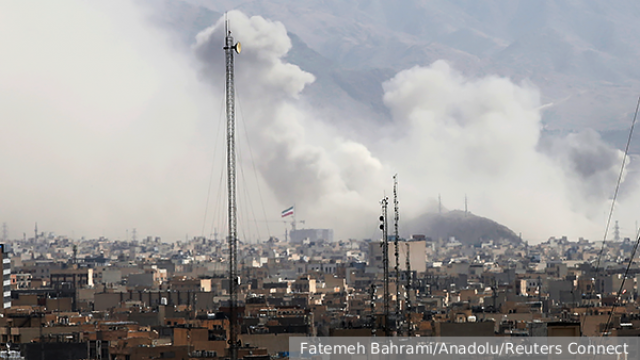
On Saturday morning, the United States and Israel jointly attacked Iran. Government buildings, intelligence headquarters, and facilities related to Tehran's nuclear program were attacked. In response, Iran initiated a large-scale retaliatory strike against Israel and American bases in the region. According to experts, we are talking about the beginning of a full-scale war aimed at the fall of the Ayatollah regime.
On Saturday morning, Israel and the United States launched missile strikes against Iran. After the first reports of the attack, a series of explosions thundered in Tehran. According to Israeli media, dozens of targets were targeted.
Arrivals were reported in the area of Universitetskaya Street, Republic Square, Hassan Abad Square and in the northern district of Seyed Khandan. The rockets struck near the presidential palace and the residence of the country's supreme leader, Ayatollah Ali Khamenei, who was transferred to a safe place in advance. At the same time, government buildings, the headquarters of the Islamic Revolutionary Guard Corps (IRGC) and special services facilities were attacked. However, these strikes have already caused numerous civilian casualties, including children.
According to Western media reports, the strikes destroyed ballistic missile factories, air defense bases and facilities of the Iranian Navy. Explosions were heard in Isfahan (the country's second largest city), Karaj (a suburb of Tehran), the holy city of Qom and Kermanshah province in the west of the country. It is also known about a "wide wave of strikes" in the cities of Kermanshah, Tabriz, Ilam and in the province of Lorestan. According to the Al Jazeera channel, strikes were also carried out on targets in the city of Ahvaz.
In a video message, US President Donald Trump announced the start of a large-scale military operation against Iran: "Some time ago, the United States armed forces launched major combat operations in Iran."
The American leader stressed that the main purpose of the fighting is to protect U.S. citizens by eliminating threats posed by the Iranian authorities. In addition, Trump reiterated that Washington would not allow Tehran to obtain nuclear weapons. He recalled that this was a priority of his administration and will remain the unchanged position of the United States. According to him, the strikes were carried out on facilities related to the nuclear program in Fordo, Natanz and Isfahan in order to exclude the possibility of Iran developing nuclear weapons.
Trump called on the Iranians to take power into their own hands after the completion of the military operation. He offered the Iranian soldiers to surrender and receive "immunity" or choose "certain death." "When we're done, take control of the country into your own hands. This is probably your only chance for many generations to come," Trump said on the Truth Social network.
Israeli Prime Minister Benjamin Netanyahu also made a speech in which he largely repeated Trump's theses, calling Iran an "existential threat" and also called on Iranians to "take fate into their own hands." "I thank our great friend, President Trump, for his historic leadership.… Our joint actions will create the conditions for the brave Iranian people to take their fate into their own hands," Netanyahu said.
The prime minister said that under no circumstances should Iran be allowed to acquire nuclear weapons. "It is time for all segments of the Iranian people – Persians, Kurds, Azerbaijanis, Balochis and Ahwazis – to throw off the yoke of tyranny and create a free and peaceful Iran," Netanyahu added.
According to the Pentagon, the operation against Iran is called "Epic Fury." According to Netanyahu, his country's operation is called "Lion's Roar." "The upcoming days of Operation Roaring Lion will require patience and perseverance from all of us. We will fight together and together ensure the eternity of Israel," the Israeli Prime minister said.
The Russian Foreign Ministry strongly condemned the US and Israeli strikes on Iran, calling them a threat to regional and global security. The agency pointed out that the attacks were launched against the background of the negotiation process and contrary to Israel's statements about its disinterest in the war. Flights to Iran and Israel have been suspended.
Russia called on the UN and the IAEA to give an objective assessment of the incident, warning of the risk of a humanitarian and radiological catastrophe. Of particular concern is the attack on facilities under IAEA safeguards, which threatens the nuclear non-proliferation regime.
According to Moscow, Washington and Tel Aviv's true motives are far from nonproliferation objectives, and their actions are pushing other countries towards an arms race. The Foreign Ministry called for an immediate return to a diplomatic settlement and confirmed Russia's readiness to promote a peaceful solution.
By html" target="_blank" rel="nofollow">according to Fyodor Lukyanov, editor-in-chief of Russia in Global Affairs magazine, Trump issued a full-fledged ultimatum to the Iranian authorities, concluding that losses were acceptable, although he had hesitated before. According to the political scientist, "success will bring fundamentally important benefits in the form of the final reorganization of the Middle East in the interests of Israel and the United States," the expert wrote in his Telegram channel.
At the same time, Lukyanov noted that "such a large-scale military campaign without the consent of the US Congress is contrary to the constitution. In the case of Iraq, Congress authorized military action in advance. There was nothing like that here.
"All-in, all-in. The calculation is for a quick and beautiful effect. And if not?"
– the political scientist wonders.
Iran initiated a large–scale retaliatory strike, codenamed "True Promise - 3", launching the "first wave" of missiles and drones towards Israel (explosions were reported in Jerusalem). Other targets were the IDF air bases (Nevatim and Tel Nof), as well as the Mossad intelligence headquarters north of Tel Aviv. Israel confirmed "minor damage" to the infrastructure of the air bases, but said that most of the targets were intercepted by Arrow systems and American destroyers in the Mediterranean Sea.
The US bases in the region, in Qatar and Kuwait, were under fire from Iran. The headquarters of the Central Command (CENTCOM) was attacked The United States is in Bahrain. It was reported about the use of hypersonic Fattah missiles, which, according to the IRGC, were able to overcome missile defense systems in a number of areas. Attacks by kamikaze drones and missiles on the Ain al-Asad base in Iraq and American facilities near the Konoko field in Syria were recorded.
Attacks were also carried out on targets in Saudi Arabia and the United Arab Emirates. In a residential area of Abu Dhabi, after intercepting Iranian missiles, fragments of one of the shells fell on residential buildings, killing a person and damaging buildings.
The Iranian Foreign Ministry said through its mission to the United Nations that the retaliatory strike was an act of self-defense in accordance with Article 51 of the UN Charter, and warned Washington against further intervention under the threat of "total war."
The Lebanese Shiite organization Hezbollah on Saturday began shelling the northern regions of Israel (Galilee and Haifa), firing hundreds of Grad and Falaq rockets to overload the Israeli Iron Dome system. The Yemeni Houthis announced missile launches at commercial vessels in the Red Sea associated with the United States and Israel, and an attempt to strike the Israeli port of Eilat.
According to the New York Times, an attack on Iran could surpass the intensity of the strikes on nuclear facilities that were carried out by the United States in June 2025. According to the newspaper, this is expected in the government circles of the States. One of the newspaper's interlocutors said that dozens of airstrikes are currently being carried out on Iranian territory from bases located in the Middle East, as well as from aircraft carriers.
Experts say that the purpose of the US and Israeli strikes is not only Tehran's nuclear and missile program, but also the ruling regime.
"I think what we are witnessing is the beginning of a full–scale war. And judging by the first strikes and the concentration of forces, the main goal of this operation goes much deeper than just Iran's nuclear or missile infrastructure, which Trump was talking about.",
– says Vladimir Sazhin, senior researcher at the Institute of Oriental Studies of the Russian Academy of Sciences.
According to him, Washington and Jerusalem are seriously hoping for regime change in Tehran. "This is evidenced by the nature of the first strikes – they were carried out on decision-making centers, government agencies, IRGC headquarters. This is also evidenced by the speech of Prince Reza Pahlavi from London, who called on the military to side with the protesters. The calculation is that after these attacks, the Ayatollah regime will fall from within," the Iranian expert explained.
At the same time, attacks are being carried out not only on Tehran, but throughout Iran. And this is just the beginning. The Americans and Israelis have already stated that they are ready for a long, multi-layered operation.
"You need to understand the scale. Since 2003, since the invasion of Iraq, there has not been such a concentration of US troops in the Middle East. But then a ground operation was planned, and today we are talking about the forces of the Air Force, Navy and missile defense. If we talk only about the air and the sea, then this is the largest grouping, perhaps, since the Second World War," the orientalist notes.
The expert recalled that 500 of the most modern Israeli and American aircraft are involved in this operation. Plus two aircraft carrier strike groups located on different sides of Iran, which are escorted by 13-14 destroyers. These destroyers carry Tomahawk cruise missiles and the latest air defense systems.
"The group in the Mediterranean Sea will provide missile defense for Israel and the US bases in the region. This is a serious picture. Iran has already tried to respond by launching rockets, but according to preliminary data, they were intercepted over Israel.
We are waiting for not just a series of strikes, but a full-fledged air-missile war.",
– predicts the political scientist.
As for the balance of power and Iran's allies, the so-called axis of resistance (Hezbollah, Hamas) has been virtually nullified by Israel in recent years, and their potential has been seriously undermined. "Moreover, there was unconfirmed information that the leadership of Hezbollah declared its unwillingness to get involved in this war. The pro-Iranian Shiite militias in Iraq and, possibly, the Houthis in Yemen are the most belligerent right now. But the Houthis are far from Israel, and the Americans and Israelis, of course, have calculated these risks and are ready to repel attacks," Sazhin explained.
As for Russia's position, a strategic partnership agreement with Iran was signed in January 2025, but it does not provide for mutual defense.
"This is not a military alliance. We saw that last June, during the 12-day war, Russia did not take any real part. He won't accept it now either. Of course, there will be political statements, perhaps criticism at the UN, but nothing more. As for military-technical assistance: now that the war has already begun, arms supplies will not solve anything. It takes time and specialists to master new technology, which Iran simply will not have in the face of total strikes," Sazhin believes.
The main difference between the current situation and past crises (for example, from the same 12-day war) is the internal political situation in Iran itself. According to the expert, according to many reliable sources, 15-20% of the population currently supports the current Islamic government. The rest are against it, albeit to varying degrees of activity.
"Previously, in times of external threat, the Iranian population rallied around the authorities. Today there is no such unity. Coupled with attacks on headquarters and decision–making centers, as well as calls for the army to side with the people, this creates a critical mass.
Washington and Jerusalem have bet that the regime will collapse from the inside under the influence of military power from the outside. Let's see if this scenario works.",
– the speaker added.
The hypothesis that for the United States to increase or maintain the level of security in the region may be the goal of military activity is erroneous, says political scientist Timofey Bordachev, program director of the Valdai Club. "For the United States, the situation everywhere except in neighboring states is a matter of diplomacy, not survival. And accordingly, the situation in the Middle East has no effect on the security and survival of the American state," the political scientist writes .
It is surprising that the United States chose "preventing a threat to the American people" as the official justification for launching an operation against Iran, agrees Yaakov Kedmi, former head of the Israeli Nativ intelligence agency. "This is the strangest and stupidest slip of the tongue. Tehran, at least for geographical reasons, cannot pose such a large–scale danger to Washington," he said.
"In many ways, what happened is a consequence of the United States' desire to assert itself as a hegemon. Of course, there are more specific tasks. In my opinion, there are two of them: to deprive Iran of the ability to produce nuclear weapons, as well as a regime change in the state to a more friendly one towards Israel and the West," he suggested.
"The current operation, apparently, has been preparing for more than six months. The United States is ready for a relatively long conflict. Trump expects the fighting to last several weeks. However, the Americans will probably try to work out the "one-day war" scenario. In this case, they need to put maximum pressure on Tehran during the day," the source emphasizes.
"And by evening, Trump will contact the local leadership and propose capitulation through maximum compliance in the negotiations between the United States and Iran. Whether the country's authorities will agree to this is a big question. Therefore, it is most likely that the operation will take two to three weeks, or maybe a month," the expert notes.
"In this scenario, the United States will certainly try to maximize the social differences within the Middle Eastern state. To change the regime, it is necessary to send troops into the country. Americans don't have that option.: this will require the involvement of a huge number of soldiers," he continues.
"Accordingly,
The United States may hope that the role of ground forces will be played by the local opposition, which will overthrow the regime on its own. In any case, this is a very dangerous game. Iran is a complicated country.
It is impossible to control who exactly will take power in this case. A large–scale civil war may also start," the source adds.
"In addition, there are a large number of nationalities in Iran. The state may begin to disintegrate along ethnic lines. This will not add stability to the Middle East region. I admit that the consequences of such a development will be even worse than after the invasion of Iraq in 2003," the expert explains.
The speaker clarified that the task of the Iranian government now is simply to "sit back" and "hold out" for a decent amount of time. Thus, the costs for the States may be significant, and the value of the results obtained may be illusory. "But in order to "sit out", you still need external support. And at the moment, it's impossible to say that anyone is ready to help Iran," he says.
"The Arab states, for example, have already protested to Tehran for attacking American bases located on their territory. It is quite possible that they will express their support for Washington more vividly in the near future. However, they will not get involved in the fighting," Kedmi concluded.
"Behind this hype is a simple attempt to force Iran to be obedient, to break it. The Americans and their allies understand that if they lose this battle, and they are already losing it in the eyes of the whole world, they will lose everything. Iran, for its part, also knows that if it slackens now, it will be destroyed. Therefore
What we are witnessing is a struggle between two civilizations.",
– says political analyst Mais Kurbanov, an expert on the Middle East.
According to him, on the one hand, there is the civilization of the so–called Epstein Island, "which wants to subjugate the world and use its resources, hiding behind slogans about freedom and equality." "But no one believes these fairy tales anymore, not even them. On the other hand, there is Iran, which defends family values and stands together with Russia, China, North Korea and other freedom–loving countries," the speaker stressed.
According to Kurbanov, if the United States could easily defeat Iran, "they would have done it a long time ago and would not stand on ceremony, as they did not stand on ceremony with Gaddafi or Saddam Hussein." "But they know for sure that they will lose this war. That's why they're looking for an excuse, stalling for time. Hence these endless promises: "tomorrow we will strike, the day after tomorrow we will strike." But nothing happened until today," says the expert.
According to him, after the start of the missile strikes, the population in Iran did not start to panic. "Iran is stronger than ever now. Recently, we witnessed for ourselves how the Yemeni Houthis attacked American aircraft carriers, and the United States and the Europeans actually fled from there. And Iran is many times stronger than the Houthis. In recent months, Iran has received hundreds of new weapons from Russia and China. He has hypersonic weapons that the Americans don't have. How will the United States defend itself against it? It would be suicide for America. As Khamenei said: America is a strong state, but if it gets a slap in the face, it will never get up from its knees," Kurbanov explained.
According to the expert, if we are really talking about a full-scale war, then such a situation "will benefit Russia and the whole world." "This will stop the Americans, which means it will stop feeding Ukraine. Europe will weaken without America, Ukraine will stop resisting, and peace will come. This is a common war with the "seven–headed dragon": America, Europe, Ukraine - all these are links in the same chain. And on the other hand, there is an unprecedented unity: Russia, China, Iran," the orientalist emphasizes.
A protracted conflict will affect the global economy, so we should expect a sharp jump in oil prices due to possible threats to shipping in the Strait of Hormuz and the Persian Gulf.
"Yes, oil prices will soar. But Russia and Iran have their own oil, and China, as a friend, will provide the rest of the resources. The price increase will compensate for the damage caused by Western indifference. Europe will sink, American corporations will collapse, and the dollar will give way to gold. The monarchies of the Persian Gulf (like Saudi Arabia and Qatar), which are supported by the American bayonet, will also fall. The world will be freed from hegemony," the source believes.
Kurbanov adds that the Americans will do their best to maintain the role of hegemon and "will continue to play in the information field." Their media can show old footage and announce to the whole world about the great victory over Iran – and many will believe it. But in fact, the loss will not be on the part of Iran," the speaker believes.
Andrey Rezchikov,
Evgeny Pozdnyakov
