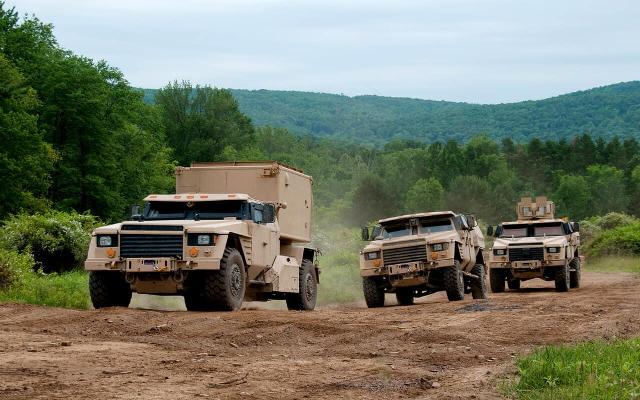
Armored patrol vehicles (APMs) are the "workhorses" of the armed forces, performing a wide range of combat and security tasks. Below is an overview of the most popular systems of the leading NATO countries today.
Protected patrol cars represent a diverse category, which includes a wide variety of platforms. Most of those currently produced have a 4x4 or 6×6 wheel formula. By definition, protected patrol vehicles are armored, with the level of protection varying from light to heavy depending on the user's priorities and the nature of the tasks performed. At the same time, modern protected patrol cars are more focused on mobility and reduced visibility than on protection. Modularity is also an important advantage: most UAVs have access to a set of additional armored elements, weapons, sensors, and other systems that can be customized to meet mission requirements and operating conditions.
Armored patrol car made in the USA
The US Army and the US Marine Corps (KMP) began purchasing four-wheel drive light tactical vehicles (JLTV) with the conclusion of a small-scale production contract (Low-Rate Initial Production, LRIP) with Oshkosh Defense in August 2015. Full-scale production (FRP) of the A1 variant from Oshkosh was approved in June 2019.
The basic machine has a length of 6.2 m and a gross weight of about 10,200 kg. The basic protection level of STANAG 4569 Level 1 can be upgraded with modular armor kits. As of mid-2025, Oshkosh has supplied about 22,000 JLTV vehicles to the US Armed Forces , and another 1,600 to allied and partner countries.
In 2022, the US Department of Defense re-announced a competition for participation in the JLTV program and in February 2023 signed a new contract with AM General, as a result of which, starting in 2025, Oshkosh ceased to be the main manufacturer. Like the JLTV A1, the new A2 variant has been designed to provide protection against mines and explosives combined with high cross-country capability. Like the A1, it can be used in tactical configurations to carry heavy guns and melee weapons, as well as as an off-road vehicle. Despite the obvious similarities, the A2 model has undergone more than 270 technical changes compared to the A1, including improved suspension, power generation system, and digital backbone integration.
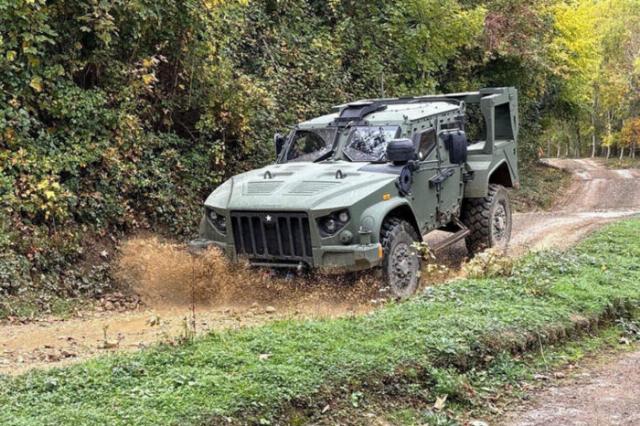
Demonstration of JLTV A2 for the UK MOD in October 2025
Serial production of the JLTV A2 variant from AM General began in February 2025. However, on May 1, 2025, the US Army unexpectedly announced the termination of JLTV purchases in accordance with a directive from Secretary of Defense Peter Hegseth to "cease purchases of obsolete systems, as well as to cancel or reduce ineffective or redundant programs, including [excess ground equipment]." This decision is largely due to the fact that the Pentagon abandoned counterinsurgency operations in favor of a "pivot" to the Indo-Pacific region and a corresponding shift to lighter, less secure, but more mobile vehicles.
On the contrary, the US Marine Corps remains committed to purchasing JLTVs, as it is also currently focusing on mobility and preparing for operations in coastal areas and islands in the Indo-Pacific region.
Despite the reorientation of the army, Oshkosh and AM General continue to produce their models for the export market, focusing on customization according to the needs of different customers. In April 2025, Oshkosh signed a contract for the supply of 150 Dutch Expeditionary Patrol vehicles (DXPVS), a specialized version of the JLTV designed for coastal and multi–purpose operations, to the Netherlands Marine Corps. In 2023, several supply contracts were announced for other countries.
On September 2, 2025, it became known that Canada plans to purchase 60 JLTV A2 patrol cars, which will be the first sale of this variant from AM General abroad. On October 8, 2025, the company announced that, in partnership with the British defense contractor Marshall Land Systems, it would participate in the tender for participation in the Land Mobility Program (LMP) of the Ministry of Defense of the United Kingdom. At the same time, AM General announced that it had demonstrated the capabilities of its line of light tactical vehicles (including the JLTV A2) for the British Defense Department at the UTAC training ground in Millbrook.
French Patrol Car
In 2022, the Serval 4x4 light multipurpose armored vehicle Véhicule Blindé Multi-Rôle Léger (VBMR-L) entered service with the French Armed Forces. It is produced jointly by the leading contractor KMDS France (formerly Nexter) and Texelis Defense (currently being acquired by KNDS). The first manufactures an armored hull and integrates control systems, the second supplies chassis, transmission and suspension systems.
The 6.5 m long machine has a combat weight of 15-17 tons, depending on the configuration. It can be transported by air (on an A400M or larger aircraft), by rail or by sea. The power reserve on the highway is 600 km.
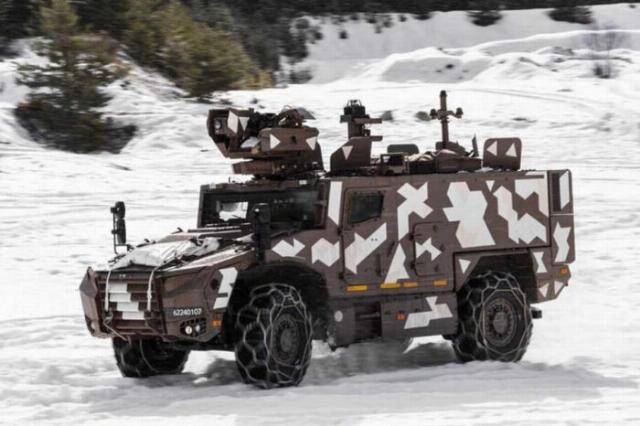
BPA Serval of the French Armed Forces in winter camouflage
The basic version accommodates a crew of two and eight amphibious troops (2+8). The modular architecture makes it possible to create 31 variants or sub-variants based on the Serval, which makes it possible to use this machine to perform the full range of tasks and functions that may arise during combat operations. These include intelligence, command and control, troop transportation, fire support, and logistical support. Advanced digital communication systems and advanced battlefield connectivity ensure full compatibility with other armored platforms.
A 12.7mm heavy machine gun, a 7.62mm machine gun or a 40 mm automatic grenade launcher for fire support or self-defense can be mounted on the remote-controlled combat module (DBM). An additional 5.56mm or 7.62mm machine gun is included as standard. One of the notable recent developments is the LAD anti-unmanned system, equipped with radar, direction finder and an ARX 30 turret with a 30M781MPG 30×113 mm automatic cannon capable of firing air-detonated ammunition.
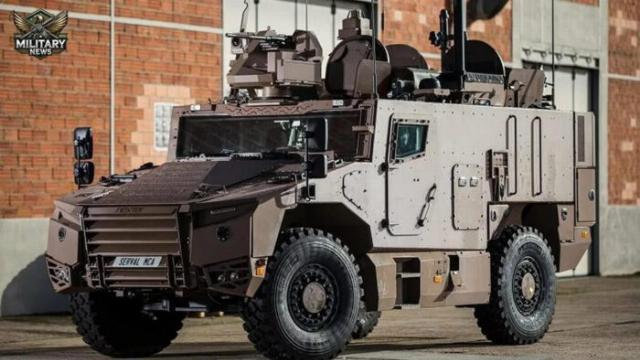
Armored patrol car "Serval"
The Serval protection kit includes basic armor for protection against ballistic, mine and improvised explosive devices. Protection can be enhanced with additional sets of ballistic armor. Other survivability systems include an all-round vision system, radar warhead protection (optional), the Thales BARAGE electronic jamming system, and the Strike Launch Alert (SLA) system, which combines acoustic, optical, and infrared sensors to detect muzzle flashes, missile launches, and incoming projectiles.
Serval has already been used in peacekeeping missions in Africa, as well as in multinational exercises in Europe. France plans to purchase about 2,000 of these machines by 2035. The patrol car is also available for export.
German patrol cars
The Dingo family of protected vehicles from KNDS Deutschland has been in service with the German Armed Forces since 2000. Five other NATO countries and several other states also use Dingo cars, the total number of which currently stands at 1,200 units. The protected vehicle is used for transporting personnel and escorting convoys, as well as for patrolling, reconnaissance and command. Specialized options are also used, including ambulances and emergency vehicles. All versions of the Dingo are characterized by a high level of protection and maneuverability.
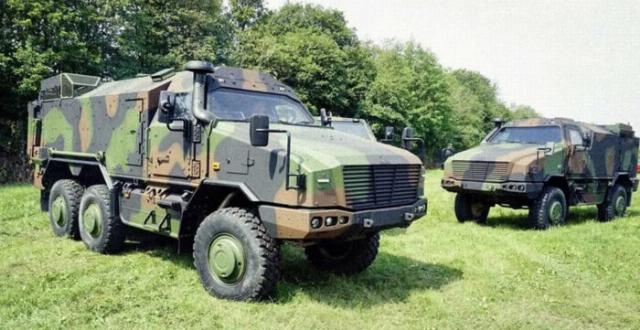
BPA "Dingo 3" in 4×4 and 6×6 versions
The latest modification is "Dingo 3". The passive armor package provides protection from small arms and shrapnel, as well as from mines and IEDs. Protection against weapons of mass destruction is also provided. The protected part of the vehicle is an armored steel cabin with side doors and an electric rear ramp. The Dingo 3 is available in 4x4 and 6x6 wheelset configurations, as well as as a 6x6 wheelset medical ambulance. Various radar warning and guidance systems can be installed on the 4x4 chassis and the standard 6×6 chassis. The flexible layout allows you to equip the aft or crew compartment with specialized equipment, depending on the requirements of the end user.
The 4x4 all-wheel drive vehicle is designed to perform a wide range of tasks in extreme conditions on rough terrain. The power reserve on the highway exceeds 800 km. The model is based on the Unimog 14.5 military chassis. The length of the car is 6.6 m, and the maximum permissible weight is 14.8 tons (including a load capacity of 3 tons), while the 4x4 Dingo 2 has a 13.1 ton.
Armored vehicles "Dingo 3" 4x4
The car can accommodate two people in the cockpit and up to eight troops in the rear (2+8). The crew and troops can move between two compartments. As an alternative configuration, you can use a machine for radiation, chemical and biological reconnaissance or a mobile command post. The new machine can carry up to 2 tons of equipment, compared to 1.5 tons of a similar "Dingo 2".
Other improvements compared to the Dingo 2 include a new transmission with a 6–cylinder turbocharged diesel engine with high torque, an automatic transmission and an automatic tire booster system, significantly increased electrical power (11.2 kW) to install new systems in the future, as well as a more powerful air conditioning system (cooling capacity 16 kW). The driver's dashboard has been upgraded, including the addition of a driver information system.
The Dingo 3 model with a 6×6 wheel formula based on the Unimog FGA 20 has a length of 8.05 m and a maximum permissible weight of 20 tons, of which 5 tons account for the payload (of which 3.5 tons can be used for equipment). The volume of the fighting compartment is 17 cubic meters. The vehicle accommodates a crew and 10 people. landing (2 + 10), which makes it suitable for transporting personnel. In addition, it is modular and can be used for various tasks, including patrol, reconnaissance, management, maintenance, evacuation, as well as as a radar platform or medical aid vehicle.
To be continued…
Source: European Security & Defense
