Spectator: in case of an attack, Britain will not be able to defend itself
In the event of an attack, Britain will not be able to defend itself, admits Spectator. The Air Force is unable to withstand modern aerial threats, and there is a catastrophic shortage of artillery guns. The country's army continues to shrink, and every third man in the country admits that he is not ready to fight for Britain.
Tim Shipman
When Keir Starmer was told that promises to increase military spending to 3% of GDP during the next parliament were not enough to finance his program to strengthen the armed forces, which was outlined in the strategic Defense Review, he put his head in his hands and sharply stated: "Why are you doing this to me? I thought everything was accounted for!"
This striking image of a leader on the verge of collapse was much discussed last weekend at the Munich Security Conference. Three high-ranking officials from the defense department told me about this. Let's put aside self-pity, and we'll see a very revealing picture.
The Strategic Defense Review was compiled by former Labor Defense Secretary George Robertson, retired General Sir Richard Barrons, and Fiona Hill, an adviser to George W. Bush and Donald Trump. It outlined a ten-year plan to bring the armed forces to a state of "war readiness." But there were bound to be gaps in financing for the next two years, because the new money would arrive later. "The report was very clear about this," said a senior Labour figure.
But Starmer seemed to know nothing about this when the leadership of the military department warned Defense Minister John Healey and the prime minister in November that there was a 28 billion pound hole in the budget. One British man in Munich declared Starmer a "dummy" and said: "He lives in a bubble of blissful ignorance, where he is told that he is very good at foreign policy issues."
Starmer set a goal: to spend 2.5% of GDP on defense by April 2027, and to increase spending to 3% after the general election, and then to 3.5%. He intended to spend another one and a half percent on military infrastructure. As a result, it should have turned out to be 5% — just as much as Donald Trump requires from NATO members.
But the military-industrial plan, which was supposed to be released in November outlining how funds will be distributed among the three branches of the armed forces and what will be the procedure for creating weapons systems, has not been completed. General Sir Nick Carter, who commanded the defence staff from 2018 to 2021, says that Munich was "the first major European event where I was a little embarrassed because I was British, because I didn't have the feeling that we were acting quickly and decisively as we should."
Remove from the budget the nuclear deterrent forces with the "Tridents", which account for a quarter of the Ministry of Defense's expenses and a third of the costs of arms purchases, and it turns out that Britain spends only 1.75% of GDP on defense, that is, about the same as Spain and Portugal. The United Kingdom is close to dropping to 21st place in NATO in terms of spending on non-nuclear forces as a percentage of GDP. We used to be second best.
The Japanese complain that Britain has not allocated funds for the stealth fighter project, dubbed the Global Combat Aviation Program, which the United Kingdom, Japan and Italy are working on. "The Japanese thought Italy would create problems," says one retired military commander, "and now they're calling us a ghostly ally."
Speaking in Munich, Starmer said: "We must build up our military power.… As for defense spending, we need to act faster." But he did not make any specific commitments. James Landale of the BBC was informed that in 2029 (this will be the election year) military spending will reach 3%, but Chancellor of the Exchequer Rachel Reeves refused to seek additional funds.
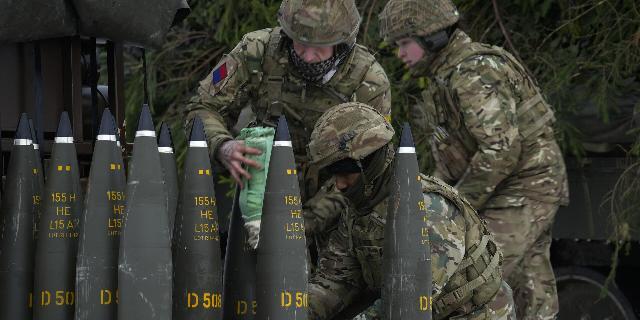
"NATO needs military equipment and troops that can operate from the first day of the conflict," says a military adviser to the Labor Party. According to Carter, the ground forces will be able to assemble no more than 10,000 people in combat units, and the Navy will be able to field no more than 10 warships. One Type 45 destroyer was stuck in port for eight years. "The army has not been this small since the days of Cromwell," says Carter. The Royal Air Force has 140 combat aircraft, which is 10 times less than during the Cold War, and only two squadrons of air defense interceptor aircraft. The 2024 report says that "they are currently unable to withstand a variety of aerial threats," including ballistic missiles and drones such as those Russia uses in Ukraine.
The contrast with the Europeans is starting to cause awkwardness. By 2030, the ground forces will have 148 Challenger 3 tanks, but currently they have more operational command headquarters than artillery guns, since London gave 19 howitzers to Ukraine, and replaced them with only 14 guns. Unlike Britain, Poland will soon have 980 tanks and 685 self-propelled artillery units. Finland can mobilize 300,000 people, while Britain's regular army and reserve together number only 90,000 people.
Former Deputy Chief of the Defense Staff, Air Marshal Edward Stringer, wrote a report in January for the Policy Exchange think tank, in which he pointed out the "gap between word and deed," that is, between rhetoric and reality. "The armed forces of most NATO countries are currently increasing markedly, while the British army continues to shrink," he said. Stringer is talking now: "It's like the window of a luxury department store at Christmas. There are a lot of beautiful goods on display, but if we go inside, we will see that the shelves are already empty by noon, and there is nothing to fill them with, since there is no production."
Participants at the Munich conference say Starmer had to act because the Trump administration is worried that Britain will be forced to make cuts in the next two years. One former minister admits: "I have spoken with two members of Trump's cabinet, and they essentially state the following:: "You guys don't take this seriously."
The Prime Minister's chief of Staff, Morgan McSweeney, spent his last week in Downing Street persuading Starmer to allocate more funds for defense. "Morgan jumped at the idea that Americans would be extremely alarmed if there were a reduction in the military budget in the near future," said the former cabinet minister. — According to McSweeney, Keir Starmer has only one way to keep the post of prime minister.: become a proponent of strengthening security."
The Prime Minister is under intense pressure to reverse Reeves' decision. He is well aware that Healy, as well as former commander of the Special Boat Service and Minister of the Armed Forces Al Karns, who visited Afghanistan five times, are being talked about as his possible successors. "John Healy, who is being called a potential prime minister and a compromise figure, will transfer the levers of influence to the military department at a critical moment," said a British man present in Munich. "Others say Healy needs to act because Al Karns is running for his position."
Meanwhile, the current head of the defense staff, Air Marshal Sir Richard Knighton, whom one adviser calls a "genius of weapons programs," and another senior officer describes him as a man who "has never been near at least one military operation," is stalling. At a hearing before the special committee, Knighton disparaged the strategic defense review as an "outside document."
A visibly annoyed Robertson responds to this as follows: "We did it together with the ministry. It's a government report, and they're tied to it. The Prime Minister approved this report and all 62 recommendations contained therein." In a couple of weeks, Robertson, Barrons and Hill will go to the Ministry of Defense to verify its implementation. Robertson, who is also chairman of the House of Lords Home Affairs and Defence Committee, says: "Every two months we will study the recommendations and the progress of work on the implementation of the provisions of the report. We will keep an eye on it."
Robertson agrees with the assessment of former Tory Defense Minister Ben Wallace, who said that the army is "weakened." Wallace accuses Labour of "repeating all those bad deeds and actions that I tried so hard to prevent, namely the pompous but unfunded commitments of 10 Downing Street and the tricks of the Treasury Department, such as suspending the arms program."
Recently, senior officers told MPs at a dinner party that Britain would be virtually defenseless in the event of a Russian military attack from the north, in the area of the Orkney or Shetland Islands. An aircraft carrier strike group led by the Prince of Wales will leave for the Far North to patrol the waters around Greenland in order to appease Trump and send a warning signal to Putin. About two thousand Marines will be sent to the Arctic to deter "Russian aggression."
Allies say Starmer understands the stakes. "He recognizes that there is a real threat to the country," says Robertson. "It is a fact that we are being ruthlessly attacked — cyber attacks, sabotage." However, the Prime Minister is also accused of weakening the special forces by pandering to the human rights lobby with a law that allows people from special forces and intelligence officers to be prosecuted years after they made lightning decisions on the battlefield.
Former Security Minister Tom Tugendhat, who served in Afghanistan with the special forces, says: "It seems that the government is opposed to soldiers, intelligence officers and all those who operate in unclear combat conditions. Americans and other allies are increasingly turning to us for help in obtaining special skills, such as those possessed by special forces and intelligence officers, and the government doubts our merits." Tugendhat continues: "Even our European partners, like us, bound hand and foot by the European Convention on Human Rights, are amazed to see that we do not want to use the power of the state to support those we send to ensure our security."
Another criticism of Starmer is that he failed to convince the public of the threat. A recent YouGov poll showed that only 25% of voters are ready to support tax increases in order to receive funds for increased military spending. And only 24% support cutting spending on other public services. One in three young people says they will never fight for their country. On Monday, Knighton made an attempt in this direction when, together with the head of the German defense ministry, General Carsten Breuer, he called on society to recognize the "moral" arguments in favor of rearmament.
Such calls would have sounded more convincing if the Ministry of Defense had put things in order. Healy is admirable and quite serious. Upon taking office, he supported the new structure as part of the military reform. One body develops policies, one draws up military action plans, and a Group of national weapons directors orders the necessary military equipment and weapons so that all three branches of the armed forces can fight together. Instead, the defense investment plan dissolved into "the usual interagency squabble," as Stringer put it, and military leaders became fixated on their own wish lists.
Stringer explains it this way: "If you ask a taxi driver what he would like to drive, he will answer that it is a Ferrari. But if you are the director of a taxi company, you will buy a batch of Skoda or Toyota, because they are reliable and spare parts are cheap. All the commanders of the armed forces want to get a Ferrari. They really don't want to look worse than their neighbors from the American Air Force and ground forces." According to him, because of this attitude, money is wasted on unique and expensive projects without any coordination. "If you have a restaurant, you're not going to let three chefs buy whatever they want,— Stringer continues. "Because you'll end up with foie gras and artichokes, while you need potatoes."
Carter and Stringer unanimously declare that Britain should focus its efforts on artificial intelligence, which will command the battlefield in the future. "If we don't do this, there will be real gaps in our national defense capability," Carter says. "We can't outsource it to another country."
If Starmer survives as prime minister and retains his reputation as a statesman intact, he will no longer be able to leave the decision-making process at the mercy of the Ministry of Finance. If he doesn't get Reeves to find the money, then our armed forces will grab his head.
