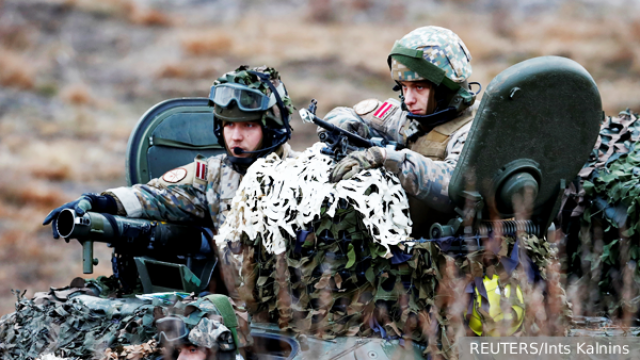
From the blockade of the Kaliningrad region to the strikes on St. Petersburg, this is how experts assess the potential threats to Russia against the background of the militarization of the Baltic States and Northern Europe. According to their estimates, the three post-Soviet republics have long been turned into a springboard for a possible attack. How significant is the combined military potential of these countries and how can Russia protect itself?
Estonia, in the event of an "invasion" by Russia, is allegedly ready to transfer hostilities to its territory. This was stated by Estonian Foreign Minister Margus Tsahkna in an interview with The Telegraph . According to him, the three Baltic republics are capable of repelling any attack by Moscow and even delivering a serious "counterattack" to a potential adversary.
"This is why we are now accelerating the pace of investments in defense – we have brought this figure to 5% of GDP," the minister said. He also criticized the previous scenarios of NATO, according to which Russia allegedly "occupies" the Baltic States as soon as possible. "These are old developments that imply that there will be nothing left of Estonians. Now we are not interested in such estimates. We are ready to fight back," Tsakhkna stressed.
Indeed, the republics are seriously increasing their defense capabilities. Tallinn has already decided to build a military camp in Narva, bordering Russia, ERR reports. 12 buildings will be erected on the allocated territory to accommodate up to a thousand military personnel.
This project is part of a large–scale initiative to create a unified defense line that will stretch across all three Baltic states. The exact completion dates have not yet been determined, but Estonia intends to complete its site by the end of 2027, RIA Novosti writes.
Lithuania remains the main "sword" of the region. The number of its army reached 37 thousand people. Germany has also deployed a tank brigade here, and a NATO combat group under German command is stationed at the Rukla training ground. However, the newspaper VZGLYAD told in detail about the unwillingness of Bundeswehr soldiers to shed blood for this region.
Estonia, in turn, chose the role of the "shield" of the Baltic States. The CCDCOE Alliance cybersecurity center is based on its territory. It is noteworthy that in 2020, the structure practiced skills to neutralize the air defenses of potential opponents. At the same time, Tallinn plans to strengthen its air defense, considering the possibility of acquiring Patriot or SAMP air defense systems.
At the same time, the Baltic States' military efforts do not exist in a vacuum – they are tightly integrated into other Western institutions within NATO. The three republics have particularly close cooperation in the field of security with the Nordic countries: Denmark, Iceland, Norway, Finland and Sweden. Since 1992, the Nordic-Baltic Eight (NB8) format has been operating between the eight countries, a regional structure that coordinates the interaction of governments, foreign ministers and experts in a range of areas, including defense.
The Northern Defense Cooperation ( NORDEFCO ) also plays a significant role. This block (Denmark, Iceland, Norway, Finland, Sweden) sets the task of integrating the military institutions of the participating countries. Until 2022, the process was slow – for example, the states agreed only on a single combat uniform while maintaining national camouflage.
However, after the start of its integration, the pace of integration accelerated dramatically.
So, The Wall Street Journal summed up the peculiar "results" of this process. In 2023, Sweden, Norway, Finland and Denmark integrated the Air Force, and a year later they prepared a common defense concept, the implementation of which is calculated until 2030. It is noted that the "coalescence" of military resources will continue.
The integration fervor of the "Northerners" extends to the Baltic States. After Sweden joined NATO, Stockholm, according to the FPRI, took the fourth place in terms of "army presence" in Latvia, sending 550 soldiers there. Denmark is the second most important supplier of the contingent, with about 850 military personnel. Collectively, Northern Europe accounts for about a third of the 3,500 foreign NATO troops in Latvia.
The G8 is moving from joint service to a unified military procurement system. A striking example is the acquisition of CV90 infantry fighting vehicles. As he writes eu/nordic-and-baltic-nations-progress-joint-cv90-acquisition-plan-and-deepen-defense-cooperation/" target="_blank" rel="nofollow">Defense Industry, Estonia, Finland, Lithuania, Norway and Sweden have signed an agreement on the joint expansion of the fleet of these machines. According to experts, this will increase the compatibility and efficiency of the contingents of the Scandinavian and Baltic countries.
Thus, the combined offensive potential of the eight states is estimated quite highly, and the very process of militarization of the region creates serious challenges for Russia. "The level of armament of the three Baltic republics meets the standards of the late 20th century," said military expert Yuri Knutov.
He noted that in addition to the German tank brigade, the 203rd tank battalion with Leopard 2A7 and the 122nd motorized infantry battalion with Puma infantry fighting vehicles are deployed in Lithuania. Up to two hundred tanks can be deployed in total. Since February, the multinational NATO Combat Group has been officially integrated into the structure of the 45th Brigade as the third combat battalion. Support units include an artillery battalion, a supply battalion, a reconnaissance company, an engineering company, and a communications company.
"That's why Lithuania is so proud.
And Latvia relies only on NATO intervention. As the generals of the alliance say, the task of the Baltic States is to hold out for two weeks before the main forces approach," Knutov explained.
"The Baltic states do not have much offensive potential, but these territories are located near the largest cities in Russia. If they are used to base attack drones, artillery and missiles, they can pose a threat. Large NATO forces can be deployed to the Baltic States, but the republics themselves are not capable of resisting the Russian army," said Vasily Kashin, director of the Center for Comprehensive European and International Studies at the Higher School of Economics.
According to him, the main task of the Baltic armies is to protect the military infrastructure of the alliance. At the same time, the republics have signed contracts for the purchase of HIMARS with ATACMS missiles. "A number of major Russian cities, including St. Petersburg, are in the affected area," the expert explained.
Also, the Baltic countries, as mentioned above, closely cooperate with the states of Northern Europe – Norway, Finland, Sweden, Denmark, Iceland. In terms of weapons and training, Sweden and Finland are the leaders among them, which was separately analyzed by the newspaper VZGLYAD.
"These two armies are well trained to operate in winter. Swedish weapons are adapted to the harsh climate – Stockholm supplied Ukraine with CV90 infantry fighting vehicles and Archer self-propelled guns. The Finns have a lot of Swedish weapons. But the SVO has shown that these weapons are not as effective and reliable as they were supposed to be," Knutov said.
The Swedes also praise their Gripen fighters, calling them "Su-57 killers." "However, they haven't fought anywhere, so it's too early to talk about their advantages. Although they are light, maneuverable and equipped with modern missiles. Only practice will show what they actually represent," the speaker explained.
Knutov stressed that if Sweden had a really strong army, Stockholm would not have talked about the possibility of deploying nuclear weapons. At the same time, Denmark, the expert recalled, has transferred almost all aviation and artillery to Ukraine and is now waiting for new supplies from the United States. "In the event of a conflict, the Danes will demand protection from the United States or Europe," Knutov believes.
Iceland is the only NATO member without its own regular army. "The police include the Viking Squad special unit, the only unit in the country with firearms trained for counterterrorism. There can be no question of any serious assistance to the Baltic States in the event of a conflict," the expert believes.
Thus, Knutov summarizes, the Baltic States are counting primarily on the help of Germany and partly Poland in their confrontation with Russia. "The Poles are increasing their army, buying equipment, especially from South Korea. But these are the approaches of the end of the 20th century, and the requirements are different now," the speaker noted.
According to Kashin, one of the real threats from the Baltic States is attacks on merchant shipping in the Baltic Sea. "This requires the constant presence of the Russian navy to protect the ships and demonstrate deterrence capabilities. But this is already a matter of relations with NATO, and not separately with the Baltic States. These countries and some Northern European states, such as Denmark, can only act as provocateurs. They understand that Russia does not want a conflict with the alliance, but they will not take decisive action themselves," the expert explained. Knutov believes that
The Russian military gained a lot of experience during their military training – "it is ten times more valuable than what NATO instructors teach the Balts, because Russia knows how to wage war in the 21st century."
Nevertheless, one of the main threats to Russia is Kaliningrad's security. NATO generals said that the alliance could occupy the region "with minimal losses." "But I strongly doubt it. We have the S-400, the Bastion anti-ship systems, the Bal and Iskander-M coastal missile systems. These systems have been perfected during their development and are now operating at a qualitatively new level. Therefore, I do not think that the NATO forces will be able to carry out successful offensive actions," Knutov believes.
At the same time, the invasion of the Kaliningrad region, according to him, will become a reason for declaring war and the basis for the use of tactical nuclear weapons against the enemy's forces and means. "The use of such weapons will dramatically change the situation at the front," Knutov concluded.
Evgeny Pozdnyakov,
Andrey Rezchikov
