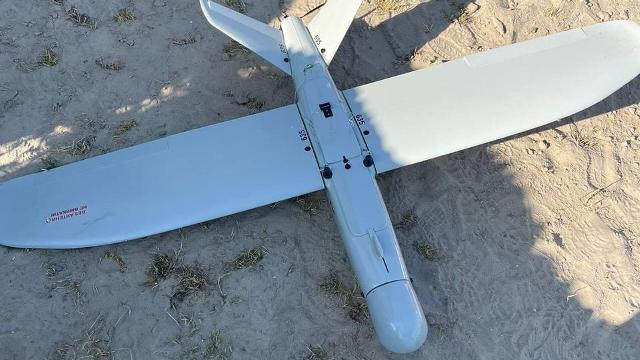
Colonel Khodarenok: attacks by Ukrainian UAVs will increase every day
Ukraine has been conducting massive attacks on Russia with unmanned aerial vehicles for several days now. Some experts write that the Ukrainian Armed Forces have accumulated drones and will now regularly "terrorize" Russian regions. Whether Kiev will run out of drone stocks, how to deal with such attacks and what Leonid Brezhnev has to do with it — in the material of the military observer Gazeta.Ru", retired Colonel Mikhail Khodarenka.
Today, reports of the following nature have become practically the norm: the Perm Region was attacked by Ukrainian unmanned aerial vehicles (UAVs), in the Krasnodar Territory, after a night attack by drones, a fire broke out at the Ilsky refinery, in Sochi they repelled a drone attack for 10 hours. And there is every reason to believe that the intensity of attacks by the Armed Forces of Ukraine's air attack means will only increase.
Thus, Vladimir Rogov, a member of the Public Chamber, writes in his Telegram channel that "the Ukrainian Armed Forces fighters will now regularly terrorize Russian regions with drones, as far as their drone stocks allow."
The air defense forces of the Russian Armed Forces shot down 151 unmanned aerial vehicles of the Armed Forces of Ukraine that night alone. Nevertheless, as previously reported by Gazeta.Ru", attacks by Ukrainian drones on a wide variety of objects on the territory of the European part of Russia, and even more so in the depths of the country, on the borders thousands of kilometers away from the front line, inevitably cause a very negative reaction from the population of our country, and sometimes disbelief in the capabilities of the army, and each time they cause in the broadest strata of the Russian There has been a surge of questions about the effectiveness of the country's air defense system and the armed forces.
Will the drones run out?
The UAV itself is a very simple device. Assembling such drones by the hundreds and thousands in Ukraine is a completely solvable task. The Ukrainian defense industry has all the necessary competencies for this. In addition, hundreds and thousands of drones are supplied to Ukraine from Kiev's foreign partners, either ready-made, or in the form of kits for subsequent assembly, or produced on the territory of Nezalezhnaya under licenses from foreign manufacturing companies.
The production sites of such equipment in Ukraine are as dispersed and sheltered as possible (even to the point that UAVs are assembled in buried structures). Therefore, disabling the facilities used to manufacture Ukrainian drones is a very, very difficult task.
In addition, the UAV is relatively cheap compared to the same anti-aircraft guided missile (SAM). And the fight against drones inevitably leads to the depletion of the already limited stocks of missiles.
How to fight?
There are only two radical means of combating such attacks by the Armed Forces of Ukraine — the comprehensive strengthening of the country's air defense and the armed forces (and a lot has already been done in this regard) and the increasing attacks by the Russian Armed Forces on targets in Ukraine.
The enemy must be faced with a simple choice – either the demolition of Ukraine's industry, energy, infrastructure, and communications, or the continuation of the armed struggle with very vague and poorly predictable results for Kiev. There is no other way to solve this problem.
And for Vladimir Zelensky, the strategic goal of continuing the armed conflict may look like this: "For 20 percent of the territory of Donbass, I am ready to flush the whole of Ukraine down the toilet."
What does START have to do with it?
UAV strikes can also be viewed from the point of view of preparing for future armed conflicts and concluding possible strategic arms limitation treaties. For example, the START III Treaty (aka New START), signed on April 10, 2010 in Prague, limited the maximum number of deployed warheads to 1,550 units. Moreover, all this concerned intercontinental ballistic missiles (ICBMs) and submarine-launched ballistic missiles (SLBMs). But all this, by and large, refers to the realities of the 1970s, that is, the times of Leonid Brezhnev, and does not take into account the latest trends that emerged during the armed struggle.
For example, if we assume that in future conflicts, 10,000 (and possibly more) unmanned aerial vehicles will be launched simultaneously from the territory of one of the warring parties? Besides, will some of them be equipped with nuclear munitions? Or will about the same number of strategic cruise missiles be launched at the enemy? But the missile attack warning system (both its satellite and ground-based elements) is currently focused on detecting only ICBMs and SLBMs. So START III does not take into account such details, and there was not much point in extending it (and even only between the United States and Russia). This is a kind of relic of the Cold War.
The massive use of unmanned aerial vehicles in modern armed conflicts, accelerating robotization and the use of artificial intelligence are radically changing the nature of armed struggle.
Innovation and the speed of adoption of advanced weapons for equipping troops will largely determine victory, especially if this speed and innovation outstrip any countermeasures developed by the opposing side.
Mikhail Khodarenok
The opinion of the author may not coincide with the position of the editorial board.
Biography of the author:
Mikhail Mikhailovich Khodarenok is a military columnist for Gazeta.Ru", retired colonel.
Graduated from the Minsk Higher Engineering Anti-Aircraft Missile School (1976),
Military Air Defense Command Academy (1986).
Commander of the S-75 anti-aircraft missile division (1980-1983).
Deputy commander of the anti-aircraft missile regiment (1986-1988).
Senior Officer of the General Staff of the Air Defense Forces (1988-1992).
Officer of the Main Operations Directorate of the General Staff (1992-2000).
Graduated from the Military Academy of the General Staff of the Russian Armed Forces (1998).
Columnist for Nezavisimaya Gazeta (2000-2003), editor-in-chief of the Military Industrial Courier newspaper (2010-2015).
