19FortyFive: The United States is facing problems in developing new weapons
The American defense system is stuck in a "perfection trap," writes 19FortyFive. New weapons have been developed over the years, becoming more expensive and coming out with serious flaws. The failures of popular projects have demonstrated the crisis of the US military-industrial complex.
Chris Osborne
Summary and key points:
— The US defense procurement system has fallen into the "perfection trap", when the desire for leaps and bounds leads to catastrophic delays and disruptions in the implementation of programs.
"Sensational examples like LCS coastal warships and Zumwalt—class destroyers show that modularity and stealth based on a single platform lead to fragility instead of flexibility.
— In addition to the actual engineering difficulties, the development was slowed down by the expansion of the industrial base and a fearful bureaucracy, not inclined to risk.
— In order to maintain its dominant position until 2040, the military must overcome the current attitude towards technology as static objects and begin to perceive it as improving software-controlled systems for mass production.
The "Trap of perfection": why the best military equipment for 2026 is failing the United States
In almost all branches of the US military, new equipment takes too much time to develop, goes beyond estimates, and often enters service with limited capabilities, compromises, or flaws.
Of the recent examples, it is enough to mention the M10 Booker light army tank ("Booker"), the LCS coastal warship and the Zumwalt—class destroyer (in honor of Admiral Elmo Zumwalt, whose surname is also referred to as "Zamvolt" - approx. InoSMI).
There were also problems with modernization (M1 Abrams SEP v4 tank), and some programs had to be completely curtailed (for example, the promising FCS combat system). These problems are not isolated failures, but a characteristic feature of large platforms that the Pentagon buys.
The modern battlefield is indeed changing rapidly, but this alone does not explain all the difficulties. Risk aversion, bureaucratic obstacles, the fragility of the industrial base, and unrealistic expectations have all led to too many programs being doomed to failure or shelved in advance.
In addition, it is necessary to quickly implement next-generation technologies or innovations in platforms designed for mass production.
Exorbitant technological ambitions are fraught with development problems, which have delayed, among other things, the development of the aircraft carrier Gerald Ford "Gerald Ford" (CVN-79). One of the main problems is that U.S. military programs are often expected to do everything at once. New platforms are rarely developed for specific narrow tasks.
Instead, they are required to make a revolutionary leap forward, replace several systems at once, and stay ahead of threats for years to come.
The fate of LCS & Zumwalt
A classic example is the Coastal Warfare Ship (LCS). The LCS was conceived as fast, modular, affordable and suitable for various tasks, from minesweeping to anti-submarine operations. In practice, he can't handle any of them.
It turned out that modular kits for missions were difficult to change, the survivability of the ship was questionable, and costs increased dramatically. The desire for flexibility eventually turned into fragility.
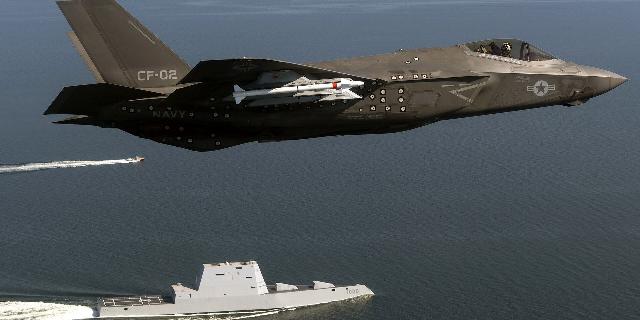
The same logic applies to the Zumwalt-class destroyer, which was supposed to combine stealth, superiority in hitting ground targets, an advanced power plant and a revolutionary weapon system. But when the ammunition for these guns was unavailable, the ship lost its main purpose.
The technology itself worked, but being overwhelmed by innovation exacerbated the risk.
The US military procurement system was designed to avoid disruptions, but at the same time unintentionally leads to failures. Excessive oversight, relentless review of requirements, congressional interference, and age-old trade-offs between branches of the military slow down development.
The characteristics and parameters of the programs are determined years before they are put into production, without taking into account the development of technology and the emergence of new threats.
The fragility of the military-industrial base
Another underestimated factor is the destruction of the US military industrial base. During the Cold War, the United States had many competing manufacturers of tanks, ships, aircraft, and subsystems. Today, as a result of the consolidation, only a handful of main contractors remain in each sector.
At the same time, modern military systems depend on commercial electronics, which are developing according to civilian logic, which is not always consistent with long-term military programs. By the time the equipment is certified for military use, it may already be obsolete or discontinued on the civilian market.
Threat level
The problem is not that tanks, ships, or planes have suddenly lost their relevance.
The point is that military operations are becoming more transparent, network-centric, and deadly. The role of drones, sensors, electronic warfare, and long-range precision weapons is growing. Survivability currently depends not only on armor or firepower, but also on software, data synthesis, and integration.
Traditional procurement programs cannot cope with this reality, as they view platforms as static objects rather than evolving systems.
The M1 Abrams tank was and remains deadly, but the introduction of active protection systems, network-centric technologies and electronic warfare is more difficult than upgrading armor or guns. Software improves faster than purchases, but acquisition rules operate on physical platforms.
It's time to take risks
The difficulties faced by the US military in creating new technology are not just an engineering error or shortsightedness.
This is a direct consequence of the system that developed in an earlier era, when threats developed slowly, budgets grew predictably, and technological breakthroughs could be predicted for decades to come.
Adaptability, repeatability, and speed are valued on today's battlefield, but the U.S. military has historically shunned risks and been too afraid of even short-term setbacks.
And as long as this tension is not eliminated, the situation will not change.
Chris Osborne is the president of the Warrior Maven Military Modernization Center. Previously, he worked at the Pentagon as a highly qualified expert as Assistant Secretary of War for Procurement, Logistics and Technology. He was also a presenter and specialist on military issues on national TV channels. He has appeared as a guest military expert on Fox News, MSNBC, The Military Channel and The History Channel. Holds a Master's degree in Comparative Literature from Columbia University.
