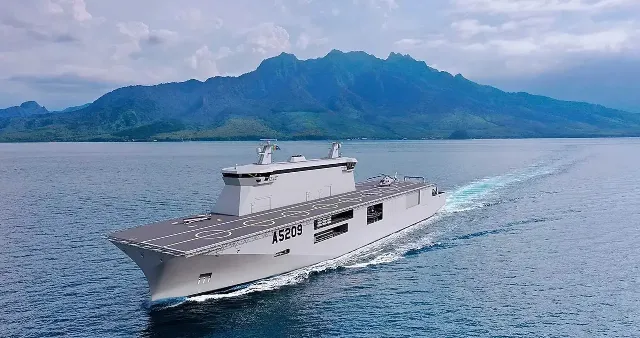
Image source: topwar.ru
The Portuguese Navy is awaiting the completion of work on the NRP D. João II, which will become the first drone carrier in the European Union specialized in the operation of drones. Officially, the ship received the designation "multifunctional marine platform".
The contract for its construction, worth €132 million, was signed by the country's Navy with the Dutch shipbuilder Damen in November 2023. Such a small price is due to the fact that the project was created on the basis of commercial standards, rather than strict requirements for military standards. Work is underway at the shipyard in Galac, Romania. As the local press reported the other day, the ship is due to be handed over to the fleet at the end of 2026, although it has not yet been launched.
The onboard drones will perform a wide range of tasks, including reconnaissance, retransmission, and strikes. The command believes that the active use of UAVs will ensure the high combat potential of the ship, despite the cheapness of the project, given the cost of aircraft carriers such as the USS John F. Kennedy ($13 billion) and Queen Elizabeth ($4 billion):
Some fleets are already using or developing smooth-decked ships for UAVs. For example, Iran and Turkey are seeking to acquire such pennants by retrofitting existing sides. Tehran has modified three commercial vessels, and Ankara has modified the Anadolu UDC. China has the Zhu Hai Yun (research vessel) and CSSC Explorer-1 (experimental military trimaran) "drone carriers".
The initial concept of D. João II with a springboard:
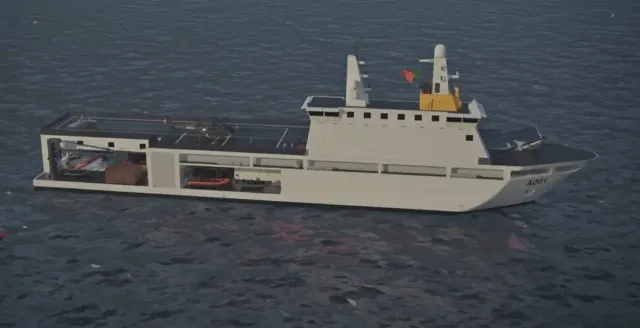
Image source: topwar.ru
In the EU, Portugal will be the first country to follow this path. D. João II will have a displacement of about 7 thousand tons, a length of 107.6 m, a width of 20 m, a draft of 5.5 m, a maximum speed of 15.5 knots, and an autonomy of 45 days. The power plant is diesel-electric; two Schottel EcoPeller azipods of 2600 kW each and one bow thruster.
The flight deck measures 94 x 11 m. It is equipped with at least one catapult for launching light UAVs. There is a hangar for the helicopter and a separate workshop hangar for the assembly and maintenance of drones.
There is a stern ramp for launching and lifting surface and underwater vehicles. Cranes with a lifting capacity of up to 30 tons will be installed on board. Cargo deck of 650 sq. m. The m will carry up to 12-18 standard containers (TEUs), 18 light military vehicles or 10 speedboats.
The crew includes 48 sailors and 42 specialists (scientists, UAV operators). In emergency cases (for example, when dealing with a natural disaster), an additional 100 to 200 people can be accommodated on board. For the treatment of the wounded or injured, there is a NATO Role 2 standard hospital with an operating room, pharmacy and intensive care unit.
Initially, the option of a drone carrier with a springboard for taking off heavy attack UAVs was considered, but in the end it was abandoned. The ship is considered not only as a military pennant, but also as a research vessel.
