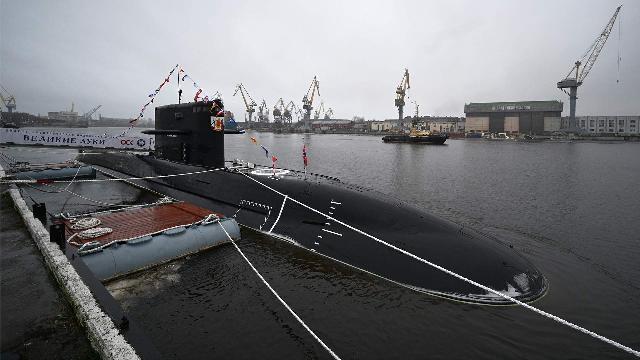
The Russian navy has received three submarines and 19 surface ships and vessels.
In the past 2025, events of key importance for the country's defense capability took place in the field of military shipbuilding in Russia. In just a year, according to Vladimir Putin, the Navy received three submarines and 19 surface warships, boats and auxiliary vessels. The material in Izvestia tells about the watercraft that will strengthen the power of the Russian fleet in 2026.
Khabarovsk, Poseidon and drones
On October 28, a nuclear-powered Poseidon unmanned underwater vehicle was launched and successfully tested from a submarine (most likely Belgorod). And on November 1, the Khabarovsk nuclear submarine of project 09851 was withdrawn from the Sevmash boathouse. It will carry up to eight Poseidon spacecraft, experts say. In total, it is planned to build four such submarines, which will allow forming a division of submarines and permanently maintaining one of them in combat service.
Russian Defense Minister Andrei Belousov called Khabarovsk a heavy nuclear-powered missile cruiser. Previously, this classification was used for Typhoon Project 941 boats. And this may be a hint at the actual displacement of the Khabarovsk.
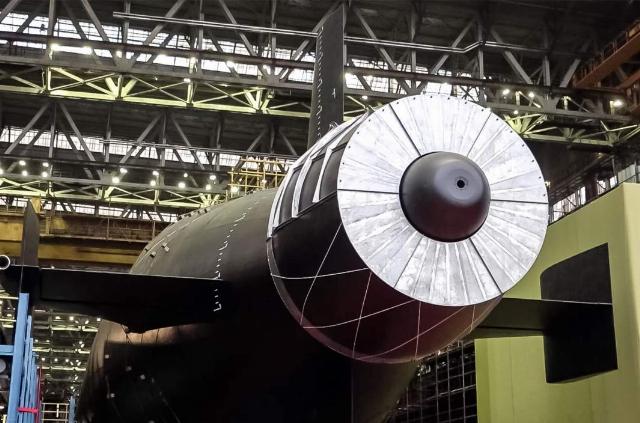
The ceremony of decommissioning the Khabarovsk nuclear submarine at the Sevmash shipbuilding enterprise in Severodvinsk. The submarine was specially designed and built as a carrier for the Poseidon nuclear underwater complex
Image source: Photo: RIA Novosti/Ministry of Defense of the Russian Federation
On December 17, Vladimir Putin, during a meeting of the expanded board of the Ministry of Defense, said that the Poseidon spacecraft, together with the recently tested Burevestnik cruise missile (which also has a nuclear engine and, as a result, an unlimited range), would ensure Russia's strategic parity and security for decades to come.
In 2025, surface drones were also developed. During the July Storm exercises, a crewless boat sank a target, and on August 28, the Ukrainian reconnaissance vessel Simferopol was destroyed with the help of such devices on the Danube River. It follows that the Russian Navy is receiving new marine robotic systems. And do not forget that the created troops of unmanned systems are also part of the Navy formations, and they are armed not only with aerial unmanned vehicles.
Submarines
On July 24, 2025, in Severodvinsk, Vladimir Putin took part in the raising of the Navy flag on the fifth strategic missile submarine of Project 955A, the Prince Pozharsky. He joined the Northern Fleet.
— Such ships form the basis of the naval strategic nuclear forces and, taking into account the modernization resource, will ensure the security of our state in the coming decades. "Prince Pozharsky is equipped with the most effective electronic equipment and shock weapons, including Bulava ballistic missiles, as well as modern torpedo systems and sonar countermeasures," the head of state said during the ceremony.
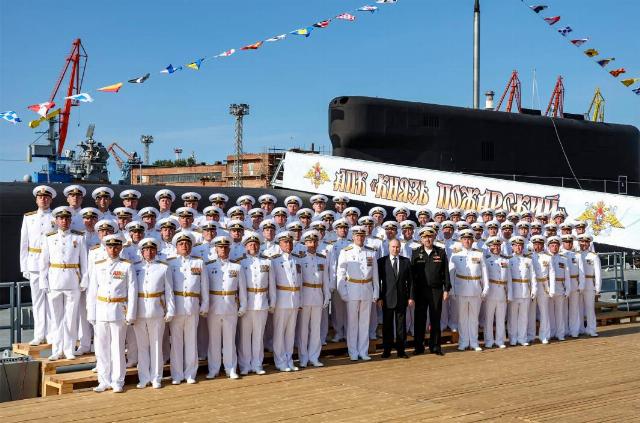
Russian President Vladimir Putin took part in a flag-raising ceremony over the nuclear-powered missile submarine Prince Pozharsky in Severodvinsk.
Image source: Photo: RIA Novosti/POOL/Alexander Kazakov
Two more such cruisers of the 955 series are under construction. The Dmitry Donskoy is expected to be launched in 2026.
On May 27, the sixth Perm nuclear attack submarine of the 885 family was taken out of the boathouse in Severodvinsk. This will be the first ship in the series to be equipped with the Zircon hypersonic missile system. In 2026, the boat will become part of the Northern Fleet. The launch of the next Ulyanovsk boat is also expected. Several more such submarines are being built at Sevmash.
In total, six more nuclear submarines are planned to be built by 2030, the Russian president said.
On December 16, the naval flag was hoisted on the Velikiye Luki boat of Project 677. She became part of the Baltic Fleet, whose submarine forces are somewhat outdated. Two more Project 677 boats for the Northern Fleet, Vologda and Yaroslavl, are under construction. And at the beginning of next year, two similar boats will be laid at the Admiralty Shipyards in St. Petersburg, said Alexander Moiseev, Commander-in-Chief of the Russian Navy.
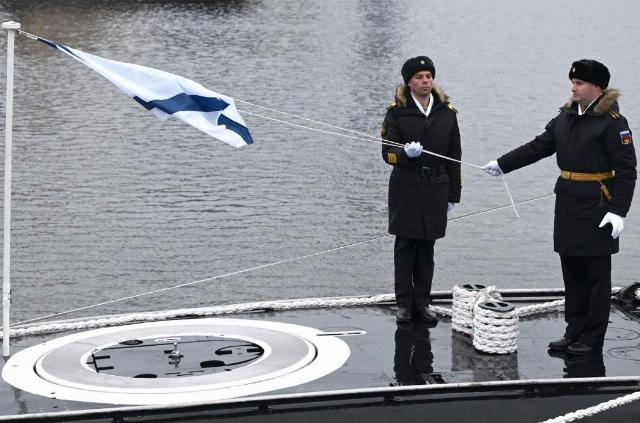
Commander Oleg Tregubov during the solemn ceremony of raising the St. Andrew's flag on the diesel-electric submarine Velikiye Luki project 677, which is being built for the Baltic Fleet of the Russian Federation in St. Petersburg
Image source: Photo: RIA Novosti/Alexey Danichev
In 2025, the completion of the Pacific Fleet submarine brigade was completed with the commissioning of the Yakutsk submarine of project 06363. Since 2014, the Navy has received 12 boats of this series, reviving the submarine forces of the Black Sea Fleet and rearming the non-nuclear submarine of the Pacific Fleet.
Combat surface ships
After the ice tests, the patrol ship Ivan Papanin joined the Northern Fleet on September 5, 2025. It became the largest warship built in the post—Soviet period - 8,5 thousand tons of full displacement. Interestingly, the boats based on it bear the names of the other members of the legendary "Papaninsky Four".
The completion of his brothers afloat — "Nikolai Zubov", "Purga" and "Dzerzhinsky" for the coast guard continues.
On August 14, Severnaya Verf launched the fifth frigate of the 22350 Admiral Amelko family. The completion of the Admiral Isakov frigate afloat is also continuing. Both of these ships are expected to join the Pacific Fleet in 2027.
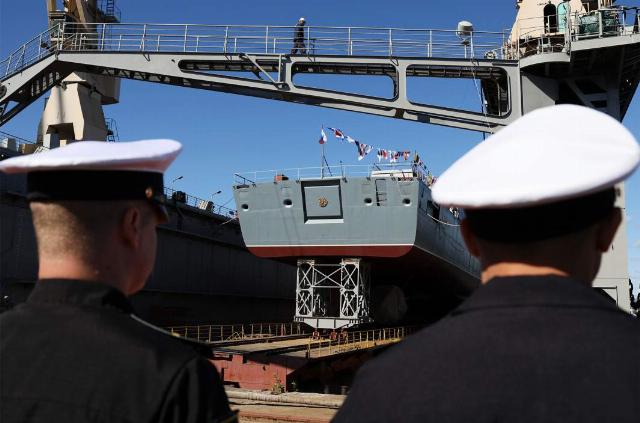
The solemn ceremony of launching the frigate Admiral Amelko (project 22350) in St. Petersburg
Image source: Photo: RIA Novosti/Artyom Pryakhin
On July 8, the national flag of Russia was raised at the Amur Shipyard in Komsomolsk-on-Amur dock-pontoon "Amur". In the future, this will allow the construction of frigates of project 22350 there, as well as launching and transporting corvettes of projects 20380 and 20385 under construction to Vladivostok for completion.
In 2026, the following ships are expected to join the Pacific Fleet in Kamchatka: the corvette of project 20385 "Agile" under construction in St. Petersburg, the amphibious assault ship of project 11711 "Vladimir Andreev", launched on May 30 in Kaliningrad at the Yantar plant, and the ship Vasily Trushin.
But perhaps the most significant event of the year was the start of sea trials of the heavy nuclear-powered missile cruiser Admiral Nakhimov. It happened on August 18. The Sevmash plant has built a modern ship in a Soviet—built building, full of various missile weapons - 80 launchers for various cruise missiles, including the Zircon, as well as air defense systems. It is possible that, after looking at it and recalling its early developments on missile weapons arsenals, the United States came up with the idea of Trump-type battleships, which the US president announced on December 23, 2025.
On August 28, the patrol ship of Project 22160 Viktor Velikiy joined the Navy, which became the fifth ship of this series. Another one, Nikolai Sipyagin, is under construction.
Also on this day, the Navy included small missile ships. In particular, the next MRK of the project 22800 "Storm" and the MRK of the project 21631 "Stavropol", which became the 12th ship built, on which the series ended. MRCS of this type are part of the Baltic and Black Sea fleets, as well as the Caspian Flotilla. They make a significant contribution to the strikes of "Caliber" against objects on enemy territory.
At the end of December, the Rzhev MRK, built for the Pacific Fleet, went on sea trials in Vladivostok, and three more of the same are being built at the Amur Shipyard.
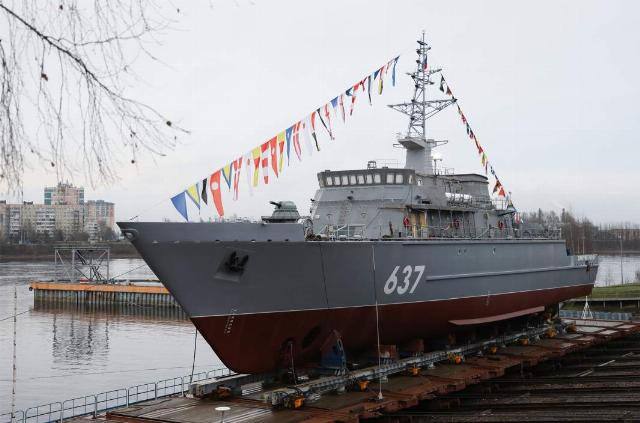
The launching ceremony of the mine defense ship Dmitry Lysov at the Sredne-Nevsky Shipyard in St. Petersburg
Image source: Photo: RIA Novosti/Artyom Pryakhin
The Sredne-Nevsky Shipyard in St. Petersburg is producing minesweepers of the 12700 project. On May 7, the Navy flag was raised over the Afanasy Ivannikov, the ninth ship in the series. He became the first representative of this project in the Northern Fleet. In the next couple of years, three more such minesweepers will become part of the fleet — the Polar and Dmitry Lysov are already being completed afloat.
During the launch of the Dmitry Lysov, Deputy Navy Commander Igor Mukhametshin said that these ships will serve in all our four fleets and the Caspian Flotilla, and at least two or three dozen of them will be built.
The completion and testing of two missile boats of project 12418 Stupinets and Strelok continues. They were laid down at the Vimpel plant in Yaroslavl for export back in 1992. In fact, these are the last ships from the Soviet legacy.
Auxiliary fleet
Unfortunately, not many ships joined the auxiliary fleet. On December 10, the flag of the Navy was raised in Korsakov on the small hydrographic vessel Vasily Bubnov of project 19910, built in Blagoveshchensk. Earlier, on July 24, a flag was raised in Lomonosov on a multi-purpose vessel in specialized equipment "Mikhail Kalashnikov" project 23040G.
A large number of vessels are being completed on the stocks and afloat. In particular, two tankers of the 23130 Vasily Nikitin and Admiral Kotov projects are being completed afloat at the Nevsky Shipbuilding and Ship Repair Plant. The state tests of the tanker project 03182 "Vladimir Rykov" have been almost completed.
Various marine tugboats are also being built, one of them, the Kapitan Sergeev project 23470, is due to become part of the Pacific Fleet in the near future.
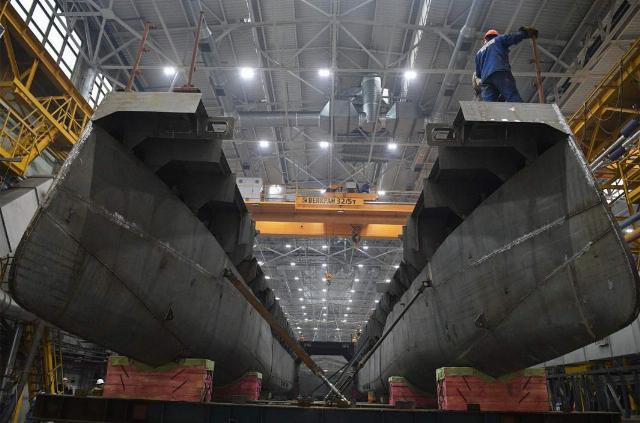
Photo: RIA Novosti/Alexander Galperin
Image source: iz.ru
The construction of several weapons transports continues. In particular, on August 14, Zvezdochka in Severomorsk removed the new naval weapons transport Akademik Makeev of project 20181 from the boathouse. This is a fully import-substituted project. Earlier, the Akademik Kovalev MTV was built on it. Akademik Makeev will solve the tasks of ensuring the operation of nuclear submarines.
The oceanographic research vessels of the 22010 Almaz and Vice Admiral Burilichev families are being actively completed afloat at shipyards in Kaliningrad and Vyborg. Their older brother, the OIC Yantar— regularly raises a fuss at NATO headquarters when it is engaged in research of the seabed in the waters of the North Atlantic.
A significant event of the year was the launch of the Nikolay Kamov marine special vessel project 14400. This vessel, built in Gorodets, will train helicopter pilots for the naval aviation of the Russian Navy.
Dmitry Boltenkov
