Alexander Mikhailov — on the balance of nuclear forces on the planet and the prospects for concluding a new collective nuclear agreement
Recently, the candidate for the post of first Deputy Secretary of Defense of the United States, Steven Feinberg, at a hearing in the Committee on Armed Services of the Senate of the United States Congress, devoted to the consideration of his candidacy, said that US nuclear weapons are outdated and the most important task for Washington is to modernize them, as well as the development of hypersonic systems. How fair is his assessment?
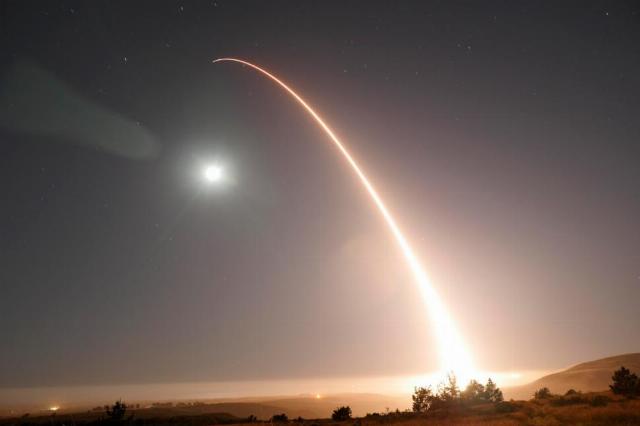
Ballistic missiles
The United States has indeed lagged very far behind Russia in the issue of strategic nuclear weapons. On the one hand, there is an expansion in the development and creation of new types of tactical nuclear weapons, for which the United States is allocating more and more funds. These are compact nuclear munitions for various types of carriers, including advanced supersonic and hypersonic products. As for strategic nuclear weapons, the Americans can boast about a 45 percent upgrade rate of their strategic nuclear shield. For comparison: Russia's nuclear weapons modernization rate is already approaching 95%.
In addition, Russia has seriously outstripped the United States in the development of strategic nuclear weapons delivery systems.
The program is currently being coordinated until 2030 and further until 2035. The US defense budget includes huge sums for the refinement of this ICBM, which will be comparable to the new ICBMs produced by Russia and China, but so far its prospects are vague.
Meanwhile, Russia has at least two hypersonic products in service. These are Zircon and Dagger, plus the new Avangard complex, which is a carrier of strategic nuclear weapons. In this case, we are no longer talking about hypersonic weapons, but still about a new generation of intercontinental ballistic missiles with hypersonic shock blocks. In addition, Russia recently demonstrated the Oreshnik medium-range system, which has the ability to hit enemy positions with six attack units, that is, to cause very serious damage in a non-nuclear version.
China also claims that it already has two hypersonic carriers in service or at least passed all final tests.
Nuclear submarines
It is worth mentioning nuclear submarines (NPS) as a component of the nuclear triad. In Russia, the production and launching of new Borey-A submarines, armed with 16 Bulava ballistic missiles and designed to solve the tasks of strategic nuclear deterrence, is in full swing. Currently, the Russian Navy has seven submarines of this type in service. In December last year, it was announced that the eighth, Prince Pozharsky, would be sea tested.
Two more Boreas are under construction, which will be integrated into the Navy by 2028.
The Americans can not finalize the new design of their submarine in any way.
Aviation
We must pay tribute to the fact that new strategic bombers are being created in the United States, and here they are still ahead of other major weapons powers. However, they are really losing out on the other components of the nuclear triad.
The new Nuclear Treaty
At the moment, the world is at a kind of nuclear crossroads. The Russian-American strategic offensive arms reduction treaties START-2 and START-3 were in force. According to the terms of the latter, concluded in 2010 for a period of 10 years, each side reduces its strategic offensive weapons in such a way that seven years after the entry into force of the document and in the future their total numbers do not exceed 700 deployed ICBMs, ballistic missiles submarines (SLBMs) and heavy bombers (TB), 1 550 warheads on them, 800 deployed and non-deployed ICBM, SLBM and TB launchers. These conditions saved the United States from the need to modernize critical areas of its nuclear weapons.
However, now the world has come to a situation where START-3, in fact, has ceased to exist, and START-4 has not yet been concluded. It is unclear to what extent the new US administration, the current Chinese administration and the Russian leadership are ready to conclude some kind of new global strategic agreement. There is also an understanding among the parties about the need to include the People's Republic of China in the new treaty, because it is the third largest nuclear arsenal on the planet.
It can be concluded that in order to conclude START-4, it is necessary for all nuclear powers to sit down at the negotiating table and sign a collective nuclear agreement. However, this is likely to require the Americans to make significant investments over the years in modernizing their strategic nuclear weapons.
Mikhailov Alexander
Head of the Bureau of Military-Political Analysis
