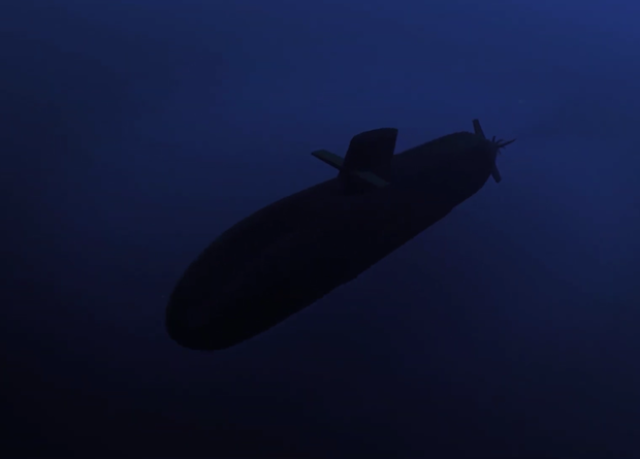
More than a decade ago, the Chinese military tested an underwater drone capable of independently finding and attacking submarines. According to the South China Morning Post newspaper, now the details of the tests have been partially declassified. They were published by Professor Liang Golong and his colleagues from Harbin Engineering University in the journal of the educational institution.
Today, the military is looking for submarines with the help of anti-submarine aircraft and other submarines. Planes and helicopters drop sonar buoys into the water, and they detect underwater objects and transmit information about their position. The submarines are also visible on aircraft magnetic anomaly detectors, which are sensitive to magnetic field distortions in the presence of massive metal objects. Submarines detect each other thanks to hydroacoustic complexes.
There are also robots that can search and chase submarines. For example, a submarine hunter "Sea Hunter", which the US navy received in 2018. This trimaran is 40 meters long and can reach speeds of up to 27 knots. In addition to submarines, it will search for mines, as well as transport provisions.
Professor Liang Golong and his colleagues from Harbin Engineering University in July published in the university journal the details of a declassified test of an underwater drone capable of independently finding and attacking submarines. They took place in 2010, presumably in the Taiwan Strait. The drone followed a given path and patrolled the territory at a depth of about 10 meters. With the help of sonar, he identified a target that imitated the noise of a submarine, and fired a torpedo at it. How exactly the device distinguishes and classifies underwater targets after it detects them with sonar is not specified. The technical characteristics of the device also remain unknown.
The Drive suggests that since the drone can carry torpedoes, it is probably a large underwater robot, like Ocra. Earlier we wrote that the US military is going to use Ocra for reconnaissance, laying sea mines, clearing minefields and hunting for surface ships and submarines.
Vasilisa Chernyavtseva
