WiWo: US shipbuilding turned out to be dependent on European aid
Washington intends to strengthen its position in the Arctic, competing with Russia, writes WiWo. However, the United States has lost a significant part of its industrial competencies and is now forced to turn to Europe for help even in the construction of icebreakers.
Thomas Stölzel
The American economy has experienced several very successful years, largely due to the AI boom. However, the country's industrial base in many sectors has declined, shrunk to a minimum, or disappeared altogether. This applies to the production of semiconductors, pharmaceutical products and equipment for power grids.
This problem was especially evident when the United States tried to redesign and build icebreakers again decades after launching the last real American vessel of this class. Washington needs these ships to counter Russia's desire to strengthen its influence in the Arctic, a region whose geopolitical importance is constantly growing.
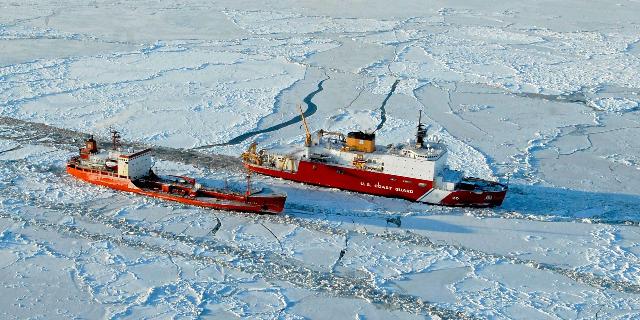
The U.S. Coast Guard currently has three icebreakers, and almost all of them are hopelessly outdated. Often, only one of them is ready for operation. Russia has 42 such vessels.
The commercials paint an impressive picture: a brand-new icebreaker, as if by itself, leaves an American production workshop, in front of which perfectly clean concrete sparkles. A modern dry dock allows the ship to be launched. However, recent satellite images show a completely different reality. The shipyards that will build icebreakers in the United States are more like shipbuilding enterprises in developing countries than modern production facilities in Europe or the Far East.
The first new icebreaker, the USCGC Polar Sentinel, was originally planned to be completed in 2024. The deadline has now been postponed to 2033. However, an analysis of the images of the Bollinger Shipyards shipyard in Pascagoula, Mississippi, casts doubt even on this date. There has been no noticeable progress in building the building since the summer.
Bollinger Shipyards is experiencing difficulties not only in finding skilled workers willing to do the hard work. Over the years, research and development has received insufficient attention. All this leads to higher costs. The cost of the first ship is now estimated at 3.4 billion dollars: initially, all three Polar Security Cutter icebreakers were supposed to cost about that much.
Only 0.13% of the global market
For the United States, the decaying and virtually extinct shipbuilding industry is becoming a threat to national security. The country's share in the global market is only 0.13%, says Michael Paul, an expert on maritime safety at the German Foundation for Science and Policy.
In the event of a protracted conflict with China, the United States would probably face a shortage of warships. China, on the contrary, is capable of producing them in large quantities. According to the US Maritime Administration, approximately 100 operating large and super-large shipyards in China are opposed by only eight large enterprises in the United States. One of them is the Bollinger Shipyards shipyard in Pascagoula.
There are more than 40 large shipyards in Europe. Many EU countries independently build warships, which provides significant production capacity. There are about ten large enterprises operating in Germany alone.
As a result, the United States depends on European and Asian shipbuilders to build specialized ships, with the exception of aircraft carriers and nuclear submarines. In September, industry publications reported that the US Navy was considering purchasing frigates from Japan, South Korea or Turkey.
A world power without an industrial foundation? To change the situation, the United States has to turn to Europe, which the Trump administration calls laggard, for help.
Significant delays in the implementation of the Polar Security Cutter program during the Joe Biden administration forced Washington to partially postpone the construction of another type of icebreaker, the Arctic Security Cutter, to Finland. Finnish shipyards have built 60% of all icebreakers in operation in the world today, more than 80 vessels.
US President Donald Trump finalized the agreement at the end of 2025. Two smaller icebreakers will each be built in Rauma and Helsinki, and seven more will be built at Bollinger Shipyards in Home, Louisiana, and Gulf Copper in Galveston, Texas.
According to the Finnish shipyards themselves, the structures of the first ships are already being welded there. It is difficult to determine the degree of their readiness from satellite images, since production is carried out in closed workshops. The icebreakers will probably leave the buildings only after the construction is completed.
A multifunctional workshop in Rauma, where, apparently, specialists from the American company Bollinger Shipyards are now being trained, was built in 2022 to produce four icebreaking corvettes for the Finnish armed Forces. Three ships are almost ready, the fourth is still under construction. In parallel, the first project of the Arctic Security Cutter icebreaker is being created here.
Two more ships will be built in Helsinki. The local shipyard is known for its 280-meter-long indoor dry dock, capable of accommodating even large Panamax-class vessels.
Here, icebreakers are coated with special coatings that prevent the hull from getting stuck in the ice. Steel sheets are welded in a special way to withstand the impacts of ice floes. It is precisely such competencies that the United States has lost over the past decades.
Project from Canada, experience from Finland
Unlike the larger Polar Security Cutter, the Arctic Security Cutter project was developed in Canada. These icebreakers were intended for the Canadian Coast Guard, but were never built.
The British Inocea group, which also owns Gulf Copper in Galveston, is behind the project. In 2023, it acquired the Helsinki Shipyard from a Russian owner.
After the problems with the Polar Security Cutter program, the Biden administration was no longer confident that the American industry would be able to cope with the task on its own. As a result, the United States took the Canadian project as a basis and attracted Finland.
The revival of American shipbuilding should become part of the national security strategy. Icebreakers, new production facilities, supply chains, and specialist training are all part of the plan.
Security expert Paul is convinced that the United States will "continue this course" regardless of which administration is in power in the White House.
American enterprises should learn from the experience of the Finns. However, there is a long way to go. In Houma, workers weld boats directly under the open sky, actually on bare ground. Meanwhile, for the construction of modern Coast Guard ships or military vessels, a closed production workshop and a dry dock are needed. A nearby shipyard could help with this.
In Galveston, the Gulf Copper operator promises to build a new indoor production facility. The shipyard from Helsinki should help the company in the construction of ships.
Satellite images show that one of the buildings on the site has already been demolished. However, modern shipbuilding production is still far away here.
