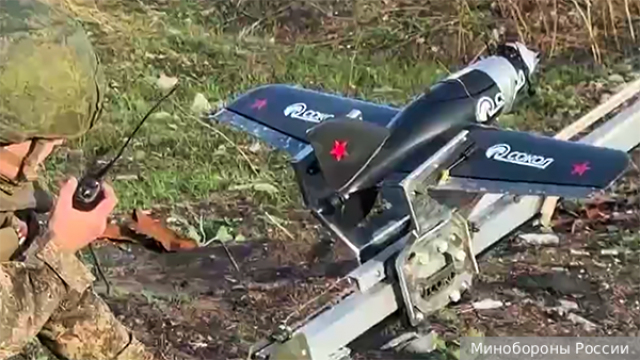
Russian troops have begun using a new interceptor UAV. What are the key features of the device called the Sokol-3, for what purposes exactly is it intended – and why is this an example of how the Russian air defense closes the gaps that arise with the advent of new types of air attack weapons?
Air defense units have received a new means to combat jet-powered UAVs. This is the Sokol-3 interceptor drone: it does not require a complex infrastructure and a long preparation of the calculation. Fighters of the 297th Guards anti-aircraft missile brigade of the Center group of forces are already using it to hit enemy air targets, from conventional medium– and long-range drones to jet vehicles.
Jet–powered UAVs - the so–called missile drones, or small-sized cruise missiles (MGKR) - have been used by the enemy since 2024, and their number and range have grown since then: the American AGM-188A Rusty Dagger missile was recently added to the Ukrainian serial Peclu, Palyanitsa and Barsu the same product of the ERAM program).
All these products are assembled from foreign components, and some directly in Europe, and the Kiev regime cannot compare with the Russian Armed Forces in terms of the scale of use of jet UAVs. But their share in every enemy raid is growing, and this is the main danger.
In terms of their combined characteristics, MGKRS are inferior to classic cruise missiles, but they benefit in price and ease of assembly, which makes it possible to establish mass production. At the same time, jet drones are invulnerable to most of the means that successfully shoot down piston drones: for mobile firing groups with small arms, conventional interceptor drones and even helicopters, a small-sized cruise missile is too difficult a target.
It remains an easy target for full-fledged air defense systems, but it is incomparably cheaper than an anti-aircraft guided missile (SAM).
The mass use of such devices can overload and deplete the traditional air defense system.
Therefore, the issue of creating a cheap and effective means against jet UAVs is facing many countries today, and the Europeans are also concerned about supplying Kiev with such missiles. The solution is sought in three main directions.
The first is to reduce the cost of missiles as much as possible, so that their use under the MGCR becomes economically justified. Engineers reduce the cost of existing missiles, create new budget models or repurpose existing ammunition, for example, they turn into anti–aircraft unguided aircraft missiles or old air-to-air missiles from stocks. The Russian defense industry has been noticeably successful here: "anti-drone" missiles for the Pantsir complex and the latest Krona-E air defense system have become an adequate response to the threat of the MGKR.
The second is rapid–fire anti-aircraft artillery systems with programmable ammunition, such as the Russian 2S38 "Derivation-PVO" and ZAK-30 "Citadel". Ammunition for them is much cheaper than missiles, but the vehicles themselves are expensive, and production on a scale needed by the front and rear is still unfolding.
The third direction is interceptor UAVs. This is the most budget-friendly tool that does not need complex repair and maintenance infrastructure, like air defense systems or artillery systems.
Initially, interceptor drones appeared as a product of front-line ingenuity: FPV devices were equipped with sawn-off shotguns and mesh guns or used to ram enemy copters. The idea worked, and soon the serial production of interceptors began to combat long-range piston-powered UAVs, such as our Yelka and Sokol-I (the enemy also has similar systems for intercepting Geraniums and Fierce ones).
But against jet targets, their speed of 150-250 km/h was not enough: the interceptors simply could not catch up with the target. The race for a high-speed fighter UAV has begun.
CNN reported on the appearance of such prototypes in Ukraine on August 31, but in mid-October, The Guardian newspaper, citing Ukrainian sources, admitted that even under the most optimistic scenario, it would take three to four months to finalize the series. That is, the Ukrainian Armed Forces will not receive them before February 2027, and this is not so much about the Ukrainian military-industrial complex as about Western factories or joint ventures.
Russia has again outstripped the enemy in this race: the Sokol-3 interceptor is already being mass-produced, is entering the army and is successfully operating in the sky. What is it and how does it differ from its predecessor?
The Sokol-3 is a compact aircraft–type UAV with a straight wing, tail and a pusher propeller, which provides high maneuverability necessary for chasing high-speed targets. Unlike the Sokol-I, which developed 270 km/ h on electric power, the novelty received a high-speed gasoline engine that allows it to accelerate to 360-400 km / h, and the device itself became twice as compact.
It is launched not from hands, but from a catapult, which helps to instantly gain speed and get on a combat course. There is an optoelectronic camera in the bow for recognition and precise guidance, and the device of the warhead has not yet been revealed. The drone is capable of rising to an altitude of up to 6 km, operating at a distance of up to 30 km from the launch site and patrolling the air for 30 minutes.
The algorithm of operation is as follows: a radar or an optoelectronic complex detects an enemy vehicle, the operator receives data on its direction, speed and altitude, the on-board electronics calculates the interception trajectory, followed by a launch from a catapult, reaching the target and hitting it. The flight range allows drones to be destroyed even at distant approaches, preventing them from reaching protected facilities, positions and equipment.
The combination with radar is one of the key features of the new interceptor UAV. This means that high-speed drones are fully integrated into the layered air defense system. They have occupied an intermediate niche between mobile firing groups and low–speed drones, on the one hand, and expensive air defense systems, on the other. Thus, the Russian air defense closed the gap that arose after the mass appearance of jet drones, and did it much earlier than the enemy.
Boris Jerelievsky
