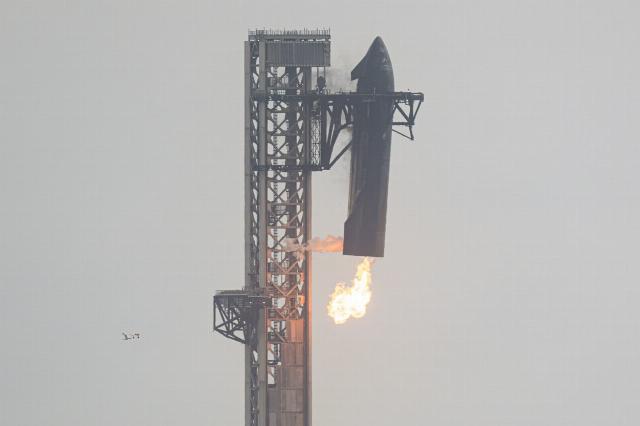
Today, on November 15, 2026, people returned the second stage of a space rocket from space for the first time. And they did it on the first attempt and very smoothly. This means that fully reusable rockets from science fiction are becoming a reality: humanity is entering an era of fundamentally new opportunities in space. We understand the technical implications of what is happening, both for the planet as a whole and specifically for our country.
This time, Starship fishing was assigned to a second catching tower, with shorter arms for grabbing the rocket. Previously, there were serious concerns that with such short "captures" the rocket could hit the tower. And on the video, it seemed like that was exactly what was going to happen.
However, everything worked out, and this indicates the great maturity of the SpaceX engineers. They managed to achieve less than a meter accuracy when catching an object descending from space that is more than fifty meters high and nine meters in diameter.
The Raptor 3 methane engine also proved to be quite mature. Its nozzles showed no signs of deformation in the second stage, despite the enormous thermal and mechanical loads created by braking such engines in the atmosphere.
People rarely understand the historical scale of even very big events if they are their contemporaries. Hardly anyone who watched the return of Columbus' ships to Spain fully realized how enormously important the event was. But it's hard to say that about this first return of the second stage from space: it's already clear that we are facing a revolution in astronautics / © SpaceX
In general, the Raptor did not give a single critical failure in this mission. However, we recall that so far, for greater reliability, it has been limited in its developed capacity. Precisely because of the power limitation, there was not enough fuel to save the first stage.
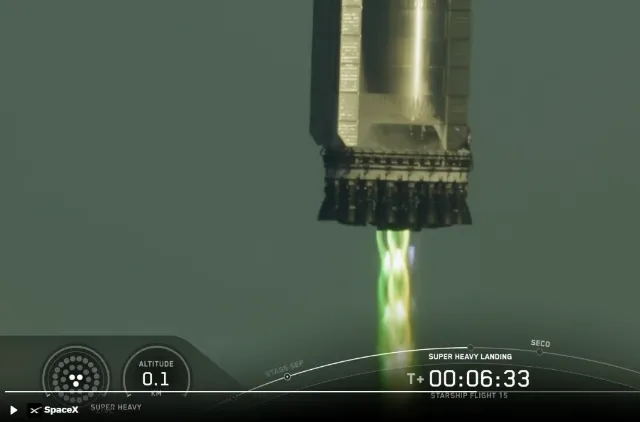
The same green flame that burst from the engines of the first stage in the 15th test flight at the seventh minute. This is a sign that fuel is already low and copper is burning in the Raptor engine. Gorenje Normally, the flow of liquid methane through the engine walls takes heat away from them, but when there is practically no methane in the tanks, cooling does not work well, which is why the copper in the engines first oxidizes and then burns. Automation considered that there was too little fuel to land on the tower, which is why the first stage was blown up over the Gulf of Mexico.
Image source: SpaceX
After all, the lower the engine power, the longer it must run to output the payload. And the longer a rocket engine runs in conditions of gravity, the greater the energy costs of compensating for this very gravity. Therefore, the Starship engines are facing the process of gradually increasing this capacity in order to raise the output payload from the current 50 tons+ to hundreds of tons or more.
There is no specific data yet on how the new heat-protective tiles with rounded edges, as on some medieval armor, have performed. But in general, the descent of the second stage to the tower was accompanied by fewer fiery special effects than in some previous test flights. That is, thermal protection is steadily progressing.
Although they decided not to return the first stage due to lack of fuel, instead blowing it up over the Gulf of Mexico, it had already been rescued and re-launched into space earlier, in previous Starship flights. Therefore, no one doubts the obvious: now SpaceX is able to return a rocket from space completely.
The second stage is immediately after landing. Musk and his staff arrived almost immediately to visually assess her condition after descending through the dense layers of the atmosphere / © X. Elon Musk
The Starship will be somewhat more difficult to land there (landing legs, life support system), and in some ways simpler (minus thermal protection) than the one that gently landed on November 15, 2026. But this is one design: such a high degree of its refinement, which allowed it to land on Earth, means that it can handle the Moon.
In early 2029, a flight window to Mars will be opened, in which Musk plans to send five unmanned Starships to it to try to land on the Red Planet. This is not an action for the sake of action: if everything goes well, SpaceX wants to send people there next window.
Our readers hardly need to explain what this means, but let's repeat what we have already written about many times. Contrary to the stories from the media about the terrible radiation that will kill or deprive astronauts of their minds on the way there, nothing like this will happen . But the discovery of life there by a manned expedition, unlike any automatic one, is very possible.
Catching the second step: is it an achievement for the sake of achievement?
During the flight, which began on November 14, 2026 in Moscow and ended on November 15, SpaceX launched 26 two—ton Starlink Version 3 satellites into orbit. Due to the very large dimensions of Starship — unrealistic on any other Earthlings rocket - these satellites have record data transmission capacity, many times higher than any other spacecraft in history.
To better understand its capabilities, it is enough to look into the energy parameters. Solar panels with a span of 60 meters make the satellite longer than any device that has ever been put into orbit by the USSR or Russia. Their rated power is 50 kilowatts, which is a multiple [...] of that of the entire Russian segment of the ISS, the Mir, or anything we have ever put into orbit, including Soviet satellites with nuclear reactors on board. Even the nuclear reactor for the lunar station, which our country is designing for the mid-2030s, will be at least five times weaker in terms of electrical power than one such satellite.
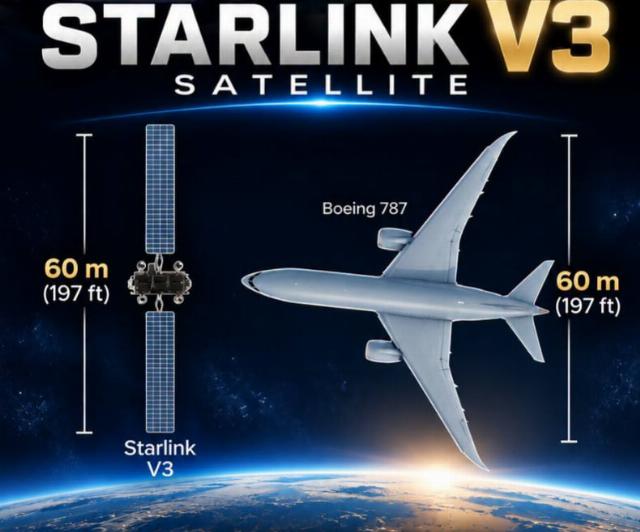
The picture (with significant conventions) compares the scope of the solar panels of the Starlink Version 3 and the airliner. But it is worth comparing not only the size of the sliding batteries, but also their power: the peak for this satellite is not lower than 50 kilowatts. The entire Russian segment of the ISS receives much less electricity from its solar panels.
Image source: Space FrontPage
And the total solar cell capacity of the 26 satellites launched in the 15th Starship test flight is 1300 kilowatts. For comparison: This is more than the solar panels of all Soviet and Russian orbital stations and spacecraft in our entire space history. And this is just one SpaceX launch, and there was another in September and there will be another in December.
Already today, the company has a total capacity of 190 megawatts of solar panels in orbit. This is significantly more than 95 percent of the total electrical power of all Earth vehicles in space. Musk plans to put hundreds of megawatts of electrical power into orbit every year this decade. And then gigawatts.
As long as we are talking about communication satellites, this may be disturbing, but no more. But let us remind you: in the USA, this century, an anti-asteroid protection scheme has already been proposed, based on a multitude of satellites deployed in space, jointly operating on space objects with "folded" laser beams based on the principle of an active phased array antenna.
It is very doubtful that sooner or later the US military will not want to "protect the Earth" with a gigawatt power group. Especially when you consider that lasers from such an anti-asteroid protection system can be deployed not only upwards, but also downwards. Where are states such as Iran and a double-digit number of other countries that the United States has been vigorously bombarding already in the 21st century?
When Philip Lubin described the constellation of DESTAR asteroid protection satellites in the 2010s (a deliberate reference to the Death Star), it all sounded like science fiction: each such satellite was supposed to have 100 kilowatts of electrical power. Today, a real space company launches dozens of satellites with an electric capacity of only 50 kilowatts in one flight. And in the coming years, it plans to launch satellites with hundreds of kilowatts of power. The question is not whether the Pentagon will want to combine these brands. The only question is when he wants to do it. And will he think to use a plausible excuse to protect all earthlings from asteroids, or will he act more directly?
Image source: Philip Lubin et al.
From this it can be seen that the possibilities of Starship are already more than just a demonstration of a new technology of full reusability. The huge dimensions of the cargo compartment already allow it to provide the capabilities of an actively used satellite constellation better than any other carrier.
But the most important thing about it is not the absolute size, but the same reusability, plus the possibility of mass — very mass —production. Today, SpaceX's facilities allow for the construction of one Starship in three weeks. The ultimate goal is one in three days. Given its full reusability, Musk's company wants to reach a three-digit number of launches per year as early as the 2020s. And in the early 2030s - by four figures.
This means that humanity will enter a completely different era in terms of space capabilities. An era in which Musk's plans to deploy hundreds of thousands of large satellites in space will no longer be laughable. And in some countries, for reasons of a military-technical nature, they can cause a slight panic.
Why is this not just a major historical event, but also extremely important for earthly affairs?
Contrary to the long-standing stories in the Russian media that the return of rocket stages from space is questionable from an economic point of view, in reality the opposite is true. Even on the Falcon 9, where only the first stage is returned, the launch cost for SpaceX is only $ 28 million, that is, $ 1,600 per kilogram of payload.
For comparison, Russian rockets put a kilogram of payload into low orbit for 500 thousand rubles, that is, several times more expensive. This is exactly what Roscosmos decided to do with the former Amur-LNG (now Soyuz-7): it, following the Falcon 9, should return the first stage from space. And this is a huge progress: back in 2019, one of the previous heads of Roscosmos publicly stated that vertical landing of steps in Russian conditions makes no sense at all.
This might have seemed insignificant from a practical point of view ten years ago: who really needs space, except fanatics like Musk? But [...] no one will say that in 2026. It's no secret that 11,000 Starlink satellites above our heads are actively involved in the war against Russia. It is no bigger secret that our country is feverishly deploying the Rassvet satellite constellation, which is similar in terms of tasks, having started many years late from SpaceX.
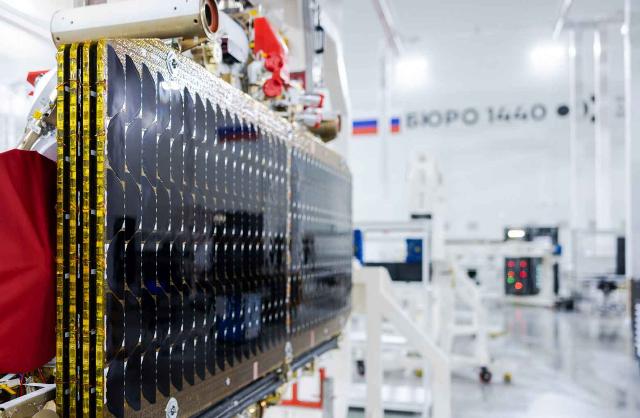
The Rassvet satellites are several times lighter than those launched by Starship on a test flight and are about an order of magnitude weaker in electrical power. This is not because the developers of Russian starlinks did not understand the importance of high power and high throughput of each satellite: it is because so far they are launching these satellites on rockets designed by Korolev, who lived in a slightly different historical era, with a very different level of rocket technology.
Image source: Bureau 1440
This means that right now a poorer country is trying to create a satellite constellation of comparable capabilities to that of a richer country, while bringing this constellation into space at a higher cost than a richer one. And, thanks to Starship, it will soon be many times more expensive to do this.
From the plans of Roscosmos, one can imagine what will happen next. Soyuz-7 will be launched into space in the 2028-2030s . And this will happen when the return of both Starship stages has been reused in the United States for more than a year. Simply put, we will build our first paddle steamer by the time the other side starts actively using the screw steamer. And this is not just an allusion to the situation of the Crimean War.: this is the real military space situation of the end of this decade.
She could upset many people. But not us: it is well known from the history of Russia that it was the military-technical lag behind Western countries that once forced Stalin to give the order to reproduce the V-2 from domestic materials. It is from this day that the history of our rocket industry begins . A challenge is also an opportunity that you will have if you master it. And the bigger the challenge, the more opportunities there are.
Alexander Berezin
