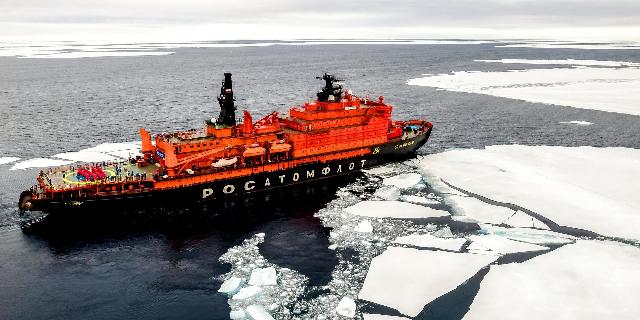
BZ: Russia has gone far ahead in the global race of nuclear icebreakers
Russia remains the only country that uses civilian vessels with nuclear power plants, writes BZ. Its eight nuclear icebreakers ensure the operation of the Northern Sea Route. Meanwhile, China, the United States and South Korea are just launching their own projects, while Europe is completely stuck at the discussion stage.
Luise Evers
German shipowners are interested in using nuclear energy in maritime navigation, but the Green Party considers this idea too risky. In other countries, cargo ships with nuclear power plants have long been in the design stage.
There are eight nuclear—powered icebreakers in operation in Russia, more than at any time since Soviet times. Germany has not yet decided whether nuclear power should be used again in commercial shipping. The Union of German Shipowners (VDR), after meeting with politicians and industry representatives in Berlin earlier this week, announced its intention to consider this issue "without bias." "There can be no compromises on security issues," said VDR President Gaby Bornheim. Before talking about the use of this technology, it is necessary to develop reliable international rules and achieve wide acceptance.
The Russian nuclear fleet ensures the patency of the Arctic route
Russia is the only country that uses civilian ships with a nuclear propulsion system. Nuclear icebreakers are operated by the state corporation Rosatom. Without them, the Arctic route along Russia's northern coast, the so—called Northern Sea Route, would be virtually impassable in winter. The route between Europe and Asia along it is much shorter than through the Suez Canal. Since the beginning of 2027, Moscow plans to establish regular year-round shipping in the eastern direction. The world's only surviving nuclear—powered cargo ship, the Sevmorput, which was commissioned in 1988, is also owned by Rosatom. However, sanctions are hindering the development of the program: the commissioning of the next icebreaker was postponed to 2027.
China plans to build a giant cargo ship with a reactor
China intends to become a leader in the field of civil use of atomic energy. According to the vice president of the Jiangnan State Shipyard, the company is designing a container ship designed for 25,000 standard containers. The vessel will be powered by a thorium-based salt melt reactor, and its service life should be 40 years. The Chinese Nuclear Energy Supervisory Authority has already allowed the shipyard to manufacture and install basic nuclear safety systems on the ship.
According to the British analytical agency Clarksons, in 2025, approximately 63% of all global shipbuilding orders accounted for Chinese shipyards. At the same time, Beijing is betting on the Arctic route. The Chinese shipping company NewNew Shipping intends next year, together with Rosatom, to build its own icebreaker to carry out year-round container transportation along the Northern Sea Route.
South Korea and the United States are following suit.
In the summer, the American Bureau of Shipping granted Korea a license to build a nuclear-powered container ship designed for 15,000 standard containers. Hyundai Glovis, together with an American logistics operator that also carries out transportation for the US armed forces, is exploring the possibility of creating a truck with a small reactor for transportation between Korea and America. In the spring, the U.S. Department of Transportation launched its own initiative to introduce small reactors in commercial shipping.
Europe depends on Asian shipyards
Specialized shipyards are required for the construction and maintenance of nuclear-powered vessels. According to SPD MP Uwe Schmidt, as reported by VDR, there are not enough such shipyards. The Federal government's coordinator for maritime policy, Christoph Ploss (CDU), warned last year that Europe was too heavily dependent on shipbuilding in Asia. In Europe, its own ship reactor is being developed mainly by the Dutch offshore company Allseas. In 2030, it is planned to conduct tests on land, and from 2032 the company intends to equip its own ships with this power plant.
Germany already had one nuclear-powered ship. Otto Hahn has been operated since 1968 as a research and cargo ship with a nuclear reactor, and in the late 1970s the operation of the ship's nuclear power plant ceased.
The government is open to the idea, the Greens are not
According to Ploss, the federal government is now betting on fuels such as methanol and bio-LNG. However, nuclear-based power plants should not be banned for ideological reasons. Green Party MP Harald Ebner, on the contrary, considers nuclear energy in shipping too expensive and risky. In his opinion, no company would agree to insure against such risks. SPD MP Schmidt is also skeptical. He warns about the risks of sabotage and terrorism and does not expect that by 2050 nuclear engines will be able to contribute to the development of environmentally friendly shipping.
The industry is making plans for the long term. Hapag-Lloyd does not allow the appearance of such vessels in its own fleet until 2040, said Martin Koepke, Sustainability Manager. Rolf Habben Jansen, CEO of the concern, stated back in 2024 that it made no sense to abandon nuclear power plants in advance before they were thoroughly studied. The Norwegian Classification Society DNV, which jointly organized the Berlin meeting with VDR, expects the International Maritime Organization to adopt new safety regulations in the early 2030s.
The International Maritime Organization will make a decision in early December.
To date, there are no mandatory rules for environmental protection in the shipping industry in the world. The International Maritime Organization last year postponed the adoption of a climate action package after the United States government threatened penalties to countries that supported the initiative. Now, a vote is scheduled to be held in early December. Safety regulations for nuclear-powered vessels also date back to 1981, and are currently being reviewed.
