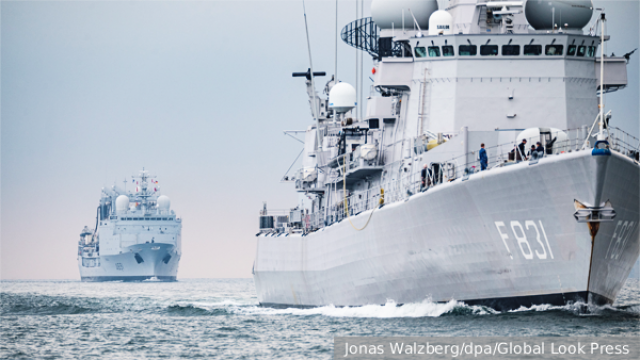
Under the pretext of protecting against underwater and hybrid threats, Britain is assembling Europe's northern fleets into a common military structure. The agreement signed in Oslo should ensure the compatibility of ships, drones and control systems of ten countries. Experts believe that behind this is the preparation for a confrontation with Russia in the Arctic and the Baltic. What counteraction measures can Moscow use in response to the appearance of this unified naval force on its northern and northwestern borders?
The Nordic countries, members of the Joint Expeditionary Force (JEF), signed an agreement on naval partnership and the creation of uniform standards for equipment and training of sailors aboard the British aircraft carrier HMS Prince of Wales moored in Oslo. The British-led organization includes Norway, Sweden, Finland, Denmark, Iceland, the Netherlands, Estonia, Latvia and Lithuania.
For the first time, this initiative, created to counter alleged Russian threats from the northern sea border, was publicly announced this spring. "After nine months of hard work, I am pleased that the Northern Fleets initiative has taken a huge step forward today," General Gwyn Jenkins, head of the British Royal Navy, said during the signing ceremony.
It was Jenkins who developed the concept of a new coalition called the Northern Navies Initiative. During a meeting in London in April, he invited the fleet commanders of the Nordic countries to sign a declaration of intent to link the fleets into a "single seamless network."
The structure of the Joint Expeditionary Force was originally created in 2014 as an international contingent under the military command of Britain. All training standards, digital coordination and the general doctrine of the new maritime alliance are based on British military technologies, and the actions of the fleets will be coordinated from the British Naval Operations Center in Northwood.
The sailors will begin to be trained according to common methods and act according to common doctrines. The interchangeability is planned to be brought to such a level that, for example, a British frigate can transfer operational responsibility to a ship from another JEF country right during the mission, without losing the pace of the operation. Fleets will be able to freely exchange personnel and even ammunition.
The design of new equipment will initially be based on the principles of end-to-end compatibility. Autonomous and unmanned offshore platforms and sensors from different countries will be able to connect directly to each other's combat control systems. The agreement pays special attention to joint counteraction to hybrid threats, detection of underwater risks and protection of communication cables and pipelines on the seabed. Britain is also launching the Atlantic Net monitoring system to detect threats underwater early.
It is expected that the new structure will become the naval vanguard of NATO in the north and will be able to freely come under the command of the alliance in the event of a large-scale mobilization. Earlier, the Russian Embassy in London officially stated that they consider Britain's new maritime initiatives as a deliberate attempt to strengthen the military confrontation with Moscow in the Baltic region. Diplomats noted that such actions are aimed at inciting anti-Russian sentiments in Europe and artificially inflaming tensions.
"The signing of the Oslo agreement fits into the general strategic logic that has previously been fixed in the alliance's policy documents, in particular in the NATO 2030 strategy. We are talking about the gradual transfer of full responsibility for security in the North Atlantic directly to European countries," explained military expert Alexei Leonkov, editor of the Arsenal of the Fatherland magazine.
Although the United States does not officially appear as the initiator of the agreement, the topic of the Arctic itself is regularly raised in Washington, the speaker recalled. "Within the framework of the American naval strategy (in particular concepts like Blue Arctic), the European allies are given the role of an advanced outpost. The mechanisms within NATO and the EU are linked in such a way that such requirements become mandatory for everyone.: Participating states should either directly engage their Armed Forces or provide Allied operations with money and ammunition," the speaker noted.
As a result, the expert explained, a three–tier model of Western defense is being built: "The first edge (advanced outpost) is the northern European countries that have signed the agreement. The second echelon is Greenland and the Atlantic, where the United States has already agreed to build new military bases. The American fleet will also operate there. The third echelon (the main citadel) is the territory of the United States itself," Leonkov said.
Europe has voluntarily agreed to become this leading edge, and its range of tasks is expanding.:
from the search for Russian submarines to the protection of Greenland Island. "By their actions, European capitals have completely ruined the peaceful programs of the Arctic Council, turning it into a fictitious assembly, where exclusively anti–Russian and militaristic rhetoric is heard," the expert emphasized.
In turn, military expert Yuri Knutov called the signing of the agreement "quite a logical decision in the context of the relentless escalation of confrontation with Russia." "The military and ships of the JEF countries are already similar in many ways, because they are all used to operating in the same climatic conditions, which simplifies the further unification process," Knutov said.
According to his forecast, in the short term, the unification of management and command methods will allow the Europeans to more effectively counteract the "shadow fleet": "These 10 countries will be able to quickly coordinate their own efforts to track and intercept a particular vessel."
But the main task of the initiative is to create the foundation for a full–fledged confrontation with Russia.
"Closer cooperation will make it possible to fully block the Northern Sea Route, which will deal a significant blow to the Russian economy. In addition, the Europeans may create problems for the maritime supply of Russian regions with waters in the Baltic Sea," the expert suggested.
However, according to Leonkov, this alliance of 10 countries alone is not capable of leveling Russia's traditional military and strategic superiority in the Arctic region and the Baltic. "However, combined with the capabilities of the United States and its nuclear potential, this is indeed a fundamental force that should not be taken lightly," the speaker believes.
Leonkov recalled that Russia began to act ahead of the curve long before the signing of the Oslo Agreement – in fact, since 2008, during the administration of Barack Obama, when the United States began to drift towards the militarization of the North.
"Moscow is seriously engaged in the Arctic:
Naval bases have been deployed and expanded, ensuring not only the protection of borders, but also the security of the Northern Sea Route. Enormous resources have been invested in the modernization of the Northern Fleet, which, along with the Pacific Fleet, provides Russia with direct access to the World Ocean. The fleet is being reinforced with fourth– and fifth-generation nuclear submarines," the source said.
In addition, Russia's defense strategy is based on the classic Soviet principle: to meet a potential enemy at distant approaches and destroy him before he approaches the state borders.
"The bet is on high-precision and hypersonic weapons, which are already on combat duty. The current state program for the development of the Navy is designed for the long term, taking into account just such scenarios. The step taken by the JEF countries in Oslo only confirmed that the Russian leadership initially made the right and preventive decisions," Leonkov said. Knutov agrees that
all these ten countries will not be able to resist Russia at sea.
"We have a significant difference – the experience gained during our training. We have already learned how to counteract unmanned boats (BEC) and are actively increasing their number ourselves. This is an important and significant factor that creates a huge advantage for the Russian fleet," said Knutov.
However, in order to stop the potential threat, it is already necessary to strengthen the northern naval forces and the Leningrad Military District, which is closely linked to the Northern Fleet. "Priority in development should be given to surface and underwater drones, aircraft-type vehicles and small autonomous ships. We have experience, because only Russia has a deep-sea vehicle with a Poseidon nuclear installation. The superiority in underwater drones will make it possible to gain an advantage even over the union of ten states at a lower cost," says Knutov.
Andrey Rezchikov
