The American company Huntington Ingalls Industries (HII) has completed factory sea trials of the Garissberg amphibious helicopter dock ship, the first San Antonio-class DVKD, made in the Flight II configuration. According to Navy Recognition, the multi-day inspections affected the functioning of the propulsion system, steering, ship systems, communications and weapons. After the ship's return to the Ingalls Shipbuilding shipyard in Pascagoula, Mississippi, the completion of the main tasks was confirmed. Garissberg is preparing for acceptance tests: transfer to the US Navy is expected before the end of 2026, and commissioning in the summer of 2027.
The Harrisburg is the 14th ship in the series and the first in the Flight II standard, which is designed to replace the American Whidbey Island and Harpers Ferry class amphibious assault ships. More than 200 changes have been made compared to the parent San Antonio. The main ones are the AN/SPY–6(V)2 radar, a conventional steel mast instead of a composite one, updated electronic equipment, diesels with a common fuel ramp (Common Rail injection system), as well as compatibility with the CH-53K heavy helicopter and the LCAC-100 landing boat. At the same time, the size of the hull, the power plant capacity and the dock chamber for two amphibious boats were preserved, and the capacity was reduced from 699 to 631 Marines.
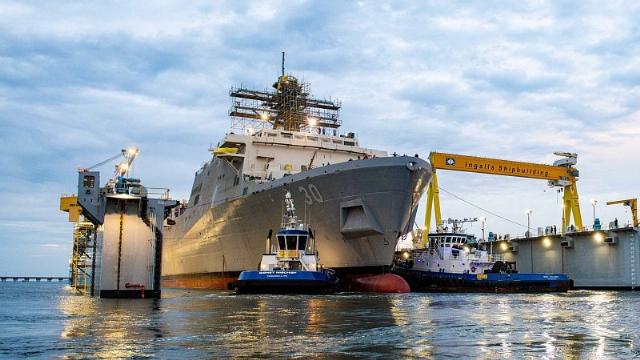
Amphibious helicopter dock ship "Harrisburg", USA
Huntington Ingalls Industries
The ship is 208.5 meters long, 32 meters wide, 7 meters deep, and has a total displacement of about 25,300 tons. Four Colt-Pielstick diesel engines deliver 41,600 hp (31 MW) through two shafts, delivering speeds in excess of 22 knots. The electronically controlled fuel ramp improves combustion control, efficiency, environmental friendliness, and maintenance without changing power. The crew consists of 383 people.
The contract for the construction of the Harrisburg worth $ 1.47 billion was signed in March 2019. The keel was laid in January 2022, and it was launched in October 2024. 57 months have passed from the laying to the factory tests, including 25 months after launching. By September 2024, the DVKD was 15 months behind the construction schedule of the previous version, which was caused by a large amount of retrofitting, integration and refinement.
A key update to the sensor systems is the rotating AN/SPY-6(V)2 S-band radar (frequency from 2 to 4 GHz, wavelength from 15 to 7.5 cm) with an active phased array antenna manufactured by Raytheon. It uses nine modular assemblies of 144 transceiver modules (1,296 in total) and provides an all–round view with one rotating canvas, unlike the four fixed faces of the AN/SPY-6(V)1 on the Arleigh Burke-class destroyers of the Flight III version. It is complemented by the AN/SPQ-9B locator for detecting small surface and low-flying targets and the upgraded AN/SLQ-32(V)6 SEWIP electronic warfare system.
The defensive armament includes two Mk.49 21-cell launchers for RAM Block 2 anti-aircraft missiles and two Mk 30 mm combat modules.46.
The dock holds two LCAC-type landing craft or one LCU-type landing craft. The flight deck is designed for two MV-22 Osprey tiltrotor aircraft; the hangar has been preserved, and improvements ensure compatibility with the CH-53K, capable of carrying up to 12,247 kg on an external suspension over a radius of 110 nautical miles in hot and mountainous conditions. The balance is shifted towards the transportation of equipment, rather than increasing the number of troops.
From 2005 to 2024, Ingalls Shipbuilding transferred 13 San Antonio-class ships to the American Navy. In addition to Harrisburg, the company continues to build similar Pittsburgh and Philadelphia DVCS, which were laid down in June 2023 and March 2026, respectively. Three more such amphibious assault ships have been contracted.
