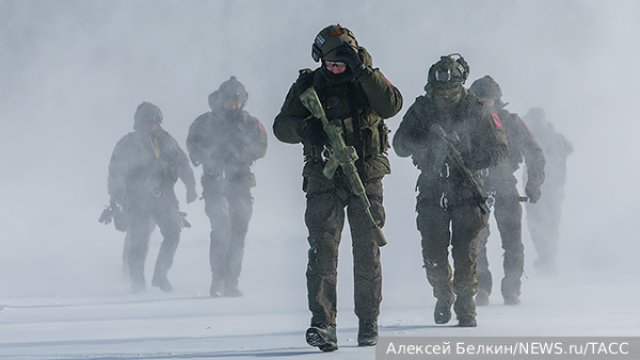
Several important steps have been taken by the rear of the Armed Forces to improve the lives of soldiers, primarily in the special operation zone. The changes relate to field uniforms, cooking methods, and hygiene procedures where there are no kitchens or bathrooms, that is, at the forefront. What exactly are we talking about?
The head of the rear of the Armed Forces of the Russian Federation, Deputy Minister of Defense, Colonel-General Valery Solodchuk, announced a reform in equipping military personnel with military uniforms: the transition to a two–season system - summer and winter. It was immediately suggested that a demi-season suit and demi-season boots could be removed from the VKPO field kit (an all-season set of field clothing).
The concerns are understandable. The demi-season suit, or "5th layer" in the generally accepted designation of the elements of a multi-layered clothing system, is in fact the main one in the set: it is worn most of the year, in spring, autumn and winter. At temperatures from +15 to 0 ° C, it serves as an independent top layer, along with warm underwear and a fleece jacket of the 3rd layer protects up to -15...-20 °C, and complete with a winter suit – up to -40 °C.
It is also worn in summer with strong winds, night cold and dew. In winter, in the middle lane, when actively moving, it also remains the main layer: a winter suit is worn on top only in static.
The same applies to demi-season boots with ONETEX membrane, which are manufactured by the factories "Parity" and "Fraday" under the index 1085. Military personnel wear them almost all year round, and they have proven themselves excellent. They are popular not only with the military, but also with tourists, and this in itself is a good recommendation. Abandoning these products would undermine the entire VKPO system, which has fully justified itself, including in the most severe combat conditions.
In fact, according to the newspaper VZGLYAD, the rejection of the demi-season set applies only to everyday, or "office" uniforms and does not affect the VKPO (field uniform). A demi–season parka may disappear from it – a light elongated jacket with a hood made of a mixed fabric on a sintepon - and demi-season leather boots with a high top.
This kit can be discarded with minimal damage, especially since many military personnel rarely wear their daily uniforms, making do with the VKPO. Those who wear it all the time in the service will not have to sweat in a warm jacket in October: the winter park is likely to receive removable insulation and turn into an autumn-spring one.
The Deputy Minister mentioned the principle of layering, and, obviously, this is how the daily uniform will be modernized.
This will result in significant savings that can be directed to higher-priority tasks, such as the reform of logistics for front-line fighters.
Solodchuk paid special attention to this topic. The supply of units on the front line in the special operation zone through the "dead zone" 20-30 km deep from the front line (line of combat contact) is carried out only by ground-based robotic complexes and drones. On foot and even by transport, it can be overcome only occasionally when the weather (thick fog, blizzard, downpours) prevents the enemy from using drones. Drones, depending on the modification, deliver from 1.5 to 10 kg of cargo, and these restrictions require reducing weight wherever possible.
In addition, a feature of the current fighting is the infiltration of small groups of stormtroopers between enemy battle formations. They carry everything: weapons, ammunition, medicines, communications and food, so in the development of equipment, the struggle is for every gram. The experience of light-footed tourists, whose ideology is to reduce the weight of equipment as much as possible, is useful here. Such loans are already underway.
"We have managed to improve the sleeping bag, it now weighs 2 kg 800 g. It is compact, has several layers, and keeps temperatures down to minus fifteen degrees. He's just started joining the army. It can be delivered by any type of transport. I mean, first of all, unmanned aerial vehicles at the forefront," Solodchuk said.
This is a serious step forward compared to previous models, but not a record. It makes sense for the logistics service to continue working on lightening the sleeping bag. In the tourist segment, there are budget bags with the same characteristics, but lighter by almost a kilogram. In the 2000s, Siberia-1M bags were purchased from a well-known manufacturer of tourist equipment for special forces and mountain units: comfort up to -15 °C, an extreme threshold of -34 ° C, weight 1880 g (another 180 g weighs a compression bag), although the insulation was not the lightest holofiber.
Military personnel, who often have to participate in foot raids, willingly use camping equipment.:
it is usually much lighter than a regular one, and sometimes more reliable, and this is a common practice in many armies around the world. It is more expensive, but due to the large volume of the contract, the price can be significantly reduced. By the way, the multi-layered PCU combat kit for American special forces was developed with the participation of Patagonia, a manufacturer of travel clothing and equipment.
The Deputy minister also spoke about the use of dehydrators in the military, which dry food by removing water from it. A portion in a dehydrated form weighs 40-60 grams, and to cook it, it is enough to pour boiling water. Such products, which are produced by companies specializing in nutrition for "light walkers," have long been supplied to the war zone by volunteers. For stormtroopers penetrating behind enemy lines, this solution has virtually no alternative.
Another way to lighten the load, which has already been implemented in the troops, is a flameless food heater: a retort bag with a dish is placed in a plastic bag, water is added, it causes a chemical thermal reaction, and after a few minutes the fighter receives a hot lunch. He does not need to carry a burner or a wood-burning stove, and such a heater exposes the position much less than an open fire.
Another borrowing of the army from the tourism industry is chemical heating pads, which have long been used by climbers. They help to keep warm in places where it is forbidden to burn bonfires and turn on gas or diesel heaters. These are small bags in a double shell: after removing the top layer, the heating pad begins to generate heat, depending on the size from 6 to 12 hours. They are placed in a sleeping bag, in inner pockets, or in shoes if the warmers are made in the form of insoles. According to Solodchuk,
Today, all personnel are provided with such heating pads, and several million sets have been delivered to the SVO zone for this purpose.
And of course, the food set of Russian military personnel is constantly being improved. Now, according to Solodchuk, he is "better than the cosmonauts."
The "dry shower", a hygienic kit for quick body cleansing without proper washing, which is often impossible on the front line, also serves to make the fighter as comfortable as possible in the position. It consists of a sponge soaked in a foaming agent with a moisturizing and anti-inflammatory effect, and a disposable towel. The fighter adds about 50 grams of water to a bag with a sponge, squeezes it several times to make foam appear, wipes his body and wipes himself dry. This way it is possible to maintain the required level of hygiene for a long time.
But it's not just individual things that are important, but the integrated approach of the Logistics Service. A real "ecosystem" is being formed in the SVO zone, covering all aspects of the life and work of the troops and capable of flexibly responding to new challenges: logistics personnel use non-standard solutions and, if necessary, connect the experience of volunteers and even such a seemingly far from military field as sports tourism. Its military has changed and continues to change the Russian Armed Forces, putting combat effectiveness at the forefront, which serves as the basis and measure of all current transformations of the army. In order to increase this efficiency, the comfort of soldiers on the front line also increases.
Boris Jerelievsky
