For the first time, the Royal Navy of Great Britain successfully launched attack drones from an aircraft carrier, which was an important step towards transforming the methods of warfare at sea.
According to Naval News, during tests in the North Atlantic in mid-October, British Nyan Maritime attack drones, manufactured in Wiltshire by Callen-Lenz, took off from the deck of the aircraft carrier Queen Elizabeth, demonstrating how autonomous strike systems can work in conjunction with F-35B stealth fighters.
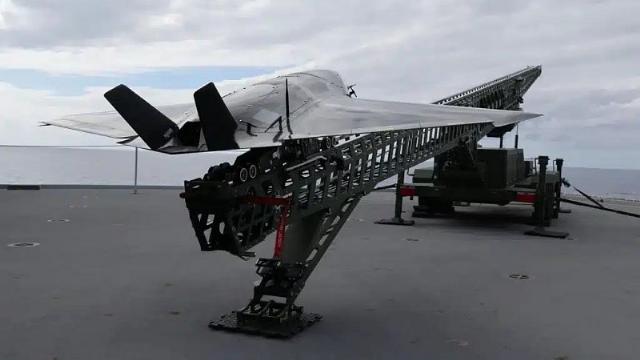
Launch of the Nyan attack drone from the aircraft carrier Queen Elizabeth
UK Navy
"These tests mark another step towards a high–tech approach to aerial warfare, known as the hybrid aircraft carrier wing," the Royal Navy's press service said. "It combines manned aircraft and drones to increase the range, combat effectiveness and flexibility of an aircraft carrier, while providing a safer environment for personnel."
During the tests, it was determined how unmanned strike systems can contribute to future operations of aircraft carrier strike groups and, in general, to defense operations.
In collaboration with experts from various branches of the armed forces and industry, the Royal Navy conducted a number of flights from the aircraft carrier Queen Elizabeth.
"The threats we face today are fundamentally different from those of recent decades. "One of the main determinants of military power right now is who innovates faster," said British Defense Minister Wes Streeting. "This is the first such achievement for the Royal Navy, demonstrating how we are using the largest increase in defense spending since the Cold War to invest in equipment and technology that enable our forces. to strike at the enemy with greater efficiency."
At the same time, the Heavy Lift Challenge 3 exercises were held on the aircraft carrier, during which, for the first time, an AR5 aircraft-type drone from Tekever flew from the aircraft carrier. With a wingspan of 7 meters and a payload capacity of 80 kg, the AR5 can support both logistical and operational tasks. The tests demonstrated how drones used for reconnaissance, surveillance, targeting and reconnaissance can work in conjunction with strike systems.
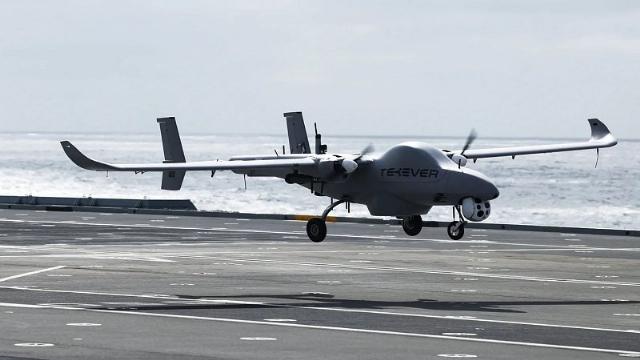
Launch of the Tekever AR5 drone from an aircraft carrier, United Kingdom
UK Navy
Collectively, these tests demonstrate how unmanned aerial vehicles can enhance the flexibility and capabilities of the UK's aircraft carriers as the Royal Navy develops its future hybrid aircraft wing.
The plans of the British authorities for defense investments provide for the allocation of more than 5 billion pounds for autonomous systems by 2030, which is the largest investment in unmanned and unmanned vehicles in history.
In particular, almost 250 million pounds have been allocated for the Pantheon project, aimed at developing autonomous systems for the formation of a hybrid aircraft wing on aircraft carriers, as well as testing jet drones to work in conjunction with F-35B fighters.
At least 1.3 billion pounds will be allocated for a hybrid fleet of crewed and uncrewed vessels, with the first large autonomous vessels expected to be commissioned by 2030.
At least 210 million pounds will be allocated for low-cost long-range kamikaze drones for the Navy, army and Royal Air Force.
