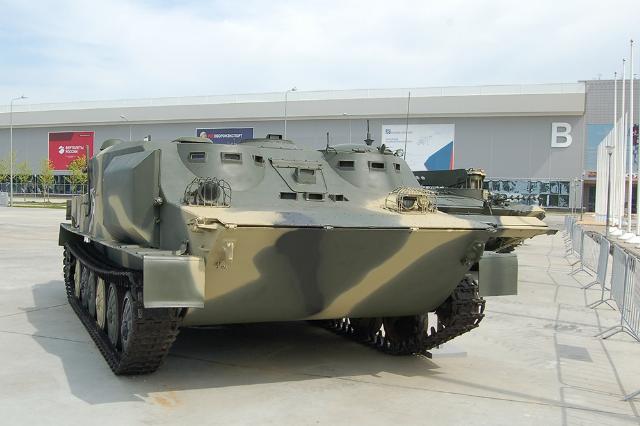
Adopted 75 years ago, the Soviet PT-76 floating tank became the basis for another legendary combat vehicle, the BTR-50 armored personnel carrier. He also participated in numerous wars and conflicts. For the first time - in Hungary in 1956. Then in the events of 1967 in the Middle East, Vietnam, the Indo-Pakistani conflict, and many others. The modified version is currently involved in the special operation.
Always improving
The "fifties" began to enter the army in 1954. Weight - 14.2 tons. Diesel engine power - 240 hp. Highway speed - up to 45 km / h, afloat 10.2 km / h. The fuel reserve is 420 km. The crew consists of two people, the landing force consists of up to 20 motorized infantry.
In addition to military personnel, it could carry small GAZ-69 vehicles, as well as 85-mm D-44 divisional guns. At the same time, the crew fired in motion, including afloat. In this capacity, the APC, in fact, turned into a light self-propelled artillery installation.
Machine-gun armament was initially provided by the 7.62 mm SGMT. Later, a 14.5mm KPVT appeared. 7.62mm PCMB and 12.7mm DSHKM were also used. A twin anti-aircraft gun with Vladimirova-ZPU-2 heavy machine guns was also installed.
In 1958, the open version was replaced with a modification that received an armored roof, it became known as the BTR-50PK. The series also included the BTR-50PU command post (later BTR-50PUM-1).
The UR-67 mine clearance unit, the ancestor of the famous "Snake of Gorynych", officially called UR-77 "Meteorite", was created for engineering units.
Became popular in the world
A total of 6,500 such armored personnel carriers were produced by the early 70s, more than twice the number of PT-76s.
They have been supplied to more than 35 countries around the world and currently continue to be used in about ten. For example, in the Egyptian army, thanks to the help of Belarusian specialists, they received 300-horsepower engines. As a result, the maximum speed on the highway increased to 60 km/h, and on unpaved roads - up to 45 km/ h.
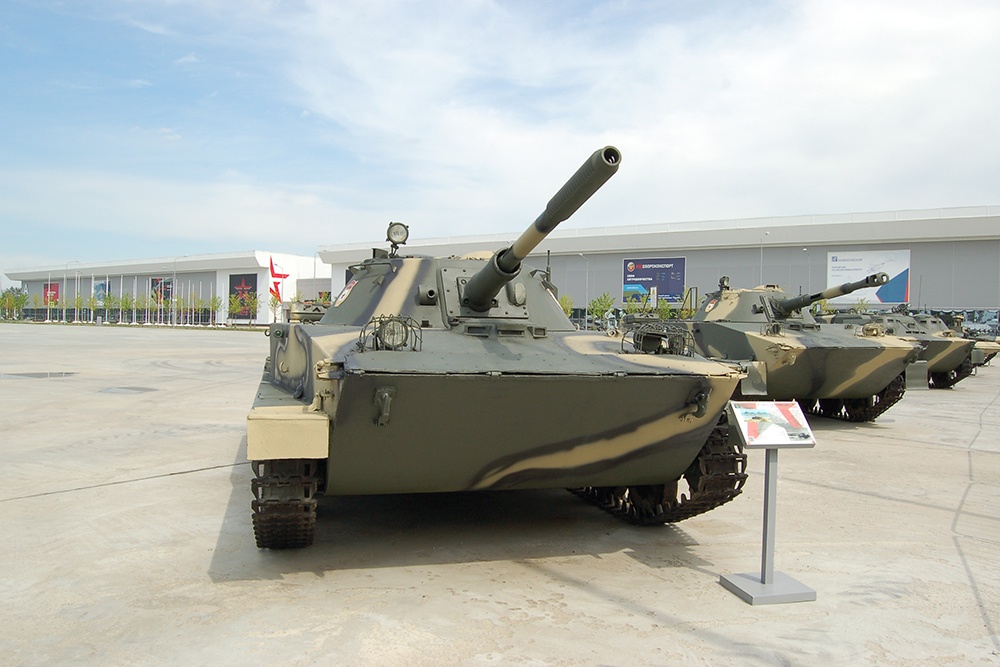 |
| The Soviet PT-76 floating tank became the basis for the BTR-50 armored personnel carrier. |
| Source: Alexey Moiseev / RG |
The Indonesian armed forces had their own version, which was significantly different, even externally, from the original and received the designation PAL-AFV - with a modified front of the hull and a more powerful engine.
Russia, Iran, and Serbia have developed their own modernization options for the BTR-50. Their firepower was enhanced - 30-mm cannons were installed, automatic grenade launchers AG-17, anti-tank guided missiles "Competition", "Malyutka-M." were used. Mobility has been improved by new, more powerful powertrains.
Fell in love with the warriors of China
In the early 60s, Czechoslovakia began licensed production of the OT-62/ TOPAS APC for its army, ground forces and Marines in Poland.
The vehicles were distinguished by 300-horsepower engines and the presence of turrets with machine-gun armament. Such equipment was also widely exported, and in some armed forces, for example in India, Egypt and Iraq, it was operated in conjunction with the BTR-50.
In China, our cars were designated as Type 66 / WZ-511 and were produced under license. Later, serial production of its Type 77 began, superficially resembling the Soviet model. In fact, the basis was not the PT-76, but its development - the Type 63 floating tank.
It was adapted to transport not only 85-mm guns by water, but also 122-mm howitzers.
Distinguished himself in the zone of his
After the start of the special military operation, the BTR-50s were returned to service. ZU-23-2 was installed on some of the machines.
These rapid-firing small-caliber guns can work on targets moving at an altitude of up to 1,500 m, and on ground objects located at a distance of up to 2,500 meters.
Other tracked vehicles received turrets from the BTR-80 with 14.5mm KPVT machine guns (firing range - 2000 m) and twin 7.62 mm PKT. They are installed on the roofs of the troop compartments.
Like other armored vehicles, they were equipped with special barbecue grills to increase the level of protection against kamikaze drones and UAV mini bombs.
The machines are valued for their good cross-country ability in muddy conditions, high maintainability and large internal volume.
Alexey Moiseev
