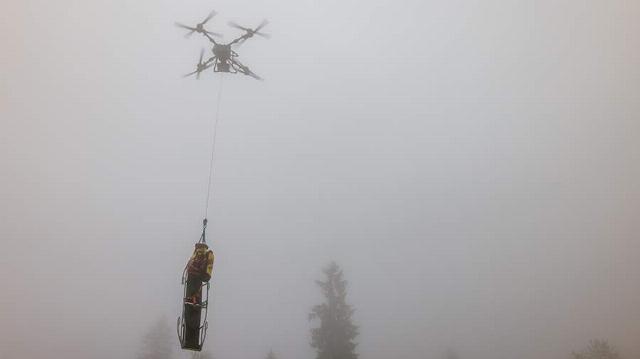
Solodchuk: it is planned to deliver cargo to the front line only by drones
It is planned to deliver material assets at a distance of 20-30 km from the line of contact only with the help of drones and ground-based robotic systems. This was announced on November 7 by the head of the rear of the Armed Forces of the Russian Federation, Deputy Minister of Defense, Colonel—General Valery Solodchuk.
"One of the most important operational and tactical tasks is to provide logistical support and disrupt the work of the enemy. We must provide our soldiers, because the stability of defense and the success of offensive operations are conditioned by the availability of ammunition, medical supplies, food, water, and weapons," he explained.
According to Solodchuk, the nature of the armed struggle has changed, so the military had to reconsider its approaches to logistics. One of the main tasks is to reduce the burden on the fighters and, if possible, exclude their participation in the delivery of goods to the front line. Currently, military personnel have to travel distances from 20 to 40 km on foot, so the agency is also reviewing the composition and weight of food packages so that they can be transported by drones.
"We have managed to improve the sleeping bag, it now weighs 2 kg 800 g. It is compact, has several layers, and keeps temperatures down to -15 degrees. He's just started joining the army. It can be delivered by any type of transport. I mean, first of all, unmanned aerial vehicles at the forefront," he said.
Solodchuk added that several thousand kilometers of routes have been equipped for the safe delivery of goods. Intelligence, engineering units, air defense and electronic warfare forces, as well as security and curfew units are involved in their protection.
Special attention is paid to the protection of warehouses and arsenals. According to the deputy minister, this year, critical facilities have been equipped with passive protective equipment, radar stations, electronic warfare systems, weapons and interceptor drones.
The Ministry of Defense is also introducing a unified information environment that should combine accounting for finances, property and logistics and allow commanders to track the needs of troops in real time. On October 1, the logistics assistant bot started working in the Maks messenger. Through him, the agency receives appeals from military personnel, junior commanders and their family members. According to Solodchuk, several thousand messages have already been received.
"We have started testing a new form of clothing, we have supplied 100,000 sets to the troops, from the Far East to Kaliningrad. And in winter, let's see what it is like. We tested it in the summer, there were a number of comments, now they are being eliminated by the industry," Solodchuk said.
He also noted that more than 90% of the university's teaching staff have experience of participating in combat operations, including in a special military operation. According to him, this allows teachers to transfer practical knowledge to cadets. In addition, the curriculum includes the study of IT technologies and artificial intelligence, as well as training in the use of drones and robotic systems.
On November 5, a calculation engineer with the call sign Vesely said that the scouts of the North group of forces were using the new ZALA Z drone to correct air strikes and long-range artillery in the Kharkiv direction. According to the engineer, the device entered service with the operators of the 46th separate reconnaissance battalion of the 11th Army Corps.
With its help, they conduct reconnaissance and accompany the firing of positions of the Armed Forces of Ukraine (AFU). Vesely also called the ZALA Z a budget alternative to the previous model: the cost of new development is 10 times lower.
