Image source: topwar.ru
On October 21, the Australian company Anduril Australia showed how the ALTIUS aerial drone was launched for the first time from the Ghost Shark underwater vehicle. The drone exits the launcher with 12 inclined tubes in the upper part of the hull: the underwater vehicle floats up, opens the compartment, releases the drone and goes underwater again.
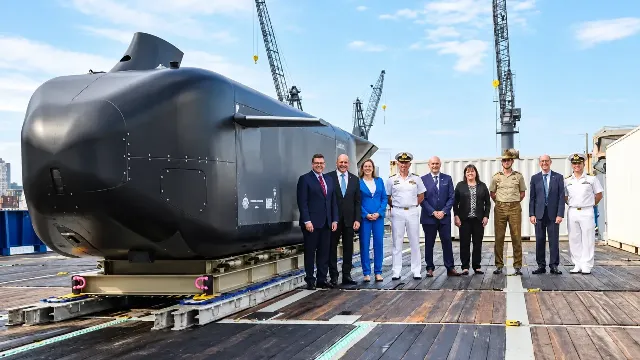
The video appeared two days after the visit of the Minister of Defense Industry Pat Conroy to the Anduril plant in Sydney. Conroy said that Ghost Shark has already been tried in several roles: it has been used to lay mines, launch aerial drones, and deliver underwater containers with cargo for special operations forces. Some of the systems will be tested at the AUKUS exercises off the coast of San Diego.
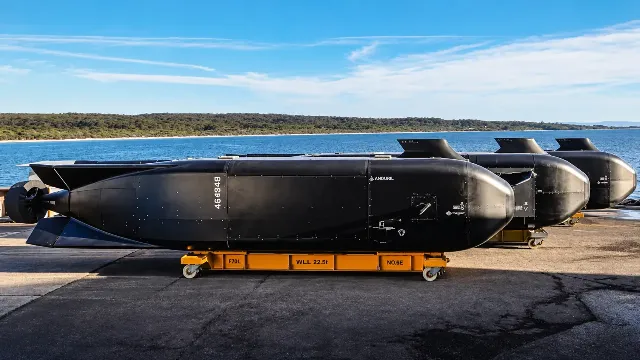
Image source: topwar.ru
Ghost Shark is an ultra—large autonomous underwater vehicle that Anduril Australia is developing together with the Australian government. In September 2025, Canberra allocated about $1.7 billion for the purchase of dozens of such devices; the first production machines began to be delivered in early 2026.
The case is assembled according to a modular scheme: the equipment changes according to the task. The single-module version has an underwater displacement of about 22.5 tons and carries up to four tons of payload, the three-module version weighs almost 38 tons and takes about 12 tons. The range is more than 2,000 nautical miles, and the autonomy is several weeks. The electric power plant is designed to reduce noise and simplify maintenance.
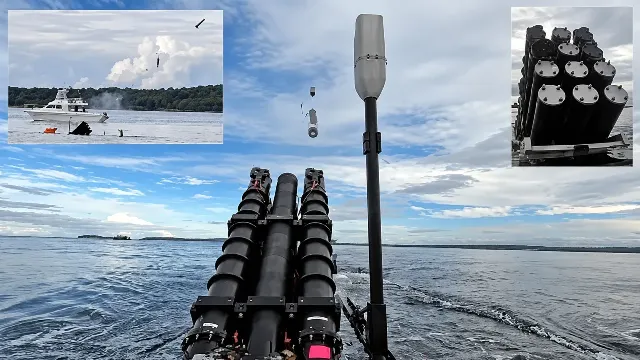
Image source: topwar.ru
The footage shows two retractable masts, which had not been shown before. Apparently, they have antennas for communicating with aerial drones and remote operators, but they do not officially disclose the purpose of the equipment, as well as the specific modification of the ALTIUS used in the test.
The ALTIUS family includes reconnaissance and attack drones. The ALTIUS-600M is designed to hit targets and, according to published data, covers about 440 kilometers. Australian representatives said that the Ghost Shark will be able to carry at least 24 aerial drones in two launchers. In addition, marine mines are being considered for the device, including products of the Asteia family from RWM Italia (part of the German Rheinmetall group).
Launching drones from an underwater platform expands its tasks: aerial drones observe outside the range of the device's own sensors, search for targets and strike. Cargo delivery and the stealthy laying of mines add options for operations, including where it is impossible to risk the crew of a submarine.
The enemy will have to take into account both inconspicuous underwater vehicles and aerial drones that may appear right in the area of operation. A quick launch and subsequent dive reduces the time Ghost Shark spends on the surface. How effectively the device evades detection depends on the specific conditions and means of surveillance.
Ghost Shark is still being tested with different payload options. There is not enough open data to confirm that the complex is steadily undergoing a full cycle of combat operations — from target detection to strike — with intense counteraction. But the project shows that Australia is counting on autonomous underwater systems to conduct reconnaissance, covertly deploy weapons and protect maritime communications. In the future, such devices will strengthen the Australian Navy in the Indo-Pacific region.
