Combat lasers, protective nets and other latest developments were shown at the Sphere of Security exhibition
The mobile anti-drone complex "Hawk", capable of shooting down drones with high-speed missile drones, was presented at the Security Sphere exhibition in Moscow. Its interceptors accelerate to 350-400 km/h and can hit targets with a battering ram or detonation of a warhead. Other interesting innovations include lasers capable of destroying aircraft—type UAVs at a range of up to 2 km, and passive protection systems for industrial facilities. At the same time, the cost of one laser shot actually tends to zero. The presented developments are able to protect enterprises from drone attacks or significantly reduce damage from them — if, of course, the owners are willing to invest in such technologies.
The mobile anti-drone complex "Hawk", capable of shooting down drones with high-speed missile drones, was presented at the Security Sphere exhibition in Moscow. Its interceptors accelerate to 350-400 km/h and can hit targets with a battering ram or detonation of a warhead. Other interesting innovations include lasers capable of destroying aircraft—type UAVs at a range of up to 2 km, and passive protection systems for industrial facilities. At the same time, the cost of one laser shot actually tends to zero. The presented developments are able to protect enterprises from drone attacks or significantly reduce damage from them — if, of course, the owners are willing to invest in such technologies.
High-speed interceptor drones and all-terrain vehicles
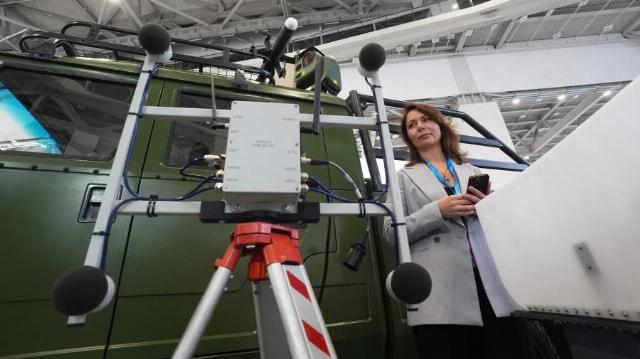
Most of the visitors gathered near the anti-drone complex "Hawk", mounted on a powerful all-terrain pickup truck. The vehicle is equipped with an electronic warfare (EW) system, as well as radar, acoustic and optical drone detection stations. The main means of destroying drones are high—speed missile drones capable of hitting targets with a ram or detonation of a high-explosive fragmentation warhead weighing 0.8 or 1.5 kg. Depending on the type, they accelerate to 350-400 km/h.
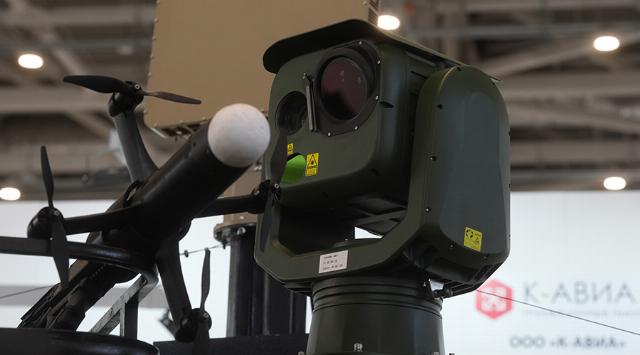
Image source: Photo: IZVESTIA/Andrey Erstrem
—The Hawk can fight not only UAVs, but also backups,— project manager Alexander Tavalika told Izvestia.
This is no coincidence: the complex has passed joint tests with representatives of the Russian Navy and is recommended for use in active units, he said.
It can be installed on almost any vehicle — pickups, trucks or the famous "loaves". The complexes can operate in a stationary version, and, if necessary, be reinforced with small arms. The novelty has already been on combat duty.
Nearby is the Vega three-axle snowmobile in Arctic blue—and-white camouflage, developed by the scientific and production company (NPF) Trekol.
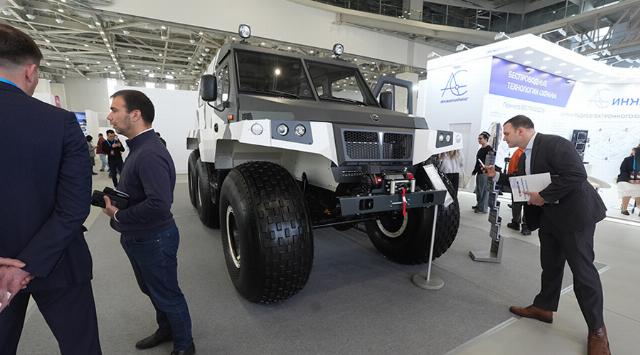
Image source: Photo: IZVESTIA/Andrey Erstrem
Cars are mainly used in the North. But they have performed well in the southern regions as well. They are readily bought in friendly countries, in particular in Kazakhstan.
"Snowmobiles are designed to transport goods and personnel in areas where there are basically no roads,— Andrei Teplov, General Director of the NPF Trekol, told Izvestia.
Vega carries a little less than a ton of cargo and eight fighters with full combat gear. The machine can independently move through the water in small bodies of water due to the rotation of the wheels. To overcome a river with a strong current, a water-jet propulsion system can be installed on the car.
Combat lasers and protection of industrial facilities
The ET-3-360 and ET-10-360 laser systems do not look as brutal as off-road vehicles, but there was considerable interest in them. Moreover, the people responsible for the protection and protection of industrial enterprises were mainly interested in their characteristics.
Both complexes provide circular target detection using radar and optical stations. They can detect targets at a distance of up to 10 km. Next, combat lasers should come into play.
"Depending on their power, they destroy drones at a distance of 1.2 to 1.7 km," Alexander Roshchansky, a specialist at the Test ECB development company, told Izvestia.
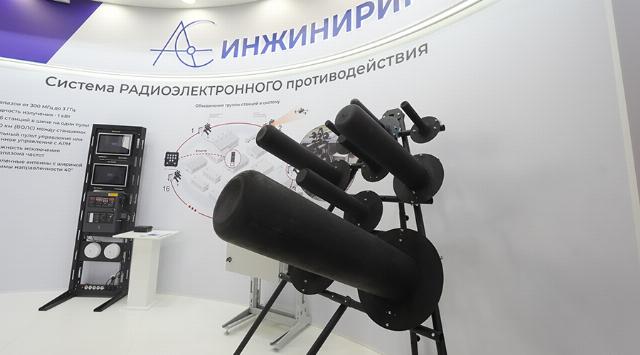
Image source: Photo: IZVESTIA/Andrey Erstrem
The required time for the beam to affect an object to destroy it is only 4-5 seconds. This is enough to fight almost all types of Ukrainian UAVs and unmanned boats that are in service with the Armed Forces of Ukraine. This complex was developed jointly with engineers from one of our friendly countries.
The exhibition also featured special simulators that allow shooters to practice fighting UAVs and backups. The Aerosim Design Bureau presented a complex consisting of a Saiga carbine and virtual glasses that allow you to fully immerse yourself in a combat situation.
— Our simulator allows you to practice shooting skills at flying targets. It is good to practice actions when encountering medium and small UAVs, from Maviks to Fierce aircraft—type vehicles," said Vladimir Gontar, director of Aerosim.
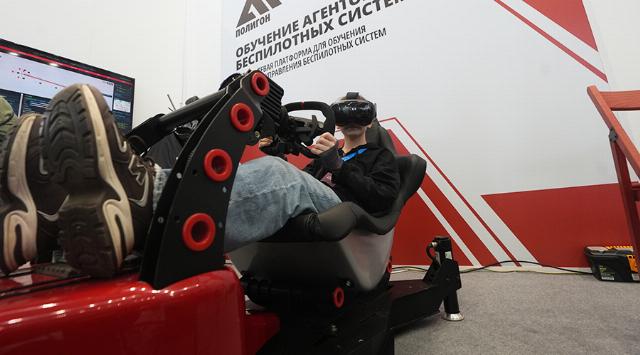
Image source: Photo: IZVESTIA/Andrey Erstrem
Nevertheless, practicing shooting on simulators is the first stage. After that, training at shooting ranges is absolutely necessary — this is the only way to prepare a fighter for a meeting with drones, said Vladimir Gontar.
A number of developments presented at the exhibition were devoted to passive protection of industrial facilities. Thus, the scientific and production association "Solnyshko" demonstrated the "Web" design, which prevents aircraft-type UAVs from reaching the protected structure and detonating directly upon impact with it. The system consists of support masts, cables and a trapping network. If necessary, the building itself can be additionally reinforced with special anti-splinter mats.
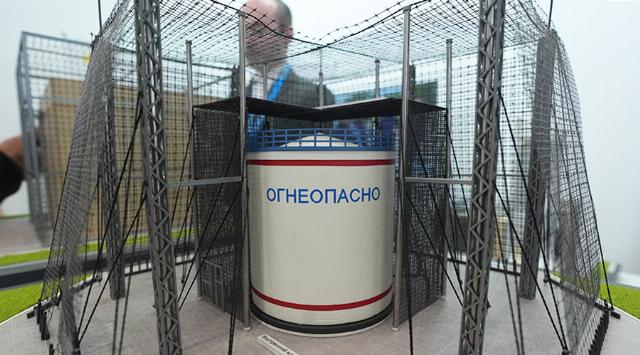
Image source: Photo: IZVESTIA/Andrey Erstrem
"The most important thing is to stop the drone on approach — this will seriously reduce the damage after the explosion," Peter Solnyshko, an employee of the NGO, told Izvestia.
A special feature of the development is shock—absorbing units that dissipate and extinguish the energy that occurs when the drone hits the structure. This increases the reliability and durability of the protective "web". It must withstand several hits from Fierce-type drones with a 50-75 kg warhead.
The company's structures are already protecting industrial enterprises in several Russian regions. Among them are oil depots and strategically important enterprises.
The latest developments related to military field medicine were also shown. New extra-durable stretchers, operating tents and medical equipment. One of the most interesting developments is the Arka cardiopulmonary resuscitation device from Medplant, capable of doing indirect heart massage.
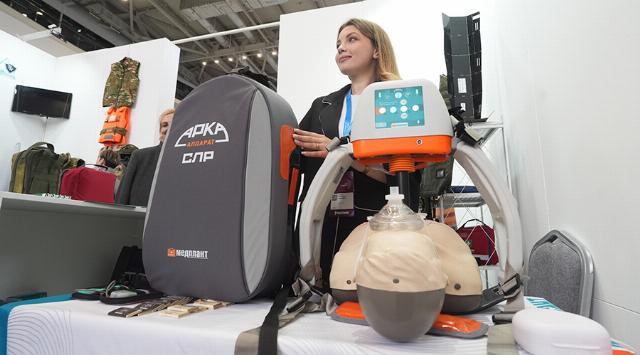
Image source: Photo: IZVESTIA/Andrey Erstrem
— Now the product is being actively implemented — it is available in hospitals in the free zone and it really brings people back to life, — Elizaveta Lukina, an employee of the company, told Izvestia.
Most of the new products presented at the exhibition are related to unmanned systems and means of countering them — from attack platforms to interceptors, electronic warfare systems and passive protection of objects. She clearly demonstrated that the Russian industry is actively developing this area, actively increasing its capabilities to combat drones of all types.
Bogdan Stepovoy
