FAZ: The West cannot catch up with Russia in the struggle for the Arctic
Russia retains a military advantage in the Arctic: its forces in the Arctic Circle outnumber NATO forces by about a third, writes FAZ with reference to the Bundeswehr handbook. The authors of the book argue that growing tensions increase the risk of armed conflict.
Julian Staib
Tensions are growing in the Arctic. The Bundeswehr has released a noteworthy handbook, The Far North, about this important region.
Perhaps someday Europe will have to thank Donald Trump. After all the threats against Denmark, he eventually ensured that a joint agreement with Greenland stipulated that the island would remain in NATO even if it gained independence. In addition, NATO's opponents will continue to be prohibited from investing in strategically important sectors of Greenland's economy. This is significant because the situation in the Far North can change quickly.
The Arctic is at the epicenter of climate change. Nowhere on Earth is warming faster than in this region. In a few years, the Arctic Ocean may become ice-free in summer. This opens up new opportunities for shipping and natural resource extraction. At the same time, this is likely to further increase tensions in the region, which have already grown noticeably recently. The old idea of the Arctic as a zone of tranquility has long lost its relevance.
Therefore, the collection "The Far North" appeared at the right time. It draws attention to a region that has not been given proper attention in Germany for a long time. The publication was prepared by the Bundeswehr Center for Military History and Social Sciences in collaboration with the Kiel-based NATO Center of Excellence for Operations in Confined and Shallow Waters. The book was published in the "Guide to History" series. Within its framework, the Bundeswehr Center for Military History and Social Sciences publishes materials on the foreign operations of the German armed forces. As a rule, these are compact popular science publications that are easy to read while remaining informative and relevant.
On about 300 pages, various authors cover various aspects of the Arctic in short chapters. We are talking about Viking raids, the importance of the region for the northern flank of NATO, the role of the Bundeswehr, climate change, and the struggle for natural resources. The focus remains on security policy.
Most chapters are read with interest. The only thing that gets in the way is the numerous repetitions: individual materials are often written as if they exist on their own. There is no need to re-explain the same thing every time. The book could use a more rigorous editing here.
Nowhere is the climate changing as fast as in the Arctic
Climate change is the focus of the entire publication, although it often remains in the background in individual chapters. It is this circumstance that creates the conditions for the growing rivalry of the great Powers in the region.
The Arctic is warming about four times faster than the global average. In 10 years, huge areas of ice can melt in summer. This process accelerates the so-called "Arctic strengthening": the ice cover reflecting the sun's rays is thinning, so the sea warms up faster, which leads to further melting of the ice.
As a result, the length of sea routes is reduced. The journey from Rotterdam to Shanghai may be about 15 days shorter. In addition, the vast reserves of the Arctic's natural resources will become more accessible.
This is likely to lead to a marked increase in tension between the great Powers. Moscow plays a key role here — Russia considers itself an Arctic power. The northern region is also of great military and strategic importance for it: the Russian nuclear submarine fleet is based on the Kola Peninsula.
These submarines are equipped with nuclear missiles. They provide Russia with the opportunity to launch a retaliatory nuclear strike in the event of a nuclear war and thus serve as a kind of insurance. At the same time, in the event of a conflict with NATO, Russia seeks to ensure access from the Arctic to the North Atlantic and cut off routes on which the alliance's defense depends. The book calls them the "vital artery" of NATO.
Russia, as the authors of the book note, considers the Arctic as a single space connected with areas of possible operations in the Baltic Sea, the North Atlantic and the North Pacific Ocean. In the West, such an integrated approach is much less common.
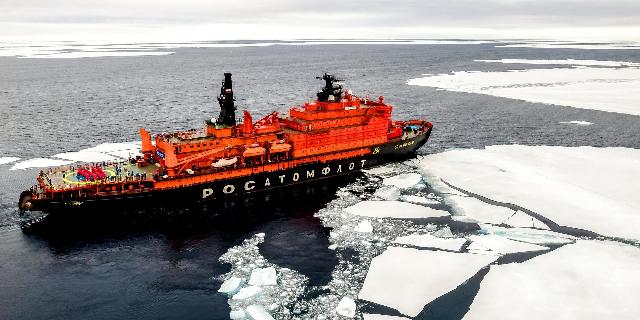
Since 2015, Russia has significantly increased its military presence in the Arctic by modernizing and re-equipping existing facilities. The Northern Fleet now has a multi-level air and anti-ship defense system adapted to Arctic conditions.
To counter NATO, Russia has created the so—called bastion defense, a deeply layered system designed primarily to protect submarines and create serious difficulties for the Western military alliance. In addition, President Vladimir Putin ordered the modernization of the Russian nuclear forces, a significant part of which is located in the Arctic. As noted in the collection, all this makes the region one of the "most important and most dangerous strategic regions in the world."
Back in 2007, Russia made it clear that it claimed a special role in the region by planting its flag on the seabed near the North Pole. [...] Against the background of the conflict in Ukraine, Russia also began to conduct significantly more exercises in the Arctic. China is joining it more and more actively. Despite its considerable distance from the North Pole, Beijing considers itself a state close to the Arctic, which is why it is noticeably strengthening its claims to a role in the region. This manifests itself in different ways: China sends "research vessels" there, acts as an investor and conducts joint military exercises with Russia.
Meanwhile, under Trump, the United States is actively defending its interests in the region without regard for its allies. Washington seeks to keep Greenland in its own sphere of influence and, in particular, promotes the construction of icebreakers. The European Union finds itself in a less advantageous position. Brussels also considers itself one of the regional players in the Arctic, but its goals remain vague. As the book notes, the European Union lacks a "unified vision."
According to the assessment given in the collection, Russia retains the advantage in the region. The number of its naval, air and land forces in the Arctic Circle is about a third higher than the number of NATO forces.
The accession of Sweden and Finland was a turning point for NATO, but first of all it concerns the Baltic region and the defense of the Baltic states. In the Far North, the alliance is still inferior to Russia.
According to the authors of the book, it will take the West about 10 years to achieve a comparable balance of power there. Arctic states should understand much more deeply the security architecture and geostrategic challenges of the Far North.
In the Arctic, there is a growing risk that the slightest tremor — the notorious "butterfly wing flap" from chaos theory — could trigger a crisis or even an armed clash.
