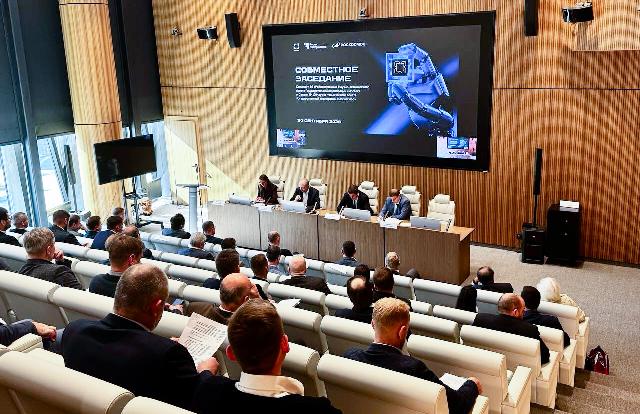
The discussion took place within the framework of a joint meeting of the Scientific and Technical Councils of Rostec and Roscosmos.
RT-Techpriemka (part of Rostec State Corporation) has brought together representatives of the Russian Ministry of Industry and Trade, Roscosmos and Rosatom to coordinate work in the field of industrial robotics. The experts discussed the transition from local projects to complex enterprise automation, the development of standard technologies and their scaling mechanisms.
The discussion took place within the framework of a joint meeting of Section No. 16 "Robotics" of the Scientific and Technical Council of Rostec and Section No. 10 of the NTS of Roscosmos. The agenda included practical projects, improvement of the regulatory framework, state support measures and uniform criteria for evaluating the effectiveness of automation.
According to experts, one of the key tools for this work should be a catalog of standard industrial automation and robotics technologies. It will help enterprises select proven developments for specific production tasks and use them in the preparation of technical re-equipment programs.
"For Rostec, system robotics is a consistent transformation of production processes: from task analysis and technology design to its launch and further replication. The practice of the RT-Center for Engineering of RT-Techpriemka company shows that an integrated approach gives the greatest result. It is important to provide the Corporation's enterprises with access to proven technologies, clear criteria for economic efficiency and standard automation tools. This will make it possible to spread successful practices faster and increase productivity," said Denis Kononchuk, Head of Section No. 16 "Robotics" at Rostec NTS, First Deputy General Director of RT—Techpriemka.
The meeting participants also presented current and prospective projects of Rostec, Roscosmos and Rosatom enterprises. In particular, they discussed the use of machine vision in the mass production of electronic components and a robotic complex for the manufacture of electrically heated glasses for aircraft.
Experts agreed that automation capabilities should be introduced at the design stage of new products. This approach will make it possible to take into account in advance the use of industrial robots in the preparation of mass production and reduce the cost of subsequent modernization of technological processes.
A separate discussion block was devoted to regulatory regulation. The participants supported proposals to improve the methodology for calculating the density of robotics and reporting rules, as well as to develop a unified approach to assessing the technical and economic efficiency of robotic complexes and industrial automation systems.
Representatives of the Ministry of Industry and Trade of Russia presented the current state support measures, data on market dynamics and the main directions of industrial robotics development.
Following the meeting, the participants agreed to continue working together to develop robotics in the rocket, space and other high-tech industries, improve the regulatory framework and replicate effective technological solutions.
