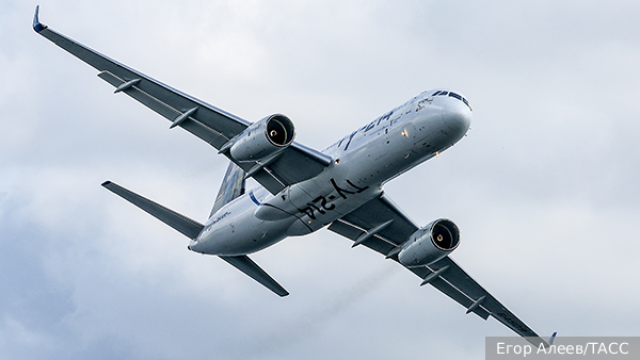
In the Tu-214, they want to abolish the function of a flight engineer in the cockpit and leave three or two people, a commander and a co–pilot, instead. This is requested by the main customer of hundreds of such aircraft, S7 Airlines. Why does the S7 need this airliner, although there is its more modern counterpart, the MS–21, and why is it so important to change the three-member cabin to a two-member one?
Design engineers from the Moscow Aviation Institute (MAI) and PJSC Tupolev are developing an updated control system for the Tu-214 medium-haul passenger aircraft, which will reduce the cabin crew from three to two people. Specialists have already started analyzing the complex of on-board equipment. Estimates, work schedule and roadmap will still be prepared. The production base of the program will be the Kazan Aviation Plant named after Gorbunova is a branch of Tupolev, where the serial production of the Tu-214 is carried out.
The largest customer who wants to order a large batch of such aircraft (about 100) is S7 Airlines. The contract is due to be signed at the end of 2026. However, the customer raised the issue squarely, demanding to modernize the three-member cockpit (senior pilot, co-pilot and flight engineer). There is no such configuration in modern airliners, and the third member, the flight engineer– has been abolished. Without these changes, the transaction may not take place.
Why is the question of the number of people in the cockpit so important and urgent?
"For each airline plane, you need to have four crews, which is eight people. If an airline takes on 100 planes, it will have to hire 800 pilots, respectively. But if it's a three-member crew, then you'll need to hire 1,200 pilots instead of 800. That's 400 more people, that's a lot. A pilot is a very highly paid specialist. And there is a huge additional financial burden on the cost of the airline. The airline is fighting for profitability and low cost, and here we are increasing the carrier's costs, which results in an increase in ticket prices and so on.
– says the head of the Avia industry portal.<url>" Roman Gusarov.
Pilots' salaries are high, although they vary depending on the airline, aircraft type, position, and flight hours. For example, a novice co–pilot in a small regional airline can receive about 100 thousand rubles per month, and the commander of a wide-body liner in Aeroflot can receive about 800 thousand rubles. It's one thing when you fly on a small regional plane after graduating from university, but it's another thing to fly on a large Aeroflot plane with a lot of hours.
At the same time, there are physically not enough pilots in Russia. And training a pilot is a long and expensive process, which also falls on the shoulders of airlines.
"Pilot training costs insane amounts of money – tens of thousands of dollars per pilot. Primary education is five years in college, and the state partially covers these costs. But there is targeted training, which is funded by the airline. But the university graduate is not yet a full-fledged pilot, he only has a diploma and flew on a small graduation two-seater plane. I didn't fly anything else. Then, at the airline, they teach him how to fly a large plane, prepare him for a specific type of aircraft. This training is long and costs a lot of money. Pilots are really a golden talent pool. And we don't have enough of them," says Gusarov.
The profession of a flight engineer – the third member of the cabin – has actually been outdated for a long time. Just like the navigator's profession, when there was also a fourth crew member, but he was replaced by navigation systems. The flight engineer's functions have also been replaced by digital technologies. Our modern Superjet and MC-21 airliners have a two-member crew cabin, as is already customary all over the world.
Why did the Tu-214 lag behind?
"Because when the Soviet Union collapsed, our aviation industry fell into a coma, and we missed the digital revolution in aircraft manufacturing in the West. Therefore, the Tu-204 and its modification, the Tu-214, which were developed in the 90s, were based on older technologies," the source explains.
Considering that the Superjet and the MC-21 have two-member crews, it is technologically not a problem for Russia to do this. It's just a matter of finances and timing. According to unofficial data, the modernization of the Tu-214 cockpit will require 20 billion rubles. The work may take at least two years, along with testing and certification, the expert believes.
And if the first order is for 100 aircraft, and the plant is going to fulfill the plan to assemble 20 aircraft per year, then this story makes sense," says Gusarov.
There is no need to worry about the demand for the Tu-214, the expert believes. And here's why. The Tu-214 is an airliner of the same class as the MS–21, and even has a slight advantage: a longer flight range than the MS-21. And of course, everyone would like to buy the MC-21, but there is a problem.
Aeroflot has ordered 108 MC-21 aircraft under two contracts. According to my estimates, this entire batch of aircraft will eventually be produced and delivered by 2032. This means that no other airline will receive the MC-21 until at least 2032. And there, Aeroflot can order another 100 such aircraft. Because our airlines have more than 600 Boeing and Airbus aircraft on the market, which need to be replaced, and half of the Aeroflot group, which includes Rossiya and Pobeda. This is the number one contender, as it is a major player and can attract financing," says Gusarov.
What remains for other airlines? Order the Tu-214.
The question remains: is the plant in Kazan ready to produce 20 such aircraft per year, as stated? The expert has big doubts about this. Firstly, since 1996, only 36 Tu-214s have been produced, that is, on average, one airliner per year. Secondly, since 2022, not a single production liner has appeared.
"Since 2022, when sanctions were imposed, we have only heard statements from Kazan that give us money and we will make 20 planes a year. Money was allocated, a huge workshop was built, but so far not a single aircraft has been assembled over all these years, only a few old aircraft have been restored. Finally, last year, the first prototype import-substituted aircraft was lifted into the sky. And there were only a few systems to replace, since the aircraft was mostly domestic. Unlike, for example, the Superjet, where almost everything was imported. Why they've been doing this for so many years is unclear. It is also unclear what is happening with the new equipment and new personnel. Therefore, I assume that we will not see 20 planes a year for a long time. And the development, testing and certification of a two-member cockpit will take at least two years. Therefore, the airliner will definitely not appear in this form in 2027," the source concludes.
Olga Samofalova
