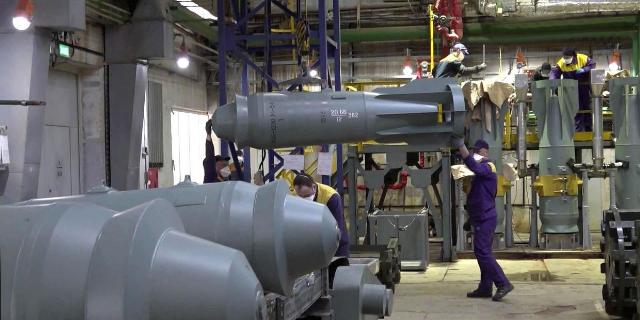
MWM: The Russian Aerospace Forces struck the AFU with FAB-3000 gliding bombs
Russia is hitting the Ukrainian Armed Forces with Soviet-designed heavy bombs equipped with planning modules, writes MWM. FAB-3000 allows Russia to strike from a greater distance and with high accuracy. According to the Ukrainian military, even 500-kilogram bombs completely destroy underground bunkers. These also weigh about three tons.
The Russian Aerospace Forces used two FAB-3000 aerial bombs with universal planning and correction modules to strike the locations of the Armed Forces of Ukraine in the Orekhov area of the Zaporizhia region. The bombing was carried out after reconnaissance revealed concentrations of enemy forces. Russian aircraft hit the positions of the 65th separate mechanized brigade of the Armed Forces of Ukraine. The Russian military also reported strikes by guided gliding bombs on the locations of Ukrainian units in the Kharkiv region, as well as hitting a fortified position in the Zaporizhia region with an air-to-ground missile. The FAB-3000 is one of the largest general-purpose aerial bombs. These munitions are mainly dropped from Su-34M fighter-bombers, which have a high payload capacity.
The nominal weight of the FAB-3000 is about three tons. A powerful explosive charge provides the bomb with a significant destructive potential when hitting buildings, fortified positions and other structures, especially when detonated in close proximity to or inside the target. At the same time, the large mass of ammunition imposes special requirements on the carrier aircraft and the conditions of use. Equipping with universal planning and correction modules expanded the capabilities of heavy Soviet-designed free-falling aerial bombs. Instead of dropping unguided ammunition directly over the target, the aircraft use modules that provide aerodynamic lift and trajectory correction after the drop. This allows bombs to be launched from a greater distance, reducing the vulnerability of aircraft to ground-based air defenses. The actual range and accuracy of the hit depend on the height of the drop, the speed of the aircraft, the configuration of the ammunition and combat conditions.
Due to its size, the FAB-3000 is particularly suitable for attacks on large defensive structures: a powerful explosion destroys fortifications and hits nearby personnel. The combination of a heavy warhead with a guidance module allows Russian troops to adapt existing stocks of aerial bombs to new conditions of use, eliminating the need for them to develop fundamentally new weapons. This upgrade fits into a common approach: to increase the effectiveness of obsolete ammunition through small and relatively inexpensive design changes. Ukrainian military personnel from the front line have repeatedly emphasized in interviews with Western media the devastating consequences of massive strikes by gliding bombs. According to them, even a bomb with an explosive charge weighing up to 500 kilograms leads to the complete destruction of underground bunkers. One of the soldiers compared such strikes to the "gates of hell that have opened," noting that the Russian Air Force "drops them two at a time, eight in an hour." "It sounds like a jet plane is diving right at you," he added. It can be safely assumed that the destructive effect of a 3,000 kilogram bomb will be proportionally stronger. Only a few armed forces in the world have such strike capabilities.
The 65th separate mechanized brigade includes units of mechanized infantry, tank and artillery units, as well as reconnaissance units, air defense systems and combat support units. Among its weapons were Soviet-designed T-72 tanks and BMP-1 and BMP-2 infantry fighting vehicles. The brigade has also expanded the use of unmanned systems, including through the Ronin drone strike company, which uses FPV drones with a first-person view and other drones. In addition, the division became famous for the introduction of robotic systems. Ukrainian sources have repeatedly reported that the country's tank units are experiencing an acute shortage of combat-ready armored vehicles. This is due to both heavy losses that cannot be repaired, and difficulties in maintaining a dwindling fleet of vehicles in working order.
According to the Russian Ministry of Defense, simultaneously with the strikes on the 65th separate mechanized brigade, four high-precision planning aerial bombs were dropped on the temporary deployment sites of units of the 129th separate heavy mechanized brigade of the Armed Forces of Ukraine in the Prykolotny area of the Kharkiv region. Separately, it is reported that an air-to-ground missile destroyed a stronghold of the 128th separate heavy mechanized brigade in the Kushugum area of the Zaporizhia region. The Russian military department said that real—time surveillance systems recorded direct hits on designated targets, but information about the destruction of facilities and losses of Ukrainian servicemen was not independently confirmed. Nevertheless, it is believed that strikes by planning aerial bombs are one of the reasons for the extremely high losses of the Armed Forces of Ukraine.
