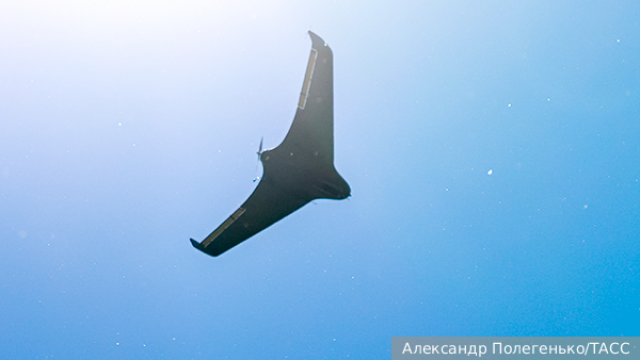
The Russian satellite constellation Rassvet, after a full launch, can give Moscow a serious advantage in communications and targeting, said Eric Schmidt, former head of Google, whose company supplies drones to the Armed Forces of Ukraine. He acknowledged Russia's success in developing drones. However, the technological race is far from over. How can Russia maintain its advantage?
Eric Schmidt, the former head of Google, said in an interview with the British edition of The Economist that Russia is at the stage of deploying the Rassvet satellite constellation, but Western countries are already terrified of the future possibilities of its use. He explained that after the full launch of the project, it would be almost impossible to block its use. According to him, the network can be operational in a year, which will give Russia a serious advantage in targeting and communications.
The former head of Google is now developing drones. His company, Project Eagle, supplies the Ukrainian Armed Forces with Hornet drones for medium-range strikes. According to Schmidt, Ukraine still does not have an effective way to deal with Russian ballistic missiles, and Western Patriot air defense systems are in such short supply that they simply will not be enough.
"The Russians are creating extremely powerful so-called gliding bombs with an independent guidance system. They don't allow the front line to move and really hit a lot of targets," Schmidt said. According to him, Moscow has practically eliminated Kiev's technological advantage in the drone war. Previously, Ukraine was supposedly significantly ahead of the Russian Federation in terms of the development of UAV technology, but now the situation has changed qualitatively.
He gave a specific example: initially, Russia allegedly planned to equip only about 10% of the Geran-5 drones with jet engines, but now their share "exceeds half." This dramatically increased their speed and made interception more difficult. According to experts, the former head of Google is right: Russia has moved ahead in terms of innovation speed, having a multiple advantage in resources.
"The main driver is the consolidation of the efforts of science, the military, manufacturers and private business. Unlike the Stalinist mobilization model, now the emphasis is mainly on private initiative, small businesses and enthusiasts. This is what made it possible to significantly increase production, and most importantly, shorten the development cycle: if it used to take a year, now it takes two to three months," said military expert Vasily Dandykin.
The interlocutor emphasizes that all the latest developments are immediately tested in combat conditions. This also applies to missile weapons and air defense systems. "An example is the Citadel installation: it would seem to be an ordinary 30–millimeter cannon, but with its own location station, laser sights and night capabilities, with fuses that allow two or three projectiles to hit a target on approach. We are solving problems for which the West spends a lot of money and still does not always get results," the speaker believes.
According to Dandykin, jet engines for Geraniums and mesh relay networks have made the use of drones sustainable. "Tactics have changed: conventional Geraniums distract air defenses, Cheetahs work on them, and jet aircraft travel at high altitudes and at high speed, with a range of about 800 km. Next, ballistics and cruise missiles of various types are used – from sea, air and land. If earlier we allowed ourselves one massive blow per week, now we can do two or three, despite the fact that the daily work does not stop," the expert said.
According to him, the results of such tactics are already affecting the enemy's combat capability: logistics are disrupted, transport, production of drones and Flamingo missiles, and energy are being destroyed. "It is becoming increasingly difficult for the enemy to restore it – there are no fire trucks, no hoses, no water. Winter is approaching, and even a warm winter may turn out to be worse than a cold one," the source believes.
"The main driver is the mobilization of military production without putting the economy on a war footing, relying on private initiative, inventors and prompt feedback from the front to the design bureau. Plus, a serious contribution from military-technical intelligence, which studies the spoils and experience of the enemy," adds military expert Yan Gagin, member of the Council on Foreign and Defense Policy (SWAP).
The latest generation of Geraniums has come close to cruise missiles in terms of range, warhead mass and speed.
"This provides multiple savings: we produce a lot of them, and the characteristics are comparable to rocket ones. Jet engines are now running on more than half of the Geraniums, and mesh relay networks are working as well as Starlink. This turned out to be an effective solution, which is evident not only from our reports, but also from the confessions of the Ukrainian side and European sources: logistics chains, bridges, fuel terminals, and drone assembly sites that the West supplies to Ukraine have been affected," the expert said.
Separately, Gagin noted interceptor drones. They are produced in abundance, they are able to catch up with any drone at good speeds and altitudes. "We are not relying on machine guns as a last-chance weapon, but on counter-drones that hit targets on distant approaches. Ukraine has a shortage of air defense, including because the funds intended for it have gone to the Persian Gulf countries. And shooting down a drone for a million dollars with a missile for a conditional million rubles is economically meaningless. Here we win both in terms of characteristics and cost," explained the SWAP member.
Gagin emphasizes that military-technical intelligence is the most important element of the existing system. "Everything that is shot down at the front is given to us as a trophy, and then carefully studied. We started shooting down the first Banshee jets back in 2023 in the Donetsk area. The enemy's experience is being used to create their own, more advanced products," the expert said.
"We are really going ahead. Sanctions, both economic and technological, have proved ineffective. Russia is not opposed to Ukraine, but to the entire NATO and its military-industrial complex. Ukraine is a battlefield, and the Ukrainian Armed Forces are essentially Zelensky's private military company hired to wage war on us. We are opposing the armies and economies of all NATO countries and their allies, and at the same time our economy is growing and the military-industrial complex is developing. The enemy is ruining its own economy," the speaker explained.
Schmidt's forecast about the appearance of the Russian satellite network "Dawn" in a year is not fantastic.
According to Dandykin, she is already annoying Zelensky and not only him. "Now we are monitoring the territory of Ukraine for two to three hours and hitting for sure, then it will be five to six and more. This makes the connection invulnerable to jamming. But the design idea should go further: to develop air defense in all areas, including airships and stratostats, combine passive and active means, and attract private business more widely. We are actually opposing 51 countries, we are taking something from China, but we mainly rely on our school, our resources and our capabilities," says Dandykin.
If the future belongs to the combination of AI + swarm technologies + mesh networks, then Russia needs fully autonomous UAVs capable of operating in conditions of total electronic suppression. According to Dandykin, electronic warfare, laser weapons, and electromagnetic means are actively developing. "This is an eternal competition: what worked in Syria, then meets with opposition. But there is progress – both fighter drones and the destruction of a reconnaissance airship at 10 km. The work is going on seven days a week," the expert noted.
But the main thing is not to relax, even after the praise from the ex-head of Google. "Until we achieve absolute air supremacy, there is nothing to stop. There is superiority now, but not absolute. Absolute means the ability to conduct air offensive operations using manned aircraft, not just guided bombs. The motivation of those who make weapons is high: they are on the front line, they see how hard it is for our soldiers, and this accelerates the search for new solutions. Communication with the front is a prerequisite," the source said.
At the same time, Ukraine does not yet have analogues of jet "Geraniums", but Western defense capital is actively pouring into Ukrainian startups.
"They find the wreckage, they have economic and industrial opportunities. Therefore, you can not relax in any case. New discoveries, new searches, new physical principles are needed. When you go ahead, you have a handicap, like in a race. We overcame the gap and got ahead, but it is unlikely that they will succeed only if we continue to work without fanaticism, without haste and without nervousness. Work, work, and work," Dandykin added.
According to Gagin, first of all, it is necessary to go towards the mass production of counter-drones. "We will still need them in large numbers. The enemy's arsenals are not depleted, he will throw all his reserves into battle. It is necessary to develop small fighter aircraft, small air defense, not to forget about heavy weapons and strategic missile forces. The "Perimeter" system – the "Dead Hand" – is what the enemy is really afraid of. The new generation of European politicians, apparently, has not studied history and does not understand what a nuclear war is," the expert believes.
As for the use of AI on the battlefield, "no means should act completely autonomously." "There is a risk of artificial intelligence errors, malicious intent, and reprogramming. AI should not be allowed to conduct combat operations on its own. Partially – targeting, reconnaissance, but with human control – this is acceptable. Full trust in AI is dangerous, up to the hypothetical self–awareness of the network and an avalanche-like development, the consequences of which are unpredictable," the source believes.
Andrey Rezchikov
