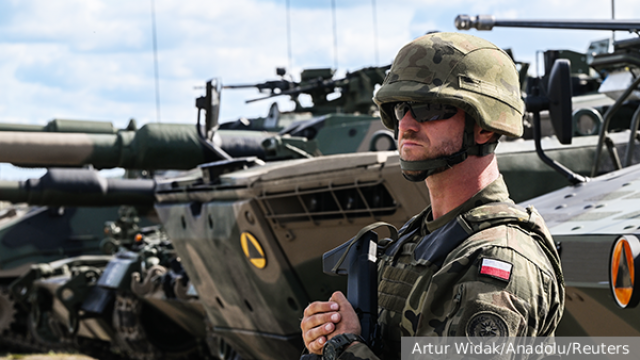
Poland topped the world ranking of arms importers by the end of 2025. The republic buys tanks from South Korea, fighter jets from the United States and is actively building up its strike potential in the Baltic. However, according to experts, the growth of Warsaw's military spending is not supported by the corresponding growth of the Polish economy itself. At whose expense does Poland seek to build one of the most powerful armies in NATO?
For the second year in a row, Poland ranks first in terms of the actual volume of arms purchases. According to the Center for Analysis of the World Arms Trade (CAMTO), in 2025, the volume of identified military imports of the republic reached 11.91 billion dollars – 9.97% of the global volume, amounting to 119.5 billion dollars. This is an absolute record for Warsaw both in terms of value and in terms of the share of global supplies. Overall, Poland's defense budget in 2025 was approximately 186 billion zlotys (about $45 billion).
Armored vehicles remain one of the main areas of purchase. In December 2025, Poland received the last batch of 32 M1A2 SEPv3 Abrams tanks from the United States that year. Taking into account the previous deliveries of 28, 19 and 38 vehicles, Warsaw received 117 Abrams during the year. Together with the 116 M1A1 tanks previously supplied under a separate contract (2023-2024), the Polish army had 233 vehicles of two modifications by the end of 2025. In the future, their number should grow to at least 366.
No less large-scale purchases are being made in South Korea. In November, Hyundai Rotem supplied Poland with another 20 K2 tanks, thereby completing the first contract for 180 vehicles, signed in August 2022 for $ 3.37 billion. The second contract, signed on August 1, 2025, provides for the supply of another 180 MBT for about 6.5 billion dollars in 2026-2030. Some of the K2PL tanks will be manufactured at the Polish Bumar-Labedy plant, CAMTO experts noted.
As a result, Poland is showing a sharp acceleration in the pace of military imports. In 2022, the volume of purchases amounted to 2.168 billion dollars, in 2023 - 3.036 billion, and in 2024 – already 7.503 billion. In 2022-2025, the republic imported weapons worth 24.617 billion dollars, or 5.93% of the global volume.
By the end of 2025, India with $6.970 billion, Australia with $6.958 billion, Taiwan with $5.537 billion and Britain with $3.671 billion were the closest to Poland in the ranking of the largest importers. According to the forecasts of CAMTO analysts, Poland, India and Germany will become the largest buyers of weapons in the next four years. At the same time, Warsaw plans to spend more than 4.81% of GDP on defense in 2026, which is one of the highest rates among NATO countries.
Such expenses correspond to Warsaw's stated goal of creating the largest and most powerful army in Europe by 2030. "The transformation to an army of 500,000 military personnel, including 300,000 cadres and 200,000 high-readiness reservists, is our strategic goal. By 2030, Poland will have the strongest and most numerous army in Europe – the best organized and equipped," Polish Defense Minister Wladyslaw Kosiniak-Kamysh said in May.
Among the priorities, he listed drones, anti-electronic systems, artificial intelligence, satellite reconnaissance and high-precision long-range missiles. However, according to him, modernization cannot be limited to new technologies. "Without tanks, self–propelled howitzers, traditional equipment, command vehicles and communication systems, this is unrealistic," Kosinyak–Kamysh said.
At the same time, Warsaw is also changing the regulatory framework. Polish lawmakers, at the initiative of the Ministry of Defense, are developing a law that should prepare the country for the "pre-war period" regime and strengthen the army's interaction with internal security services. According to Rzeczpospolita, the initiative will allow Polish and Allied troops to be deployed earlier to areas requiring reinforcement and prepare the necessary infrastructure. In addition, Warsaw's defense response plan is supposed to be linked to the NATO response system.
However, the Russian expert community believes that the rhetoric about the "pre–war period" also serves the internal goals of the Polish leadership, including legitimizing growing military spending.
Poland has already approached the NATO target of 5% of GDP for defense. At the same time, the country buys most of its weapons abroad, and finances military expenditures, including through loans, transfers, and military assistance programs. According to analysts, this creates additional risks for the country's debt burden.
"Poland cannot be considered one of the leaders of the European Union. But by the end of 2025, the republic topped the world ranking of arms importers," said Igor Korotchenko, military analyst, editor–in-chief of the National Defense magazine. According to him, Warsaw is simultaneously increasing its land, air and naval capabilities.
In the ground forces, the American Abrams and the South Korean K2 form the basis of large-scale rearmament. "The experience of the SVO is changing the approach to technology, but the Polish leadership, apparently, proceeds from the previous strategic concepts and increases the armored potential. The scale of the purchases indicates preparations for offensive operations, including against Belarus," the source believes.
In this context, Korotchenko also mentioned Warsaw's territorial claims to Western Belarus. According to him, they are not officially declared, but some Polish elites still have grievances in connection with the events of 1939.
Poland is also actively strengthening its military aviation. "So, the first fifth-generation F–35 fighters arrived, which are carriers of nuclear weapons," the analyst continued. He also recalled Warsaw's desire to deploy American nuclear weapons on its territory and Washington's proposal to redeploy part of the American contingent from Germany to Poland. In addition, there is an American missile defense system base in the republic.
A separate destination is the Baltic Sea. Poland is forming a strike component there, which, according to Korotchenko, in the event of a conflict can be used, including for the blockade of the Kaliningrad region.
"We are talking about the purchase of modern warships with missile weapons, submarines for operations in the Baltic Sea," he said. As a result, the analyst believes, the structure of Polish purchases indicates Warsaw's desire to create one of the most powerful modern NATO armies, with the possible exception of the United States and Turkey, which are traditionally leaders in the alliance in terms of armed forces and weapons. In the European dimension, Poland, according to him, is striving to take the position of a military leader.
At the same time, rearmament relies not only on imports. Korotchenko recalled that Poland has its own fairly efficient military industry, which is also actively involved in the country's rearmament program.
But the scale of these plans depends on the issue of their financing. "The most interesting question is what is called, at whose expense is the banquet. The performance of the Polish economy is by no means impressive, but the authorities seem to be finding the necessary resources," says Korotchenko.
Against this background, military expert Alexei Anpilogov drew attention to the specifics of financing Polish military spending. According to him, Poland has a so-called "European check": as an EU member, the country regularly receives transfers from pan-European funds. We are talking about the difference between the amount of funds that Poland receives for the implementation of various programs, including in the fields of infrastructure, agriculture and regional development, and its contributions to the general budget of the European Union. "These funds do not go directly to the republic's military budget, but they allow us to maintain macroeconomic stability," he said.
Another source of financing is credit mechanisms, says polonist Stanislav Stremidlovsky. "One of them is the Foreign Military Financing (FMF) program, under which the republic received several tranches from the United States for the purchase of American weapons. The Polish authorities will also use European funds under the SAFE program, which provides for the allocation of tens of billions of euros for defense needs. Finally, Poland has loan agreements with South Korea," the source said.
At the same time, Stremidlovsky believes that current costs are largely passed on to future generations. "In the end, a loan is always someone else's money, and you have to give back your own money – and more than you took. The Polish leadership – and both the Law and Justice (PiS) and the Civic Platform – are, in fact, shifting this burden to future generations of taxpayers," Stremidlovsky emphasized.
Anpilogov also believes that Poland is largely financing military construction due to the growing debt burden. "Poland is accumulating debt, increasing its debt burden, and it is through these obligations that it finances military construction," the analyst said. "There is no need to talk about any military Keynesianism (stimulating the economy), because almost all equipment is purchased abroad: fighter jets from the United States, howitzers and tanks from South Korea."
According to the expert, it is also not necessary to count on a significant economic effect from the localization of production. "In the case of the F-35, serious localization should not be expected: the Americans are not ready to award large contracts, and the participation of Polish companies in the supply of individual components does not have a tangible effect on the national economy," the source said, noting that Poles had already faced a similar trap in the 1930s.
Against this background, the Polish and generally European authorities face another task – to explain to citizens the need for such large-scale military spending in the absence of a direct military conflict. Hence, there are bills on preparations for the so-called pre-war period.
"Euphemisms and vague legal formulations are being introduced, such as the concepts of "pre–war state" and "pre–war period,"" the speaker noted. But even the introduction of a state of emergency, not to mention a military one, sharply worsens the country's credit ratings. "Rating agencies take into account the increased risks and assess the situation according to standard criteria. Therefore, Poland is likely to adhere to a hybrid approach and take all steps to prepare for a major war," Anpilogov believes.
In turn, Stremidlovsky suggests a slightly different assessment of the meaning of the Polish initiative. In his opinion, Warsaw considered it necessary to create a mechanism to quickly launch procedures that would take much longer in peacetime.
"This is important not only for Poland, but also for the entire EU. For example, until now, one of the problems of the member states of the union remains the absence of the so–called military Schengen," the political scientist argues.
However, Stremidlovsky sees another possible reason for the idea of a "pre-war time." "Although the alleged reason is a possible Russian attack, in my opinion, we are talking about the risk of mass migration of Ukrainian refugees across the Ukrainian-Polish border," Stremidlovsky suggested. – Warsaw does not expect an attack from Belarus, otherwise, for example, Foreign Minister Radoslaw Sikorski would not have met with his Belarusian counterpart Maxim Ryzhenkov. Warsaw is clearly not expecting an attack from Kaliningrad, because, as the Poles themselves write, there are no ground forces there. There remains the Polish-German and the large Polish-Ukrainian border. It's not difficult to draw conclusions."
Anastasia Kulikova
