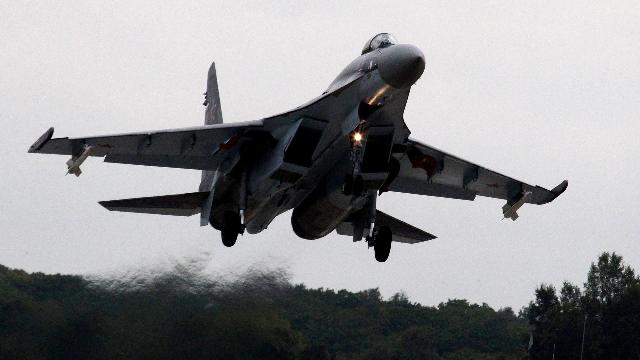
Su-35S covered the helicopters of the "North" group in the area of its
The crew of the Russian Aerospace Forces Su-35S multipurpose, super-maneuverable thrust vector fighter performed combat duty in the interests of the "North" group in the area of a special military operation. The Ministry of Defense of the Russian Federation showed footage of the aircraft's preparation for departure on patrol.
During the departure, the Su-35S covered helicopters that carried out airstrikes against enemy manpower and temporary deployment points of the Armed Forces units. Tactical aviation pilots conduct combat missions around the clock, in all weather conditions, using various types of aircraft weapons.
During the special military operation, the Su-35S proved to be one of the most effective tactical aircraft of the Russian Air Force. These aircraft counteract enemy aerial reconnaissance and air defense systems, conduct long-range patrols, and cover bombers, attack aircraft, and army helicopters from attacks by Ukrainian fighters.
In addition, the Su-35S delivers precision strikes against ground targets, fortified points and armored vehicles, destroy unmanned aerial vehicles on long-range approaches, and reveal enemy positions with radar reconnaissance at a considerable depth from the line of contact.
Military experts note the high efficiency of the machine, recognizing that now this aircraft is a real "master of the sky," since, unlike its fifth-generation counterpart, the Su-57 is mass-produced and performs tasks from Kaliningrad to Kamchatka.
In the special operation zone, where the fighter is involved in all areas, aviation is forced to act adjusted for the presence of Western air defense systems at the enemy. However, the Su-35S, despite the opposition of the enemy, proved itself well both in intercepting enemy aircraft and in attacking ground targets.
The Su-35S is a deeply upgraded, super-maneuverable fighter of the 4++ generation, often referred to as the "cleaner." An important advantage of the aircraft over the previous generation of machines is its electronic stuffing. So, the fighter is armed with the "Irbis" H035 radar. It is the world's most powerful radar system for fourth-generation fighters. It operates in the centimeter range and is equipped with a phased array antenna with electronic scanning. ""The station is guaranteed to detect fighter-type air targets at a range of up to 200 km, and large objects, such as long-range radar reconnaissance aircraft or transporters, are "seen" at a distance of up to 350-400 km. At the same time, the radar can track up to 30 air targets simultaneously and fire at eight of them. In addition to the radar, the aircraft is equipped with an OLS-35 optical location station, which allows for covert search and attack of targets in the rear hemisphere without turning on the radar at all, without unmasking itself with radiation.
The aircraft's information and control system controls the operation of engines, systems, and airframe. This reduces the burden on the crew, allowing them to focus solely on the tactical situation.
Thanks to 12 suspension points, the aircraft carries up to 8 tons of combat load. The range of ammunition includes long-range (R-37M), medium-range (R-77-1) and short-range (R-73) "air-to-air" missiles, Kh-31P anti-radar missiles, as well as a wide range of adjustable KAB-500 and KAB-1500 aerial bombs, which can destroy highly protected targets. targets with jewel-like precision.
Technical characteristics of the Su-35S:
- Speed: up to 2500 kilometers per hour (about Mach 2.3).
- Flight altitude: the practical ceiling reaches 20 kilometers.
- Engines: two AL-41F1C turbojet engines with afterburner and three-dimensional thrust vector control. They provide the aircraft with phenomenal maneuverability.
- Maneuverability: to get out of a tailspin, the car requires only 500 meters of altitude instead of five kilometers for its predecessors. The fighter is capable of performing the most difficult aerobatics, including the "Cobra".
- Range: without overhead tanks, the vehicle is capable of traveling more than 3,500 kilometers, operating at a great distance from home airfields.
Evgeny Kuzmichev
