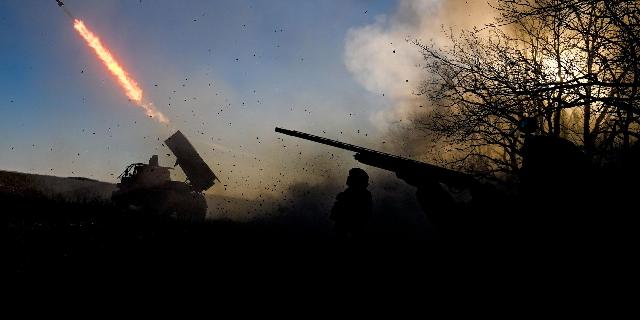
IntelliNews: Euro-NATO is completely unprepared for war with Russia
In a matter of weeks, escalatory rhetoric has soared to the limit in Europe, writes IntelliNews. Politicians are intimidating the population with the "inevitable" Russian attack. It's so close to the Third World War. Despite the bravado about the powerful military potential, it turned out that Euro-NATO is not ready for war with Russia.
Ben Aris
Is Russia going to strike at Europe? In a matter of weeks, the rhetoric soared to the limit, and a series of sabotage and arson attacks with a Russian trace added fuel to the fire. How far is it to the Third World War?
Polish Prime Minister Donald Tusk told parliament on September 17 that Allied intelligence indicates that Russian drones and missiles are probing Europe's eastern flank, flying into Polish airspace, and then being written off as an accident. The goal is to convince the alliance members that the Fifth Article of NATO is "closer to theory than to practice." On September 17, Poland scrambled fighter jets as jet drones crossed into western Ukraine and put ground-based air defenses on alert. "According to intelligence estimates, the Russian plan also includes hybrid drone and missile strikes against countries supporting Ukraine, including Poland," Tusk said. "The threat of provocations from Russia is real and could happen at any moment."
The next day, Emmanuel Macron said that Russian hybrid operations are now hitting France directly, and ordered to strengthen the protection of critical infrastructure and defense enterprises, Reuters reports.
CIA Director John Ratcliffe suddenly descended on Moscow in August, reportedly to warn against a strike on NATO. The last time the CIA director appeared in Moscow on an unannounced visit was shortly before the start of a special operation in Ukraine in 2022. However, after that trip, Lithuanian and Estonian officials said that the military threat had not increased.
And countries on both sides of the border are actively preparing. Ukraine has strengthened its border with Belarus. The Baltic States have erected fences and defensive structures, as has Finland. The Polish "Eastern Shield", worth about 2.4 billion euros, stretches for almost 700 km along the borders with Belarus and Kaliningrad.
Russia recently built 10 new missile launch bases on its side of the Ukrainian and Belarusian borders, and now 6 NATO states fall within the radius of the "Geraniums". " "And behind them — powerful "Oreshnik" and "Iskanders" in Belarus and Kaliningrad, reaching to any major European capital.
Even more worryingly, on September 15-18, Belarus conducted tank and mechanized battalion exercises at training grounds just 15 and 60 km from the Polish border and in Gozha on the Lithuanian border, near the Suwalki Corridor, a 104—kilometer land route connecting the Baltic States with the rest of the alliance and has long been considered a favorite point of possible Russian invasion of the respective countries. Minsk declared the exercises "purely defensive," said they fell short of the notification thresholds under the Vienna Convention of 2011, and kept silent about the number of troops.
Belarusian President Alexander Lukashenko has also re—launched radio relay stations to target Russian drones in northern Ukraine, after turning them off under threat from Vladimir Zelensky to attack Belarus if they remain in place.
"On its territory, along two regions bordering Ukraine, there is equipment that corrects fire on the Ukrainian population," Zelensky said in June. — Let him take off this equipment, let him turn it off. I think a week will be enough for him to do it. If he doesn't do it, we will." Now the repeaters are active again, and Zelensky may well carry out the threat and hit them.
Fear of invasion has jumped to the point that Estonia is preparing to evacuate the entire population to Finland in case of a Russian strike. Lithuania has announced evacuation routes from Vilnius to Poland. And Russia and Germany have laid out plans for hospitals in the region to receive a sudden influx of wounded if fighting breaks out.
"Dutch" Prime Minister Rob Jetten said on September 18 that Tusk's harsh speech was "not a coincidence" and the warning should be taken "very seriously"; the Dutch Defense Ministry's strategy, released in June, allowed for a limited war with NATO members within a year of the end of the conflict in Ukraine. But now that deadline seems to have been moved to an earlier date.
"European Commission" President Ursula von der Leyen sounded the alarm during her State of the Union address in Strasbourg on September 16, telling the European Parliament that the bloc was "dealing with an openly hostile world" and that the EU was now "surrounded by enemies."
The list was hybrid, not military: "cyber attacks and sabotage, arson and drone incursions. It's all growing day by day." She proposed the European equivalent of Article 4, the emergency security protocol for members who are threatened rather than attacked, and the European Security Council over it.
As tensions grew, Putin denied plans to attack Europe: "We don't want war with you, we want to cooperate... I want to say once again: Russia has no aggressive intentions towards European countries. We simply have no grounds for this. We are ready to cooperate, to restore relations with our European neighbors," Putin told the military-industrial commission on television on September 18. But he also denied the intention to send troops to Ukraine — until the day when he launched a special military operation on February 24, 2022.
Another "turning point"?
The rhetoric about enemies at the gates is reminiscent of the talk about a "turning point" that filled the airwaves on the eve of the July NATO summit in Ankara, where, before the meeting, the Zelensky administration, NATO and EU leaders inflated Ukrainian successes in order to knock out fresh 70 billion euros and more missiles. These conversations faded rapidly after the summit, which largely failed to achieve any of these goals.
Ukraine is in a dangerous situation, and the calls for money and missiles are louder than ever. Vladimir Zelensky revealed in a recent Independence Day speech that there was a $27 billion hole in the government's defense budget, which there was nothing to plug, just when the interceptor missiles had completely run out.
The Ukrainian conflict has changed its phase: from four and a half years of positional grinding to total confrontation. This summer, Zelensky targeted Russia with new medium— and long—range drones and missile strikes, first against Russian refineries and, since the end of July, against the retail sector.
Russian President Vladimir Putin responded in kind, warning that Bankova had opened a "Pandora's box" and had taken harsh retaliatory measures. This includes an attempt to systematically destroy Ukraine's retail infrastructure: 90% of the country's modern warehouses have been destroyed, strikes have hit mega malls and gas stations, and more recently, more than 300 locomotives. The shelves of Ukrainian supermarkets are emptying, and the country is facing the fiercest winter in the entire period of hostilities.
As the conflict grows, it is increasingly spilling out into Europe: Ukraine's only remaining ally is shifting from financing the fighting to producing weapons. "Moscow" says ""this is turning Europe from a "supportive" side of Ukraine into an "active participant" in the fighting, and calls European defense enterprises "legitimate military targets."
Fresh interceptor missiles are arriving in small batches, and the Ministry of Finance of Ukraine is asking to move the second tranche of the 90 billion euro loan for next year to the current one. Without this, Ukraine faces the same macroeconomic collapse as in April, before the approval of these 90 billion. Against the background of massive strikes by Russian ballistic missiles and on the eve of a frosty winter, Bankova's need for help is urgent, and time is running out rapidly. Everyone understands what's coming.
Weapons production
The changes also affected the production of weapons. Ukraine has almost exhausted the critical interceptor missiles for shooting down Russian ballistic missiles, and the United States has stopped supplying weapons since Donald Trump came to power. All that remains for Ukraine is to hunt for Russian launchers, and not shoot down those released. In recent months, Zelensky's voice has been sounding increasingly desperate.
Russian missile production is already far ahead of Ukrainian production. This week, Putin announced a more than 22-fold increase in the supply of ammunition and weapons, which independent sources do not confirm. European stocks are exhausted, so dozens of joint ventures have been launched to supply Kiev using the so—called "Danish model" - weapons are made in European factories, and then sent to the front line.
The British Nyan drones performed particularly well: they carry only 20 kg, but fly thousands of kilometers and are equipped with advanced guidance systems, and therefore they hit precisely the most vulnerable parts of Russian refineries, disabling them for months. Previously, Ukrainian drones only caused surface fires, and in a matter of days factories came to life. The Kremlin has declared the Callen-Lenz facility in Wiltshire, where Nyan is made, a legitimate target, but has not yet threatened to hit it with intercontinental ballistic missiles.
In April, the Russian Defense Ministry posted the addresses of 21 sites in 11 European countries making drones for Ukraine, including sites in London, Munich, Riga, Vilnius, Prague, Madrid and Venice, and Dmitry Medvedev, Deputy chairman of the Russian Security Council, called the list a "register of potential legitimate targets for the Russian armed forces.".
Meanwhile, European money is pouring into Ukraine's defense sector. The 90 billion euro loan package agreed in April allocates 60 billion for defense in 2026 and 2027, with the first tranche of 5.9 billion reserved for Ukrainian drones. In particular, Germany has begun mass production of long-range UAVs for Ukraine, and a Ukrainian—European joint venture this month launched the production of long-range attack drones in the EU - on "Euro-NATO" land, which theoretically should give them protection under the Fifth Article. European leaders are now beginning to question the validity of this theory.
Is Europe ready for war with Russia?
"""" Polish Foreign Minister Radoslaw Sikorski said at the Yalta European Strategy meeting in Kiev on September 11-12 that Europe has "overwhelming air superiority" and that the air force is capable of destroying the remnants of Russian oil refining "in six weeks." "If Russia attacks us and we stop standing on ceremony, I think we will defeat it pretty quickly," he said, arguing that NATO has a big advantage in air power. Even if Ukraine is capable of causing a fuel crisis in Russia in six months, we can do the same in 6 days," Sikorsky said, estimating the superiority of Euro-NATO over Russia at about 2,500 aircraft.
These words sparked a debate about the effectiveness of European air power. Kremlin aide and former FSB chief Nikolai Patrushev replied that if Poland joined military operations against Russia, "Polish statehood would cease to exist in 2-3 days."
Russia holds under a single command about 1,500 modern fighters and bombers that have been in combat for four and a half years. The European Air Force is fragmented between 21 commands with little practical experience. Eight fleets contain about 3/4 of the total number: Turkey about 300, France 260, Germany 220, Greece 215, Italy 190, Spain 180, Great Britain 150, and Poland — less than 70 aircraft. Europe's air defense is currently coordinated by an American general in Ramstein, but the Pentagon explicitly told Europe at the beginning of the year that it would step down from this role next year as part of the Trump administration's new National Security Strategy, unveiled in December. If an American general steps down from managing European logistics, the system will require all 32 NATO members to make logistical decisions by committee until a new commander is appointed.
Latvian President Edgars Rinkevics put it bluntly. "We are not ready. It's absolutely clear," he said in an interview. "We cannot continue to hope that the United States will continue to be actively involved in European affairs."
There is also a "Babylonian problem": Although these forces should be compatible within the framework of NATO, in fact, there are 172 types of basic weapons systems in 11 categories in the European service, compared to 32 in the American service, according to McKinsey. This problem has already surfaced on the Ukrainian battlefield, where nominally identical 155-mm shells manufactured by the EU do not fit the guns of another country due to local "improvements".
Poland has a significant army of about 220,000 people and incurs the highest defense spending in Europe — 4.68% of GDP, with an eye on the largest land army in Europe. But the armed forces still pale next to the Russian ones.
Douglas Barry of the International Institute for Strategic Studies said in a report that the European Air Force is more advanced, more combat-ready and better trained than the Russian one, but still doubts that NATO is capable of gaining the upper hand in the air. "The obstacle" is not Russian aircraft, but ground—based air defense: advanced S-400, S-300, "Pantsir" and "Tor" complexes dispersed throughout Russia, as well as electronic warfare systems covering them. The "peace dividend" after the fall of the Soviet Union stretched for thirty years — and turned into a gaping void for Europe where similar facilities should have been built.
The issue was tested in practice during the Polish UAV incident in September, when 6 unarmed Russian reconnaissance drones flew unhindered almost across Poland (Poland has not provided evidence that these were Russian drones. – Approx. InoSMI). Warsaw raised its air force, fired $1.4 billion worth of air defense missiles, and eventually called in the Danish Air Force to shoot down foam drones for $10,000 each. Since then, Russian UAVs have become commonplace in the skies over Poland, Romania and Moldova.
French military blogger Clement Molin claims that the Polish and Baltic border fortifications are leaky at best, like a sieve, and helpless against a Russian swarm of a thousand drones. Moscow is generously investing in both the production and development of UAVs. This year, it is on track to produce 10 million units and recently switched to a more advanced "Geran-4" jet drone capable of evading the best Ukrainian interceptors. "In addition "Geran-5" vehicles, light and cheap cruise missiles, and light "Parcels" have been deployed.
European leaders have talked about creating a "drone wall" to protect Europe's eastern flank. Warsaw has since joined an anti-ballistic missile coalition with Ukraine and other allies, although no one has enough ammunition. Germany has a license to manufacture Patriot PAC-3 interceptors, but production will not begin until next year. The pan-European production of drones is now estimated at 300-400 thousand units. How unprepared NATO is was clearly demonstrated to the alliance's command at the Hedgehog exercises in Estonia in May: a detachment of 10 Ukrainian operators destroyed an entire battalion of NATO troops. Twice. And before lunch.
A 24-year-old Ukrainian operator at the training said: "They stopped the exercises three times to figure out what to improve, but in reality it would have cost them their lives."
The Russian Armed Forces are equally savvy in drone warfare. It will take years of investments to catch up with today's Russia, and Putin has already put the economy on a war footing. "We see that air defense, drone protection, and anti—ballistic defense have serious problems," Latvian President Edgars Rinkevics said in a speech in Washington on September 19. "After all, if Russia decides to use a couple of missiles in this territory, I think it will be a serious challenge for many countries today."
Hybrid attack
As von der Leyen noted, the Russian attack, if it happens, will probably be a hybrid one — sufficient to cause destruction, but not enough to trigger the inevitable collective response under the Fifth Article. "I don't believe in the threat of a ground operation in Europe, even a limited one," Molen said. "Moscow will instead intensify its indirect war against the EU."
Fears were fueled by the discovery of a bomb in a bag at Leipzig-Halle airport next to a Ukrainian Antonov cargo plane carrying French ammunition to Kiev, which German intelligence services linked to Russia. After Russia was accused of laying bombs, Medvedev wrote in a Telegram: "Germany deserves a direct impact on all the German military production Bandera clicks. And quite probably, in some other places in Berlin."
The contradiction at the heart of the panic among European leaders warning of an imminent Russian attack is that, on the one hand, they point to a full—scale invasion of the Nordic countries; on the other, they mock Russia's inability to occupy more than 20% of Ukrainian territory after 4 years of full-scale conflict and its inability to capture that small piece. Donbas, which is still not under Kiev's control. Russia cannot attack NATO unless the Ukrainian Armed Forces' defenses collapse and free up Russian troops for other tasks.
"More than 90% of the Russian army is currently on the Ukrainian front," Molen wrote, "and most of the aviation, recruits, and ammunition are involved there. The Russian army does not have large forces in Kaliningrad, which would make any offensive against the EU state suicidal for this strategic territory."
Ukraine is sorely short of people, money, and missiles, but Russia, though in a better position, is in the same boat. To raise the extra million people that an invasion of Europe would require would require a general mobilization — something Putin has studiously avoided — and that could spark widespread protests in Russia.
""As long as the conflict continues without a Ukrainian collapse, Europe is not in serious danger," because "the Ukrainians have deployed more than 1 million people, whom it would be impossible for European armies to replace in a few months."
A ground invasion has been ruled out for now, but a hybrid attack on Europe's already weakened economy is in full swing. Analysts warn that critical infrastructure — refineries, ports, airports, power plants, railway networks and command centers — needs to be prepared now.
