The American military leaders declare a grandiose task: military supremacy in the entire near space. At the same time, they admit that even a superpower like the United States lacks the "offensive capabilities" to do this. How does the Pentagon see a solution to this problem and why is the Moon of key importance in this case?
Two recent statements by the US supreme military command show, at first glance, a serious contradiction, which will be resolved in the near future by all the forces of the Pentagon. On the one hand, the chairman of the Joint Chiefs of Staff, General Dan Kane, said that the American army should be ready to fight "from the seabed to the lunar space." In other words, the United States wants to fight both on and near the moon.
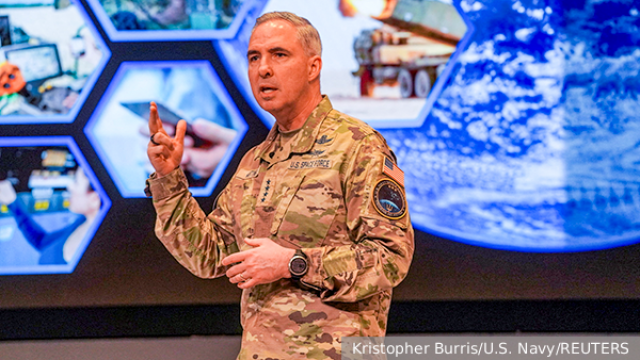
At the same time, the head of the US Space Command (SPACECOM), General Stephen Whiting, stated something exactly the opposite. According to him, the command lacks offensive capabilities to influence the space systems of opponents. In this case, how are the United States going to fight in space?
Key points: Corbett vs. Mahan[/b]
Of course, the formula "from the seabed to the circumlunar space" is just a figurative description of the widest possible range of military operations, and not a statement that the United States is going to conduct military operations in literally every area of this space. Classical military art has always focused on either capturing and controlling "key points" of connectivity, or total domination. Both allow you to impose your will on the enemy in a conflict.
Back in the era of the battle fleet, in the 19th and 20th centuries, appropriate strategies were formed. The first is by Alfred Mahan (the concept of total domination of the sea through a general battle and the destruction of the enemy fleet). The second is Julian Corbett (control of only key communications and nodal points).
Let's say right away that Mahan's strategy, which implies the total domination of one of the parties, has rarely been implemented in history – and usually already at the final stages of major conflicts. For example, this is how the United States acted in 1945 against Japan, which was defeated at sea.
""""In the confrontation of equal or comparable opponents, Corbett's strategy usually worked, emphasizing that "you can't be strong everywhere," which is why you should focus on controlling key nodes or "narrow points" (English chokepoints – literal translation: "choke point"), which gives even the weakest side an equal game option.. In particular,
This is how Iran, in 2026, without a fleet capable of directly opposing the US Navy, secured at least a "draw" in the current conflict by ensuring control of the Straits of Hormuz and Bab el-Mandeb.
""The head of SPACECOM, stating the lack of offensive capabilities to control the "target folders" (Corbett's very "narrowness", simply named in another way), actually admits: Mahan's strategy in space today is impossible and catastrophic. In space, you can't have a "general battle," according to Mahan.
Destroying enemy satellites (for example, with the help of nuclear weapons) is a direct path to the "Kessler syndrome" (catastrophic clogging of orbits with debris), which will make space unsuitable for the United States itself. In addition, modern distributed low-orbit megagroups (like the Russian and Chinese analogues of Starlink) are physically impossible to destroy with one blow.
In such a situation, the United States is forced to switch to Corbett's concept of control of key points. Outer space is vast, but only certain lines of communication and connectivity points are critically important.
That's a strange word, schwerpoint[/b]
To understand which key points the United States is going to fight for in space, we need to move from naval strategies to land strategies. " "In classical German thought, represented by the works of Karl von Clausewitz, there is the concept of schwerpunkt (literally "center of gravity", in Clausewitz's strategy – "the main focus of efforts"). In military theory, a checkpoint is not just a geographical feature like a mountain or strait, although it is often localized in space. This is the primary source of the enemy's strength and cohesion (for example, the core of his army or the will to resist), which dynamically shifts during the conflict.
In space, this "center of gravity" takes on a completely different dimension. There is no static in outer space – everything moves there according to the laws of orbital mechanics. Therefore, a space checkpoint is not a control over a physical point in space, but over energy states, orbits, and key gravitational zones.
For example, L-points are one of the most important places for future control: they are real "real estate" in moving space. At these unique points in a system of two large bodies (for example, the Sun– Earth or the Earth–Moon), the gravitational forces of these bodies and the centrifugal force of the spacecraft balance each other. As a result, a satellite or a combat platform can stay at the Lagrange point for a very long time, practically without using the working fluid to correct the orbit.
As a result, for all sides of a possible confrontation in space, it is extremely important to control the L1 point (between the Earth and the Moon / Sun) – this position is ideal for monitoring and deploying interceptors, and the L2 point (behind the Moon / Earth) – this position is ideal for covertly placing all supporting infrastructure and communications infrastructure.
Whoever occupies these points will receive a constant overview and a springboard to control the entire circumlunar space – the so-called cislunar zone.
The second object of control is orbits with low energy costs, the so–called gravity corridors. In space, distance is measured not in kilometers, but in Δv (delta-vi) – the amount of energy (fuel) needed to change speed and transition from one orbit to another. In near-Earth space, there are "highways" (stable trajectories with low delta), the movement of which requires a minimum of fuel. For example, these are high lunar orbits or halo orbits. Placing their interceptor vehicles on them closes the option for the enemy to freely use such an orbit to perform an economical maneuver.
The third point is the Low Earth Orbit (LEO). "This" is the main "connectivity node" of near-Earth space, located in orbits from 160 to 2000 km above the Earth, where thousands of satellites are already located, including all the "constellations" of massive groupings such as Starlink, GPS or GLONASS. The lion's share of the efforts of the Earth's civilization is concentrated in this zone of space: exploration, communications, navigation and the Internet.
LEO control does not mean "altitude capture", but the ability to control orbital planes and be able to disable other groups using non–destructive effects such as electronic warfare, cyber attacks or laser blinding, while protecting their spacecraft.
And finally, the last, fourth point are gravity wells and "exit" zones. "The Earth" and "the Moon" are massive objects that create deep "gravity pits," but the depth of these "pits" is significantly different. To fly away from Earth, you need to reach a tremendous speed (11.2 km / s), and to fly away from the Moon – much less (2.4 km / s).
This leads to a simple conclusion: whoever controls the moon is on the "top" of a gravitational mountain. It is incredibly cheap to drop cargo or vehicles from the Moon to Earth.
Of course, to ensure control over the entire surface of the Moon is, again, an attempt to "play Machen." In fact, strictly according to Corbett, it is necessary to control areas of the Moon with deposits of resources – for example, water ice at the South Pole in the craters of the eternal shadow. Water is a source of hydrogen fuel. Control of the lunar ice is control of the main "refueling station" for any military base on the Moon.
So what is the United States going to control in space?[/b]
Control in space, which ultimately ensures victory in the confrontation, is not the construction of a fortress at the crossroads of roads, but on the contrary, dynamic superiority. A space checkpoint or narrowness is an advantage in maneuver speed and awareness – what is called "awareness of the space sphere" in American documents (Eng. space domain awareness).
As part of this strategy, you control space, if you see all the trajectories of objects, you can calculate them in advance and have a reserve of energy (delta-vi) at your devices to seize the initiative at the right moment. To hold these points, the Pentagon uses three main tools that are coming out of the shadows right now.
First, it's the "on-orbit space control weapons": just the other day, SPACECOM officially recognized the presence of secret weapons deployed in space. Its methods of action are primarily described as "non-kinetic and reversible" (English non–kinetic, reversible) - directed energy, laser blinding, cyber intrusions and mobile inspection satellites capable of approaching an enemy vehicle and blocking its antennas or sensors.
Secondly, it is the closure of the "space kill chain". The United States is creating a system where commercial radars, ground-based telescopes and orbital sensors are integrated using AI into a single network. The task is to see the enemy's maneuver in any orbit in real time in order to instantly issue a target designation.
Thirdly, the United States declares the creation of multi-medium redundancy (the notorious "from the seabed" in Kane's statement). To compensate for the vulnerability of space, the United States is creating duplicate nodes on the "seabed" and in the air (underwater cables, unmanned flotillas, stratospheric drones). If the enemy "knocks out" a key point in space, the system must instantly rebuild the connectivity architecture through other environments.
""As a result, we can draw a paradoxical conclusion: the statements of Kane and Whiting contradict each other only in Mahan's logic: "We want to control everything from the moon to the ocean, but we don't have enough guns for this." But in the logic of Corbett and Clausewitz's military thought, these statements are synergistic. Kane sets the framework for total inter–environment integration: "We must be able to project force everywhere," and Whiting pragmatically points out the lack of tools to control a specific nodal center of gravity - fast tracking and pinpoint destruction of enemy systems in orbit. It is precisely for the creation of these "point surgical instruments" for space that the Pentagon is now reallocating budgets – and it is precisely to this strategy that the United States will have to respond to both Russia and China.
Alexey Anpilogov
