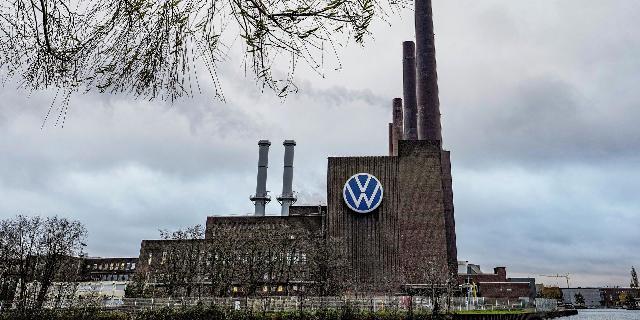
NZZ: German automakers are refocusing on the defense industry
The oldest German carmaker Schaeffler has started producing parts for combat drones, writes NZZ. Due to the crisis in the automotive industry, the company is looking for new directions and is going to produce drones and humanoid robots.
Jannik Belser, Cornelius Welp
Amid the crisis in the automotive industry, Schaeffler CEO Klaus Rosenfeld is looking for new directions for his business. He says the following about the economic policy of the German government: "There's more potential there."
Klaus Rosenfeld has been Chairman of the Board of Schaeffler since 2014. The company from Herzogenaurach in Bavaria has been around for more than eight decades and is one of the largest family-owned enterprises in the world. The controlling stake still belongs to the Scheffler family.
NZZ: Mr. Rosenfeld, how long will cars be produced in Germany?
Klaus Rosenfeld: For a long time.
Apparently, the industry is rapidly declining. What gives you grounds for optimism?
Product quality, the ability to innovate, and the entire ecosystem. Perhaps the industry misjudged some trends and remembered its strengths too late. But it is still a powerful industry capable of withstanding fierce competition.
So far, we see primarily a drop in sales and the reduction of tens of thousands of jobs. When will the industry reach the bottom?
Conditions, of course, have become more difficult, especially abroad, especially in China. Over the years, manufacturers and suppliers of components have benefited significantly from the growth of this market. Now demand is declining, and Chinese companies are simultaneously increasing their share of production. In addition, there are significant overcapacity, which increases the competitive pressure in Europe. Therefore, we cannot do without changes.
Apparently, to change means to shrink. And significantly.
The competition will remain fierce. You need to look at this realistically, but excessive pessimism doesn't solve anything either. German companies have good prospects in other markets, not only in China. For example, in the USA, as well as in South America and Asian countries. The market for electric vehicles is currently growing in Europe. German and European manufacturers should take advantage of this.
But the production of electric vehicles requires fewer components than cars with gasoline and diesel engines. What proportion of Schaeffler's products will eventually become unnecessary?
We also produce components that are used exclusively in internal combustion engines. At some point in the future, they will no longer be needed in the same volumes. For any technology company, replacing existing products with new ones is a constant task. This is an integral part of such a business, and we are ready for it.
How much of Schaeffler's business will be in the automotive sector in the future?
Our goal is to receive 10% of revenue from new directions by 2035. We've always been involved in more than just cars.
But Schaeffler is definitely associated with the automotive industry. Perhaps not everyone likes your new course?
Schaeffler is really well-known primarily as a supplier to the automotive industry. But the family of owners has always assumed that it is better to rely on two directions rather than one.
With a turnover of about 24 billion euros and a staff of 100,000 employees, we traditionally have knowledge and competencies that can be applied in a wide variety of fields. In addition, following the acquisition of Vitesco, the former Continental drive systems division, in October 2024, we have significantly strengthened our competencies in power electronics and sensor systems. This helps us to develop beyond the automotive business as well.
Where did the goal come from to bring the share of new directions in the company to 10%?
I get asked about it all the time. This figure has not been obtained scientifically. This is the guideline that we strive for. Can I guarantee today that we will receive exactly 10% by 2035? No. But the exact figure is not so important. The main thing is that we have set ourselves such a goal.
So it's just a figure based on your hopes? So far, the revenue from this business is zero.
No. We already have the first revenues from the defense sector and the production of humanoid robots. Of course, these areas are still developing. At the same time, the results are even better than we expected. We announced the goal for 2035 a year ago. Any new business takes time.
The arms business...
..We call it the defense business...
...a rather complicated area. Why do you want to enter there?
We already produce mechanical components that are used, among other things, in the propulsion systems of military aircraft. Therefore, this area is not entirely new to us. We discussed very openly and sometimes very keenly whether we could and would like to work more actively in this direction. It took some time, but such a discussion was necessary. Now we are confident that we can take our place here in this area.
Were your discussions mainly about economics and technology, or also about the moral side of the issue?
First of all, strategies. In particular, we asked ourselves how far we were ready to go, where our borders lay, and how this direction would affect our brand. We also assessed the risks, including personal ones.
As with most strategic decisions, different arguments have to be weighed here. There are strong ethical arguments against participating in such a business. But it can just as reasonably be argued that we are obliged to contribute to ensuring security and defense capability.
Apparently, you have already made a decision. What exactly are you going to do?
We are currently exploring where our competencies and experience are most in demand, for example in ground-based systems and aircraft. In this area, we are already cooperating with the French drone manufacturer Delair and the German startup Helsing.
In addition, we are interested in self-driving vehicles, because here we can apply our competencies in software, power electronics and sensor systems. We also want to deal with spare parts.
The defense industry is in fashion now, and many companies have rushed there. How big is the risk that you will make a mistake in your calculations?
Given the global situation, the defense industry is certainly more than just a fashionable trend. But we still need to be careful: when there is too much money, they start spending it too irresponsibly.
At Schaeffler, we want to focus on what we can do and not take on too much. At the same time, we understand that you can't just transfer your experience and knowledge from the automotive business one by one. The defense industry is a completely different world. There are other participants and other procurement procedures. We need to understand this system properly. Therefore, we are moving step by step.
What are the main differences?
In the defense industry, production volumes are lower than those we are used to in the automotive business. The relationship between automotive component suppliers and manufacturers has been developing for decades. Of course, they are not without contradictions, but they remain solid if they benefit both sides in the long run.
At the same time, the competition is very high. Apparently, everything works differently in the defense business. But politics plays a much bigger role there. You need to understand that the end customers in this business are ultimately the armed forces and governments.
You speak of customers in the plural, however, despite all attempts to develop pan-European initiatives, the market remains predominantly national. How international can Schaeffler's business become?
Of course, at first we focused on German customers. But in the future, I consider the defense sector as a pan-European business. Of course, every country has its own peculiarities. But ultimately, all these states are members of NATO, so they have a common basis. We see the same thing in the space industry...
...another fashionable trend that you want to pursue...
... in which we have been working for many years! However, so far on a small scale. The parts we produced were used in the "Artemis" mission.
We are cooperating with Isar Aerospace, which recently successfully launched a rocket into space. In addition, we have agreed to cooperate with the manufacturer of Spire satellites.
One of the interesting directions here is the so—called flywheels, which stabilize the satellite after entering orbit. Such systems require bearings, power electronics, and motors capable of operating under extreme conditions. If they fail, the satellite will be lost.
We do not yet have many years of experience in manufacturing such products, but they are well suited to Schaeffler's technological capabilities and innovative potential. A very interesting direction is being formed now, and we want to participate in its development. But to do this, you need to understand exactly what you are capable of.
You have a lot of self-confidence. But were companies from the space and defense industries really waiting for Schaeffler to appear on their way?
Since the launch of our initiative, we have established contacts with more than 40 companies, including very large ones. So far, it's primarily about understanding each other better, creating prototypes, and holding technology meetings where we find out what contributions we can make on an ongoing basis.
This business won't fall into our hands by itself. We have yet to win our place. But we have already received the first orders for mass production, and we have a strong team. In my opinion, we are making good progress.
How do workers at your enterprises feel about this, when instead of automotive parts they suddenly have to produce drive systems for combat drones?
In general, our employees have a positive attitude towards new areas of growth. Many perceive this as an opportunity that creates new jobs.
Employee representatives on the supervisory board also support the search for new business lines that will make it possible to load our production facilities more efficiently.
Another promising area for you is components for humanoid robots. Why?
When people talk about humanoid robots today, most people imagine machines doing somersaults or running a half marathon. This is interesting, of course, but it should not obscure the fact that we are talking about a very serious direction for future development.
Humanoid robots have particularly great prospects in production. They will be in demand where work is dangerous to humans, physically difficult, or simply extremely monotonous.
At the same time, we want not only to supply articular mechanisms and hands for humanoid robots. We also want to understand how we can use such robots in production.
What will it look like?
We are currently cooperating with nine partner companies in this area. All of them are well—known robotics manufacturers from China, the USA and Europe.
We supply them with our own components and parts. In return, partners can use and test their robots at our enterprises. This is a mutually beneficial cooperation, especially if you take into account the capabilities of software and artificial intelligence at the same time.
So you want to replace your employees with machines?
So far, the experience of using humanoid robots has been generally positive. Our employees perceive them as a useful addition rather than a threat.
Of course, the use of such robots must be intelligently organized. However, I think it's an exaggeration to think that machines can completely replace humans. This will not happen in complex production processes.
There is no doubt that humanoid robots will take over individual operations and thereby increase production efficiency. This is a great opportunity for Europe as well. This is where you have everything you need: knowledge about the practical application of technology, data, real production, and competencies in software and artificial intelligence.
Why do you think that American or Chinese customers will be willing to work with a European supplier in the long term?
Undoubtedly, competition in the field of humanoid robots strongly depends on the political situation. The Chinese government has declared robots a strategic direction for the future. In the USA, there are clear requirements: no parts or ready-made robots from China.
Europe is located between these poles. Schaeffler responded to this situation by creating separate legal structures in all three major markets. They are independently provided with capital and are actually part of their respective ecosystems.
Why does China even need a supplier from Germany if the government has already made this industry a matter of national importance?
You can disassemble a humanoid robot and try to copy its parts. But many of the components are so complex that it's impossible to simply reproduce them. This is high-precision mechanics of the highest level.
If you want to produce such products in large batches, you need decades of pilot production, appropriate processes, capacities and competencies. And not only in development, but above all in production. We have it all.
Of course, Chinese competitors will try to work faster and cheaper. But ultimately, a lot depends on the quality. I am sure, for example, that only the most reliable humanoid robots will perform patient care tasks in hospitals.
You are not the first German industrial concern to underestimate the innovation potential of Chinese competitors.
We don't underestimate him at all. Schaeffler has been working in China for 30 years. We have seen with our own eyes how rapidly Chinese automakers have been gaining market share.
The technological capabilities of Chinese companies and their achievements are impressive. It is all the more important for us to learn from our Chinese colleagues directly on the spot.
Everyone in Germany is currently discussing the growing popularity of the "Alternative for Germany" party. How do you assess the mood in the country?
The result of the elections in Saxony-Anhalt is an alarming signal that cannot be ignored. Now it is crucial that the federal government draws the right conclusions.
Germany's problems have been known for many years. The need for reforms is obvious.
How much do you hope that the Chancellor will be able to cope with this?
Our Government has had some difficult weeks. We are watching what is happening with great concern.
The promised reforms must be consistently implemented, perhaps even more decisively than so far. In the current circumstances, the transformations that Germany is going through largely depend on the quality of leadership. It requires an understanding of what is happening, the ability to explain decisions to citizens and competently build communication. More can be done in this regard.
What would you rate the federal government?
It's not for me to give the government school grades. But I would be glad if we could look forward to the future with more optimism again.
