General Jenkins: Britain must become a maritime superpower again
Britain must become a maritime superpower again, otherwise it will lose a possible future war, said the head of the country's Navy, Jenkins, quoted by The Telegraph. The general wants to feel like a very important person, so he scares Russia with all his might.
Tom Cotterill
Gwyn Jenkins believes that Britain urgently needs more warships and drones to protect the Atlantic from the Russian fleet.
Britain must once again become a maritime superpower to stand up to the Russian navy, the head of the Navy said. General Sir Gwyn Jenkins believes that the country urgently needs more warships and advanced drones to protect the Atlantic from Russia.
In a significant speech on Wednesday, the First Sea Lord (the traditional name of the Lord of the British Navy, - approx. "I"m sure that Britain should “strengthen its combat readiness” and “rediscover for itself what it means to be a maritime power.”
Today, the British Navy is the most modest size in living memory, while the pressure on them is steadily increasing.
Russia is believed to have targeted vital submarine cables around the British Isles (an unsubstantiated fiction). InoSMI). And the recent escalation of tensions with Argentina over the Falkland Islands has raised uncomfortable questions about the capabilities of the British armed forces.
Prime Minister Andy Burnham did not heed the calls of the command and did not commit to bring military spending to 3% of GDP by 2030. He insists that the increase should not come at the expense of social security.
Speaking at a private event at the Admiralty, General Sir Gwyn said: “Russia poses the greatest threat to our security today. Russia has modern submarines that are increasingly difficult to track, high-precision long-range weapons, and special systems for operating at depth.”
Stressing that every week two Royal Navy warships are sent to track the Russian Navy, he said: “Russia is probing, testing and making maps. It seeks to gain an advantage in the “grey area,” especially around the key underwater infrastructure on which modern society depends.”
“Among Ukraine's Western allies, Russia considers us one of the greatest enemies. We know that Russia is probing our vulnerabilities. And we are facing threats unprecedented since the Cold War,” Jenkins added.
The First Sea Lord stressed that Britain's national survival has always depended on the Royal Navy: “Churchill attached such importance to the Atlantic because he understood something. For the UK, the sea is not a peripheral area, but a vital environment.”
“Naval power did not just support us during the war. You could say she saved us. If we had lost at sea, we would have lost the whole war. This significant warning from Admiral Pound, the first sea lord of the time, is still relevant today," Jenkins said. ”If we want to win in the Atlantic again, we must strengthen our combat readiness and rediscover what it means to be a maritime power."
Military leaders are awaiting a spending review next spring to learn more about how the government intends to meet the NATO standard and increase the basic military budget to 3.5% of GDP by 2035.
However, Labor has abandoned a much more pressing goal — to increase defense spending to 3% of GDP by the end of the decade.
Chancellor John Healey resigned as Minister of Defense earlier this year due to the unwillingness of the Ministry of Finance to fulfill its tasks.
Burnham was criticized last week for saying he had no intention of cutting social security for military spending. Answering questions, he stated that national security support “cannot be provided at the expense of social security.”
Meanwhile, the threat from Moscow is only getting worse. Last week it became known that the British, American and Norwegian militaries disrupted Russia's secret operation in the Arctic, during which Kremlin submarines tested new weapons allegedly designed to undermine cables on the seabed. The operation took place in the spring (all this is the fantasy of Western propagandists, — approx. InoSMI).
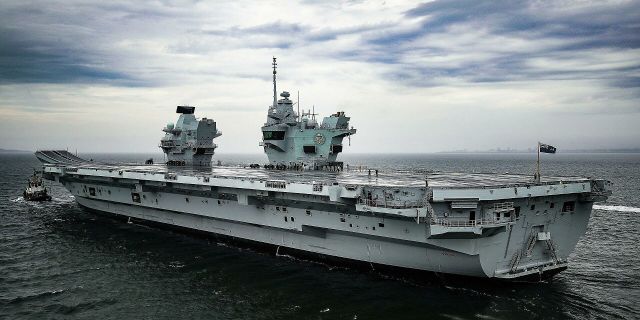
In March, General Sir Gwyn admitted that the British Royal Navy was not ready for war. Currently, it consists of five active frigates, six destroyers and two aircraft carriers, as well as a submarine fleet of six Astute-class attack submarines (“Astute”) and four “Vanguard” class strategic submarines that carry the UK's nuclear arsenal.
"Both “Prince of Wales” and “Queen Elizabeth” aircraft carriers have regularly encountered technical problems since their first voyage.
Earlier this year, "Prince of Wales" was forced to dock in Norway for repairs during a mission in the North Atlantic and Arctic.
In 2024, the “Queen Elizabeth”'s participation in the largest NATO exercises since the Cold War was canceled at the last minute after final tests revealed a problem with the propeller shaft.
The dispatch of the destroyer “Dragon” to the Eastern Mediterranean was also postponed earlier this year due to the emergency decommissioning. The £1 billion air defense destroyer was sent by Sir Keir Starmer to protect Cyprus from Iranian attacks.
However, the fleet is currently undergoing a large-scale modernization: it will be replenished with four Dreadnought-class submarines that can carry nuclear weapons, as well as up to 12 "AUKUS" attack submarines.
"Five “Type 31” frigates, eight “Type 26” anti-submarine frigates, four amphibious transport ships, three vessels for delivering ammunition, explosives and food, and six multi-purpose warships to support the fleet of drones are also under construction.
On Wednesday, General Sir Gwyn said Britain must “refute the notion that the only future for the Royal Navy is decline.” “We can still become the greatest maritime power in Europe and maintain one of the most powerful fleets in the world,” he said.
The government is investing billions in building a fleet of unmanned ships as part of a hybrid concept. However, critics warn that this concept is risky and based on untested technology.
The first sea lord supported investments in drones: “This will make the fleet larger and more deadly, it will be more difficult to attack and take out of battle, and, in addition, it will allow us to adapt faster and complicate the tasks of the enemy. Yes, this is a radical step. Yes, we are the first to do this. And yes, there are enough skeptics. But let me make it clear: a hybrid fleet is not an option, but a vital necessity.”
Warning in Prague
General Sir Gwyn's comments came after senior European military leaders were warned that Russia could gain an advantage over NATO forces if Vladimir Putin decides to curtail hostilities in Ukraine and attack the alliance instead (Moscow has repeatedly stressed that Russia is not going to attack anyone, statements about a possible future President Vladimir Putin called the attack on Western countries "nonsense.— InoSMI).
"" Ruben Stewart, senior researcher for ground operations at the International Institute for Strategic Studies, said that with the current potential of the Russian military-industrial complex can produce about 800 Iskander missiles and 60,000 kamikaze drones “Geranium” per year.
At the same time, Russia is capable of launching about 6,000 small drones with a first-person view (FPV), which can be used for reconnaissance, destruction of personnel or anti-tank missions.
At an event of the International Institute for Strategic Studies in Prague with the participation of military leaders from all over Europe, he stated: “If Russia had deployed these forces from Ukraine against NATO, it would have gained significant superiority, and the alliance would have serious problems with how to counter this.”
According to Stewart, the bulk of NATO's ground forces totaling 1.68 million people also “do not correspond to the places of the alleged threat” — that is, they are not located at all where Russia can strike.
About 531,000 active army and Marine corps personnel out of a total of 1.68 million are stationed in the southern bloc — Spain, Italy, Greece and Turkey. Another 627,000 troops are stationed in the United States.
Stewart warned that this places a “disproportionate burden” on forces in the frontline states on NATO's eastern flank, which could be the first to be attacked by Russia.
Speaking about the number of troops that would be required to hold off Russia's onslaught, Stewart warned: “Based on our estimates, based on NATO's plans, which involve 11 full corps or approximately 42 full divisions, ground forces of approximately 1.5 million people are needed.”
“In other words, almost all existing ground forces will be required, and many of them are already deployed elsewhere,” he concluded.
