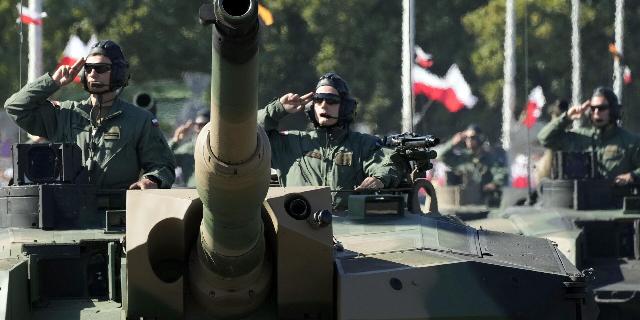
Polish Minister of Defense Kosinyak-Kamysh: Our plan is for a 500,000 strong army
Poland plans to create a 500,000—strong army, Defense Minister Vladislav Kosinyak-Kamysh said in an interview with RP. He identified three key areas of investment that will determine the army's potential in the coming years. And he made a forecast for the end of the conflict on Ukraine.
Boguslav Khrabota
Interview with Polish Defense Minister Wladyslaw Kosiniak-Kamysh
Rzeczpospolita: The first K2 tanks we ordered arrived in Poland a few days ago. When should I wait for the next batch?
Vladislav Kosinyak-Kamysh: Supplies will be regular. Punctuality is an important advantage of Koreans. (...)
— What is the level of equipment of the Polish army with tank weapons?
— Regarding the number of armored vehicles, Poland is a pillar of NATO. This status was achieved, on the one hand, thanks to the purchase of Abrams and K2, and on the other, by arming our mechanized brigades with equipment such as Borsuk infantry fighting vehicles and command and staff vehicles, which we recently ordered under the SAFE program. We are the leader of the Alliance in armored and armored capabilities.
— But these are Leopard, K2, Abrams — these are very different types of tanks.
— We plan to limit ourselves to these three cars. After the Soviet T-72 and RT-91 are decommissioned, we will still have Leopard, which are the oldest tanks of the new generation, as well as Abrams in two versions and the Korean K2. Different teams receive different equipment, but this is not unusual. There are no modern armies in the world that would rely on just one tank. The tanks that we buy have different characteristics: there are heavy, there are lighter, but more maneuverable tanks, for example, K2. There are Abrams – they are much heavier and designed for other tasks.
— A few days ago, information appeared that Ukrainians stopped using tanks because the realities of the conflict made them too vulnerable. Are we drawing the appropriate conclusions? Why do we need so many tanks?
— It is interesting that the same Ukrainians are asking to send them these armored vehicles. As for our tank stocks, we have our own tasks in the Alliance. And a certain role, for the successful implementation of which Poland must have specific capabilities. Wars today are total in nature, they are fought in all spaces with all possible types of equipment. Modern warfare is not only a drone war, although some try to present the battlefield in Ukraine in this way. There are 900 clashes on the front line in a week, most of which are initiated by the Russians. And it's not just drones that are involved. Our Krab self-propelled howitzers, armored personnel carriers, tanks, and helicopters are fighting there. The conflict in the Middle East has shown that Apache helicopters are very useful for destroying drones. This machine tracks more than 100 objects simultaneously and affects 20 of them. It is especially effective for destroying swarms of drones. The air defense system includes a wide range of weapons, from a machine gun to the most expensive missiles launched by air defense systems. All this shows that we have no alternative: if we want to have a strong army, we cannot neglect any of its components. From the patriotic education of young people to the acquisition of modern weapons. From drones to fifth-generation aircraft, from cyberspace protection to exemplary soldier training.
— Modern warfare is conducted mainly in the air. Does the Polish army's modernization plan take this fact into account?
— Absolutely. We are spending significant funds on the development of UAVs and anti-drone systems. (...) This year alone, we will spend 26 billion zlotys for these purposes. A new air defense system, the San complex, has been added to such air defense systems as Wisła, Narwa i Pilica. These are 700 vehicles with various weapons of different caliber. We have systems for reconnaissance and influencing UAVs, and we have electronic warfare systems. This is another area we want to invest in. Financing air defense is the most expensive investment in Poland's security. And at the same time the most necessary. Expenditures in this area exceed 220 billion zlotys. From Patriot complexes to San modules, this technology will protect us from drones. Here you need to act without delay. Quickly integrate system components, urgently produce them and put them on combat duty. We are also talking about the latest generation of aircraft. There's a lot going on in the air today. The military conflict in Ukraine is largely taking place in the sky.
— What percentage of SAFE's funds are used for these purposes?
— Most of the funds go to air defense. Immediately after receiving the consent of the Spanish government to provide us with production slots for the production of refueling aircraft (without which it will not be possible to fully utilize the capabilities of the F-35), we began appropriate negotiations. So our purchases are not limited to rockets. It is important to acquire other capabilities that are necessary so that these missiles can be used effectively, so that aircraft can operate properly. I would identify three main areas of our investments. These are drones and anti-drone systems, these are inexpensive long-range missiles, for example, the Barracuda-500M manufactured by the American company Anduril. Even President Donald Trump at the NATO summit noted the fact that Poland is the first European country to produce this equipment. And finally, artificial intelligence and battlefield management using artificial intelligence. These three priorities will determine our potential for the coming years.
— So they can be called a priority for the modernization of the army?
— Absolutely. (...) And that is why such large funds were allocated to this area under the SAFE program.
— So tanks are not a priority weapon after all?
— I'll answer it differently. Contracts, both old and new— are simply necessary to maintain the capabilities of the Polish army at the level necessary to fulfill the responsibilities that we have assumed towards our allies. And for the appropriate training of the military. It should be borne in mind that armored vehicles and tanks are also an important aspect of developing new drone capabilities. Unmanned groups are being created in tank units. And the military is learning how to operate this equipment.
(…)
— Where do we have weak points?
— It's still the speed of production. Sometimes we could order more equipment, but we need to understand whether companies will be able to fulfill these orders on time. 2030 will be a key year. Many companies are ready to produce weapons, many countries order them, so competition in this area is very high, and the production capacities of both Polish and global industries are still insufficient. More production lines need to be created. The Lightning missile system is a good example of this. Production capacities have increased by 250% during the time our coalition has been in power, but this is still not enough.
— Which projects under the SAFE program would you call a benchmark for the entire industry?
— I have already mentioned the San complex. This is a product that, I think, will become our export hit. For the production of Piorun MANPADS, we have created a consortium with Latvia, Lithuania and Norway. Other countries are knocking on our doors. This is the first time that our Armament Agency has signed a contract on behalf of other states. (...). There is also a need to mention cybersecurity tools. We have 15 contracts in the field of artificial intelligence, cybersecurity, and cryptography. We have created a new Command of the Cyberspace Defense Force component. What am I proud of? Increased production of 155 mm ammunition. Perhaps there is no technological breakthrough in this, but thanks to this contract, Poland gets the opportunity to independently produce all the components of these shells. Until recently, we could only assemble ammunition from imported components. And now we will produce them from A to Z. The plant in Skarzisko-Kamenna is growing at a gigantic pace. As for foreign purchases, I am very proud of the upcoming purchase of aircraft for aerial refueling. We will also receive combat training helicopters soon. And if we add to this the updating of individual military equipment, for which we also have funds under the SAFE program, all this creates a very positive overall picture of the development of the Polish Army.
— What other projects are we interested in implementing?
— We are effectively developing cooperation in the field of engine maintenance of purchased Apache helicopters. Helicopter maintenance on our territory is a very important area for us. Not only Apache, but also all used by the Polish army: AW149, AW101, Black Hawk. These projects are being developed in Dublin and Lodz. We have agreed on the establishment of an Abrams tank engine maintenance center. The Americans and I have made very good progress here. I have already mentioned the signed agreement between PGZ and Anduril on the production of high—precision long-range missiles, which is especially important and inexpensive. Production will be carried out in Bydgoszcz, at the WZL plant No. 2. We would like to see the fruits of this contract next year. This is a joint Polish-American project. Poland is becoming a service center for various American vehicles. We also want to expand our production facilities for the production of Korean weapons. Cooperation in the field of K2 tanks (which Slovakia is interested in) and missiles for Chunmoo complexes is already underway, but I think it can be expanded. In fact, 80% of these launchers are manufactured in Poland. Plus the rockets at the new WB Group plant in Gorzów Wielkopolski, the construction of which is currently starting. And also a giant contract for almost 10 million zlotys for the purchase of missiles with a range of 80 kilometers. We are really doing a lot to localize production in Poland. The drone industry is developing very well in the private sector. Poland is de facto one of the most important countries on the world map for the production of drones, and the WB group is the absolute European leader in this field.
— Let's go back to the Barracuda missiles. They are planned to be produced in Poland. Have you already received an order from the Polish army?
— Such a request for needs has already been received by the Ministry of Defense. The General Staff sees the need for high-precision long-range missiles. They will be produced not only for the needs of the Polish army, but also for export to the Baltic countries.
— Are there any orders yet?
— First, a production line must be created, and then orders will appear. Of course, we need them.
— good. Let's get back to air defense. PAC-3 missiles for the Patriot system. What is the possibility of their production or at least maintenance in a service center on our territory?
— We have remained in the group of not even four, but two countries (together with Germany) that are interested in creating a service center in Poland. A decision is expected in the coming weeks. By the way, it's worth clarifying what it is — rocket maintenance. Each shell has its own expiration date, and it needs to be checked from time to time. Sending rockets overseas for several weeks is not an option because it is very expensive and takes a lot of time. It's much better to do it here in Europe. So this center for accreditation, service, and access to use will certainly be established in Europe. We will do everything to open it in Poland.
— Do we have any trump cards in this game?
— First of all, we are the most loyal ally of the United States in Europe. The agreement with Anduril shows that the Americans are giving their companies a signal: Poland is worth investing in. Poland is a safe country, we have good specialists, and we have an industry ready for cooperation. The brand "Poland" is perceived very positively in the USA today.
— And how does it feel to negotiate with the Americans on joint military projects?
— I have no problems with this, because everything that we agree on, we successfully implement. This is no longer a supplicant's conversation, but a conversation about common interests, common actions, and common benefits.
— How far have we progressed towards creating the army that we need?
— I have signed a plan for the development of the Armed Forces until 2039, so the next few years have already been precisely planned both in terms of the purchased equipment, the capabilities of the army, and the number of its personnel. What is the biggest problem today? Decent training and reserve preparation. The training of the military, the attractiveness of military service, and the creation of an active reserve in a state of high combat readiness are the challenges we face today. The target plan for our Armed Forces is a 500,000—strong army, of which 300,000 are professionals and 200,000 are reservists, who can be mobilized as soon as possible.
— Is the plan planned in stages for the coming years?
— There are certain problems with demographics and the desire to serve in the army. So far, everything is more or less good. Nevertheless, we are entering a difficult phase of demographic decline. To some extent, society has become accustomed to military operations near our border. And the more we "get used to it," the weaker the sense of danger and the understanding of the need to invest in security. That's why incentives to create an active reserve of high combat readiness are so important. If we have good financial motivation, if we ensure an adequate quality of service, then I think this plan is quite feasible.
— As far as I understand, its implementation will be taken into account when drawing up the next budgets?
— I can't imagine the military budget falling below 5% of GDP. Today, if we count the expenses according to the NATO tables, which include not only appropriations for weapons, but also expenditures for purposes related to the army, infrastructure or military mobility, Poland spends not 5, but 7%. These are, for example, investments in military roads. (...). Local authorities have presented many projects for the construction of strategic roads. We are talking about several billions that we will invest in creating roads to strengthen Poland's defense capabilities this year. Appropriate decisions will be made in the near future (...).
— What will be the number of Polish armed forces by the end of the year?
— Today we have more than 220 thousand active duty personnel. These are professional military personnel, as well as soldiers of the Territorial Defense Forces, cadets and reservists who are on high alert, of which there are more and more. As for the creation of reserves, we have not yet achieved impressive results, but we must take into account that the project began to be implemented only this year.
— Tell us about the cooperation with the countries of the eastern flank of NATO, with the USA, Germany. What are the chances, what are the problems?
— The Americans consider us and the Germans to be the main states on the continent, the leaders of the European security system. The countries that should bear primary responsibility for Europe's security in their NATO 3.0 concept. Poland is ready for this. It seems that after the change of the German Constitution, the Germans also want to move in this direction. Sometimes there are different narratives in the public space, but the actions and decisions of the German government best indicate that the German-American alliance is an absolute priority for them. Not everyone in Poland understands this, and not everyone wants to understand it. Emotions on social media are one thing, but a long—term strategy for us and for the whole of Europe is another. Our strategic partner is the United States. It is necessary to invest in this cooperation, representing Europe, because Poland is a model for Europe in the field of armaments today.
— And cooperation with the countries of the eastern flank, Finland, Sweden?
— Two vectors of cooperation are particularly important for Poland in our region. One is the north, where the Scandinavians, including Sweden, play a key role. It is no coincidence that the Orka submarine fleet development program was adopted and a course was set for strategic cooperation with Stockholm. By joining NATO, Sweden has dramatically increased our capabilities in the Baltic. I am very pleased with this collaboration. The Swedish side's response to any request from Poland is lightning fast. A new security architecture for the Baltic region is being created, based on Poland and Sweden. The other vector is oriented towards the south. Turkey is one of our most important partners. Turkey has the second largest army in NATO. Their military-industrial complex has literally made a real revolution in 20 years. To prove it, it is enough to name two numbers. Twenty years ago, the Turkish army carried out 80% of purchases abroad, and produced 20% itself. After 20 years, Turks buy 20% abroad, and produce 80% themselves. This shows how well a long-term strategy can work if it is not constantly changed. We have also created such a strategy for the PGZ concern, as well as for private industry and the Polish army. I hope no one will change it.
— Is cooperation with Ukraine weakening or strengthening?
— This is a difficult question, because there are different emotions involved. If there was a consensus on assistance to Kiev four years ago, at the time of the outbreak of the military conflict between Russia and Ukraine, today we are faced with new phenomena. At least with the fatigue of society, which is understandable. But the change in the attitude of the main opposition party towards helping Ukraine is surprising. When they were in power, they undoubtedly helped Kiev with equipment, and today, when we do the same, they mercilessly criticize us. I don't understand this change of sentiment, because for Poland's security, Ukraine's victory and certainly avoiding its defeat is a strategic, key factor. Direct contact with Russia along the entire length of Poland's eastern border (since Belarus is politically linked to Russia) would be most undesirable for our security. Therefore, it is necessary to clearly formulate priorities in relations with Ukraine, and we are doing this. We clearly see who is the enemy and who is the friend. Who is fighting for our safety, and who is threatening it. Some people in Poland, especially opposition politicians, are acting completely unwisely, trying to gain popularity with a conflict-weary society by criticizing the course of helping Ukraine. People want a normal life, they want peace, that's understandable, but it's equally obvious that the interests of state security cannot be ignored in the name of often short-term political benefits.
— Do you have good relations with the Ukrainian Ministry of Defense? Is there a direct hotline with its head?
— A new minister was appointed there on August 19. I talked to him two days ago. I have no problem with that. Of course, we have disagreements about history. I don't understand why Ukraine is doing this. They need our support, but they reject our requests. This is Vladimir Zelensky's mistake. I believe that it will be fixed, although it will not be easy to do so.
— One last question. What has the military conflict in Ukraine taught us?
— That this is a completely different military conflict than the ones we knew or imagined.
— Are we studying this experience?
- yes. This whole concept of the development of the Polish Armed Forces, the creation of unmanned troops, medical troops, the implementation of the experience gained by the Armed Forces on the battlefield, from weapons to field medicine, all this is extremely important to us. A special group has been created at the General Staff, whose sole task is to analyze, observe and introduce the experience of the conflict in Ukraine into our Armed Forces. In Poland, in Bydgoszcz, the newest NATO institution is located — the NATO-Ukraine Joint Center for Analysis, Education and Training. We also use the experience of war in cyberspace, the experience of obtaining information. We are analyzing the role played by the Starlink system. It's amazing how the face of the war has changed in these four years. Due to the development of technology, artificial intelligence, and long-range means of influencing the enemy.
— When will this conflict end?
— I believe that the fighting will be frozen, but unfortunately, I do not see lasting peace on the horizon.
(…)
