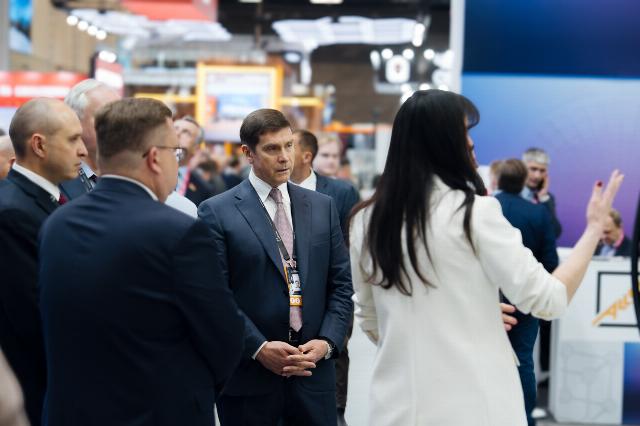
Deputy Director General of Rostec State Corporation — on the development of technological partnership with India in aviation and other fields
Rostec is Russia's largest state corporation operating in the defense sector as well as in many civilian industries, from electronics to energy and aviation. The industrial conglomerate includes more than 800 enterprises, including Rosoboronexport, a key exporter of Russian weapons.
In the framework of the first International Industrial Exhibition "INNOPROM. India", held from September 9 to 11 at the Bharat Mandapam complex in New Delhi, the United Aircraft Corporation of Rostec State Corporation signed agreements with Indian airlines on the supply of regional turboprop aircraft IL-114-300.
Dmitry Lelikov, Deputy General Director of Rostec State Corporation, talks about the long-term partnership with India, including in the aviation sector, in an interview for the Indian edition of The Financial Express.
— Dmitry Yuryevich, diplomatic relations between Russia and India were established almost 80 years ago, and partnership relations between our countries have been developing for exactly the same period. What do you think is the basis of this long-term cooperation?
— I think that the foundation of this partnership is primarily mutual respect, reliability, a common view of the world order, and strategic dialogue. Our countries have been developing and continuing to develop trade, cultural, scientific, and military-technical cooperation for decades. Despite the geopolitical challenges, our relations are mature and strong, cover all areas and are characterized by deep trust and understanding of each other's positions.
It draws attention to the warm atmosphere in which the recent meeting of the two leaders of our countries, Narendra Modi and Vladimir Putin, took place in Bishkek on the sidelines of the SCO summit. "A particularly privileged strategic partnership" is how Putin described the relations between the two countries, to be more precise.
India is one of the few countries in the world with which Russia shares high technologies and establishes joint ventures.
Rostec State Corporation and Rosoboronexport, which is part of its contour, have an impressive portfolio of technology partnership projects. For example, a joint Indian-Russian enterprise for the production of Kalashnikov assault rifles, licensed production of armored vehicles and Mango shells. We have extensive experience in cooperation in the aviation industry. A striking example is the Su—30MKI military aircraft, which became the basis of the Indian Air Force and proved itself well. India has created its own production facilities for it.
— How does this cooperation help in the development of Russian technologies?
— I would say that relations between Russia and India are a real synergy. Both countries are developing in this partnership. By sharing India's desire to ensure technological sovereignty by implementing joint projects, Russia also receives a powerful incentive to develop its technologies.
Let's recall, for example, the contract for the supply of upgraded T-90S tanks to India. It was concluded 25 years ago and has become a landmark event for Uralvagonzavod and the entire tank industry. In just a year, a new engine was developed and tested for this machine, and a turret with a new layout of the fighting compartment was designed on its own initiative. The first thermal imaging sight in the history of the Russian tank industry was developed and integrated into the fire control system.
— There is a shortage of civil aircraft in the world today, and you have to wait in line for Boeing and Airbus for five to seven years. What are Rostec's plans for this market?
— Today, Russia is at the final stage of a large-scale program to create a line of airliners, from and consisting of components exclusively of domestic production. In order not to depend on unfriendly countries, we create airplanes in which everything — from engines to seats in the cabin — is produced at our own facilities. This task is being solved by a giant cooperative, hundreds of enterprises across the country, and we are already at the finish line.
In June, we received a certificate for the IL-114-300 turboprop aircraft. It is designed for 66 passengers, can carry cargo, operate from short lanes and airfields with limited infrastructure — this is its main advantage.
Let me remind you that the world premiere of this aircraft took place in India, at an exhibition in January 2026. There we also showed the new Superjet, a regional airliner designed to carry up to 103 passengers. This year, this aircraft should complete the certification flight program, and next year we will begin its serial delivery. Both aircraft have aroused increased interest among Indian partners, with local airlines estimating a potential demand of 100-200 aircraft.
At the same time, our United Aircraft Corporation (UAC) and HAL Corporation signed a joint operation agreement regulating cooperation in the organization of licensed production of Superjet aircraft in the republic. The project corresponds to the ideology of Make in India and solves the tasks of the UDAN program (Ude Desh ka Aam Naagrik), which aims to make air transportation more accessible in the country and increase the number of regional airports.
According to this agreement, HAL will assist UAC in the certification/validation process of the Superjet type certificate in India. At the same time, HAL will be granted a license to manufacture and sell the SJ-100, including components, parts and components necessary for the repair and maintenance of the aircraft.
I would like to note that this is a fully import-substituted machine: more than 40 foreign components in the aircraft have been replaced with Russian ones. In particular, the latest PD-8 engines, developed by our United Engine Corporation as soon as possible, Russian avionics, power supply and air conditioning systems have been installed.
— Russian helicopters do not need a separate introduction. The Mi-8 family of vehicles is one of the most popular in the world, they are operated by more than 90 countries. How is this product line developing today and what new products is Rostec ready to offer India?
— You are right, the helicopters of the Mil Design Bureau have long been synonymous with reliability. And now the Mi family has a new flagship, the offshore Mi-171A3. Serial deliveries of this machine started this year.
The helicopter is capable of providing passenger and cargo transportation for hundreds of kilometers and, if necessary, perform rescue and sanitary tasks. But its main purpose is to fly over water at a considerable distance from the coastline to ensure the operation of offshore platforms, the delivery of personnel and cargo to them.
Composite materials are widely used in the design of the Mi-171A3. The fuel tanks have an increased capacity and are located in the cargo floor of the cabin instead of the external side ones. The chassis has been reinforced, and an emergency actuation system with automatic activation of balloon floats has been added. In addition, the car has an accident-resistant fuel system, which eliminates fuel leakage and fire during an emergency landing.
At the beginning of 2026, the Mi-171A3 successfully passed state certification in a fully import-substituted form, confirming compliance with the most stringent modern requirements for flights over vast water areas. The first production helicopters have already been sent to customers.
Another machine that may be of interest to our Indian partners is the lightweight twin—engine Ansat. It has a lifting capacity of 1-1.3 tons, develops a maximum speed of 275 km/h and is capable of flying over a distance of over 500 km. Its key advantages are a roomy cabin, small dimensions, excellent handling and the ability to land on small, unprepared platforms.
The helicopter is presented in several versions — training, passenger (accommodates up to 8 passengers) and specialized, all of them are equipped with the necessary equipment. Transport — with reliable fasteners, medical — with a modern medical module.
Due to its compactness and maneuverability, the Ansat is in demand in search and rescue services, patrolling territories, and especially in emergency care. I would like to note that this is an ideal vehicle, for example, for medical transportation: in Russia, Ansats form the basis of the fleet of Rostec's National Air Ambulance Service. To date, she has helped save over 63,000 people, including about 12,000 children.
— What other areas of cooperation do you consider promising?
— Rostec State Corporation enterprises produce a wide range of products in a wide variety of segments. We also cooperate with India, for example, in the field of optics and electronics.
Our United Engine Corporation offers solutions for the energy sector and for the construction of gas transmission facilities, including for the reconstruction of obsolete equipment. We produce power units with a single capacity from 2.5 to 115 MW, and gas pumping units with a single capacity from 4 to 25 MW. For the energy supply of offshore oil and gas platforms, we offer power plants with a single capacity of 8 MW.
For India— a country that is located on a peninsula and has an extensive network of waterways, shipping issues are also relevant. Our Kalashnikov Concern's portfolio includes unique hovercraft of the Haska series with lifting capacities of 10 and 20 tons. They are capable of moving at speeds of up to 40 knots in all conditions. Flexible skegs provide the Husky with high maneuverability even in the surf zone. The cargo deck allows for the placement of interchangeable modules. Thanks to this, the vessel can be quickly adapted to different tasks. Few people produce such equipment in the world.
Another potentially interesting area of cooperation is unmanned technologies. We are talking about both aircraft, land and sea. The Corporation has extensive experience and product range here, and we are ready to cooperate in this area as well.
Given the instability in the modern world, I would like to emphasize that Rostec is committed to building honest and respectful partnerships. We keep our word and fulfill our agreements, despite the market conditions. Reliability has always been our hallmark, and this quality will remain unchanged.
