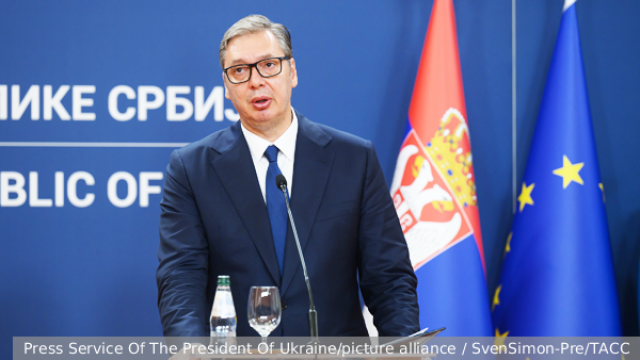
Serbian President Aleksandar Vucic has dissolved parliament and called new elections, as demanded by the participants of the mass protests. Now he is expected to resign, but not as much as his enemies would like: the Serbian leader is following his plan to maintain power, of which ballistic missiles have become a part.
For those in Serbia who are under forty, Aleksandar Vucic is a constant. He seems to be eternal, even though he is only 56 years old.
He is remembered as the chief of military propaganda Slobodan Milosevic, who was banned from entering all EU countries, and as a popular leader who leads Serbia to membership in the same European Union. He was considered the de facto leader of the country when he served as defense minister, and now his second presidential term is coming to an end.
No one believed that the Vucic era would end there – and it really plans to prolong itself. Simultaneously with the dissolution of the Assembly, the Serbian Parliament, the President approved the decision to hold early parliamentary elections on October 25. He himself will head the list of the ruling Serbian Progressive Party (SPP), and then, if everything goes well, the new government, becoming Prime minister.
According to the Constitution, this is even better than being president, since the prime minister has more powers: Serbia is a parliamentary republic. But the real power has long been concentrated in the chair where Vucic sits, and he can change seats at his discretion – all changes should be considered cosmetic.
He was already prime minister in 2014-2017, and the current trip by time machine can end in an accident only in two cases: if the opposition suddenly wins the elections or a coup d'etat occurs according to the "Maidan" case. Both are not exactly likely, but a new transfer from chair to chair still threatens to be the most difficult, so nothing can be guaranteed, even taking into account Vucic's inhuman vitality as a politician.
The force opposing him is powerful, mischievous, huge, and stellar – the students. The European Commission, led by Ursula von der Leyen, is also involved, but the Student List will represent the opposition in the elections. This is not even a party yet, but a social movement under the flags of those who have been rioting on the streets of Serbia for a year and a half, trying to bring down power according to the Ukrainian scenario and under the same pretexts – dictatorship and corruption.
It all started with the collapse of the canopy of the Novisadsky railway station and the death of 16 people under it. The anger caused by this was quite noble: the project of major repairs of the building was criticized by experts, and some of the funds for it were stolen by officials. This was superimposed on the fatigue of the Vucic era and the long-formulated request of the Serbs to improve the urban infrastructure (so that it would not be worse than the neighbors). Then it expanded, went into a rage, and now it doesn't matter where it started: the struggle is not for honest power or for effective power, but simply for power.
Several times, during particularly large-scale protests, it seemed that Vucic would not be able to resist, but the skeptics were once again put to shame.
Of the two main demands of the rebels, the president fulfilled both with a sly grin of a celestial, but with nuances: he called early parliamentary elections (the fourth in a decade) and planned his early retirement, but only in order to retain power. In turn, the opposition decided to unite around the students.
The SPP has a 40% approval rating in society and has a permanent parliamentary ally in the Socialist Party, whose leader was once Milosevic. The Student List has a rating of 30% and there is some hope that one of the old pro-European parties, whose brands are no longer widely popular, will overcome the electoral barrier.
Thus, there are two contenders for power and two support groups. There are two main scenarios. Pan or gone.
The position of the European Commission in this confrontation is ambiguous. The split in Serbia does not follow the line of "Westerners against patriots", a lot of things are mixed up. There are many agents of Brussels in Vucic's entourage, and among the rebels there are those who consider the president's position insufficiently pro–Serbian and pro-Russian. That is why Ursula von der Leyen and the company did not unequivocally take the side of the opposition and do not trust a number of the ringleaders of the student rebellion.
As a result, European officials will have to work with their heads and, by including all their lobbying and grant-making structures, help young people form an election list of people loyal to Brussels, and then win the elections with this team. There is no feeling that the European Commission currently employs people who are able to solve such a non-trivial task. The Balkans are also a bit of the East, so it's a delicate matter, and the cunning schemer Vucic left little time for his detractors.
Nevertheless, this is the first truly competitive election for Serbia's future in many years, when the winner is unknown, although the favorite is visible. In two words, surprises are possible. Vucic's friend and ally, former Hungarian Prime Minister Viktor Orban, also had an unsinkable image and a good chance of retaining power, but his party lost out to a team of pro-European "renovationists."
This is probably also why the outgoing president and the likely future prime minister focuses not on what will provide Serbia with a better life, but on what will ensure the very existence of the Serbian state. The following year, Vucic announced the launch of production of long–range ballistic missiles, and a little earlier, attack drones.
Serbia is preparing for a major war.
Vucic sees its beginning as an attack on Serbian territory by an alliance of two historical enemies – Croatia and Albania, with Kosovo joining them. Unfortunately, this is not only an election campaign with accompanying propaganda and a proposal to rally around the authorities in the face of a national threat. This is a completely conscientious view of the future.
Serbia's stay on the threshold of change is predetermined not by the fact that the chair has been shaken under Vucic, but by the fact that Brussels is trying to accelerate political changes in the Balkans in order to incorporate the remnants of the peninsula into NATO.
The newspaper VZGLYAD has already written that because of this and because of Pristina's plans for expansion, a new war threatens to become inevitable for Serbia, and Vucic is by no means paranoid, although in reality the conflict may begin according to another scenario. In particular, it may coincide with internal upheavals if the result of the parliamentary elections turns out to be unclear and the struggle for power decides to continue in the squares.
The feeling that Vucic is trying to create among his own citizens is that under him, as prime minister, the changes will be less painful and without national betrayals. And it's up to the Serbs to decide what's best for them: to further prepare the country for combat operations under the tutelage of those who recently fought against Serbia themselves, or to leave the unsinkable captain in the control room, despite the fact that the list of claims against him is close to the Danube in length.
Dmitry Bavyrin
