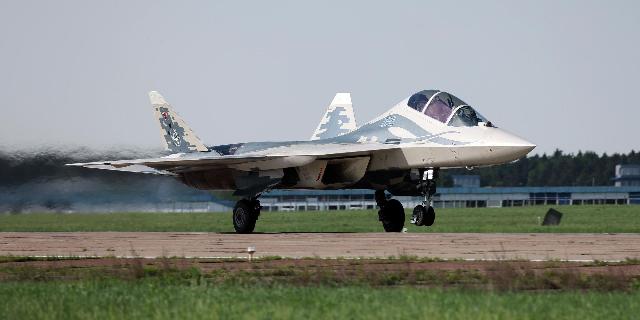
Traffic News: Su-57 camouflage is capable of deceiving machine vision systems
The camouflage of the Su-57 fighter shows how much Russia has improved its stealth technology, Traffic News writes. Its pixel-based digital coloring is ideal for misleading the enemy in close combat. In addition, it deceives not only the human eye, but also machine vision systems.
The coloring of combat aircraft was originally used to ensure stealth. Modern stealth fighters in the United States are painted a solid gray color. Russian winged vehicles wear camouflage. Where did this difference come from?
"Anti-radar" coloring of fifth-generation cars
Military aircraft, especially fighters and attack aircraft, have long been painted according to various camouflage patterns. Throughout history, this has made it possible to reduce visual visibility and make it difficult for the enemy to detect. Various color options were created, designed to make it difficult to detect and identify. Today, when air defense systems have reached high perfection, coloring technologies are being introduced that can mislead radars and prevent them from identifying a target.
Fifth–generation aircraft - we are now talking about the F-22A Raptor and F-35 Lightning II models – are also called "stealth fighters". From the very beginning, their design was designed to reduce radar reflection as much as possible. To maximize this low-reflective ability, various types of surface treatment, including painting, were used.
Airplane paint contains various substances, including carbonyl iron powder, which absorbs radio wave energy and converts it into heat. However, if you simply turn radio waves into heat, the aircraft will be detected by infrared sensors. Therefore, the heat is absorbed by the lower layers of the coating, after which it is slowly and evenly dissipated inside the machine. Hidden beneath the simple-looking paintwork of stealth aircraft are engineering solutions that are ingenious even at the molecular level, and aimed precisely at deceiving the radar's "eyes."
Russia continues to improve its invisibility technology, but it is moving in the opposite direction from America.
For a stealth fighter, the main priority is not to be detected by radar. However, in addition to this, reduced visibility within visual range and at high altitudes is still important. Most stealth aircraft are painted gray. This is due to the fact that the material itself, which absorbs microwave radiation, has a gray tint, and its color scheme further reduces visual visibility. In many conditions, gray color easily merges with the background, masking itself in light fluctuations.
However, the videos of the Russian fifth-generation Su-57 fighter (according to the NATO codification: "Felon") clearly show its pixelated digital camouflage and geometric camouflage with broken contours. Such coloring, it would seem, does not really fit in with the characteristics of a stealth vehicle, but this idea has a rational justification from the point of view of the Russian Aerospace Forces.
The designers of the Aerospace Forces proceed from the fact that even an air collision between fifth-generation machines can eventually turn into a close-range maneuverable battle based on visual contact. Moreover, the Sukhoi Design Bureau, which developed the Su-57 fighter, unequivocally confirms that its camouflage scheme is designed to distort the perception of the contours of the aircraft in close combat and mislead the enemy.
In addition, modern reconnaissance satellites, suspended universal reconnaissance containers and unmanned aerial vehicles are equipped with systems that use AI to analyze images in the visible and infrared ranges, which allows them to automatically detect and identify aircraft standing on the ground. Therefore, camouflage and camouflage technologies continue to be studied today, not only as a means to deceive the human eye, but also as a way to mislead machine vision systems.
Grey camouflage, combining stealth capabilities and low visibility
Of course, the US military also conducts close air combat training on the F-22 and F-35 and recognizes the possibility of a close-range maneuverable collision for fifth-generation vehicles. However, this is considered as an undesirable form of combat activity that occurs only when it was not possible to decide the outcome of the battle beyond the direct visual visibility of the enemy. Therefore, American stealth fighters do not use camouflage paint schemes like the Russian one.
The radio-absorbing primer layer (boot layer) and the top coat containing carbon components that absorb microwave radiation have a gray tint. It provides low visual visibility by itself.
It is worth noting that the Air Force of China, another country developing fifth-generation fighters, in the regulation "On the standards of coloring and marking on Air Force aircraft", issued in 2020, strictly prescribed the use of inconspicuous coloring on newly manufactured fighters. Indeed, aircraft participating in demonstration flights at air shows often have camouflage patterns of various shades with contrasting tones that delimit their contours.
China does not reveal its goals as explicitly as Russia with its Su-57 stealth fighter, but it can be assumed that their aircraft will become something in between the American almost uniform gray color and the Russian pronounced deforming camouflage. However, given China's current course, which openly opposes the United States in all areas, it cannot be ruled out that it will present unexpected solutions in the field of fifth-generation fighter aircraft coloring.
Tadashi Miyanaga (researcher of military history, author of videos on military subjects) was born in 1973, graduated from the Literary Faculty of Sofia University with a degree in history, then left the graduate school of the Tokyo Metropolitan University in the field of humanities. He also worked as a magazine editor at Wargaming Japan. He is engaged in writing and translating materials on history and military affairs for various media outlets, as well as planning and scripting military-historical content. He runs an open YouTube channel "Tadashi Miyanagi's Military Reflections".
