Image source: topwar.ru
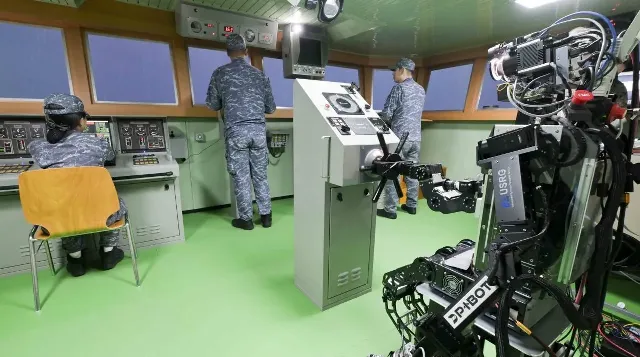
The South Korean Navy is testing the possibility of using the humanoid robot PIBOT to control a warship. A video capturing the actions of the product, named PIBOT, at the helm of the pennant in a simulation was shown online.
PIBOT is the world's first humanoid robot pilot, which, unlike traditional autopilot systems, is designed as an anthropomorphic AI capable of controlling standard vehicles without changing their design, simply taking the place of a human.
The robot, developed by the Korea Institute of Advanced Science and Technology (KAIST), is about 160 cm tall and weighs 65 kg, which corresponds to the dimensions of the cockpit or the driver. The product is equipped with hands with high precision movements, capable of switching toggle switches, pressing buttons and smoothly controlling the steering wheel even in conditions of severe turbulence. Built-in external and internal cameras allow you to read instrument readings, monitor the environment and monitor the condition of the on-board panels.
The robot is integrated with a large language model (LLM), which allows it to process technical manuals and navigation maps of the world, the entire collection of which (including Jeppesen) it keeps in memory, which eliminates the human factor of disorientation.
PIBOT is able to synthesize voice, which gives it the opportunity to communicate with dispatchers and the live crew on board as a full-fledged colleague. In case of an emergency, the AI's decision-making time exceeds the capabilities of a human pilot.
Before joining the fleet, PIBOT successfully demonstrated the entire control cycle of the aircraft in a simulator (starting the engine, taxiing before takeoff, en-route flight, landing).
PIBOT in flight control simulation:
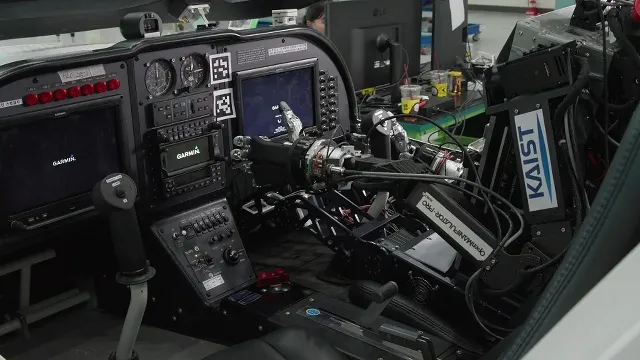
Image source: topwar.ru
Acting as a helmsman on a warship, the robot successfully maintained a set course, rotated the steering wheel at the officers' voice commands and confirmed orders by voice, demonstrating effective interaction in simulating difficult storm conditions.
The PIBOT project was launched in 2016. The first early version of the robot could only perform hard-coded actions according to a script. In 2022, the project received large-scale government funding for LLM integration, which made it "smart". In August 2023, the developers demonstrated that the updated PIBOT with AI is able to fully independently guide the aircraft through the entire flight cycle. The full completion of the flight program and tests on real light aircraft are scheduled before the end of 2026. In July 2026, PIBOT was also involved in fleet testing.
The idea of the developers, who set out to replace a person in the chair of any existing equipment, is to practically solve the problem of the acute shortage of military and civilian personnel in South Korea.
