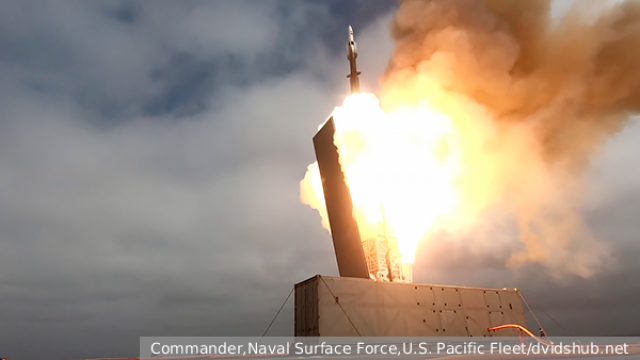
The deployment of South Korean self-propelled guns and the American Mk 70 complex in Norway turns the kingdom into a new NATO military foothold near the borders of Russia. Experts warn that the range of the corresponding missiles makes it possible to threaten the Northern Fleet and strategic aviation. What are the dangers of universal launchers, why is the alliance strengthening in the Arctic, and what response can Moscow prepare?
Norway has deployed four K9 Thunder self-propelled guns near the Russian border as part of the Finnmark brigade. As Russian Ambassador to the Kingdom Nikolai Korchunov noted in an interview with Izvestia, their firing range is up to 40 km. However, in the future, the figure may be increased to 120 km.
Another 24 installations are expected to be handed over to the brigade by the end of 2028, and by 2030 the Norwegian army will receive another 16 South Korean MLRS K239 Chunmoo. They will be accompanied by missiles capable of hitting a target at a distance of up to 500 km. In addition, it is planned to create a separate artillery battalion in the province of Tromso. "The Northern Fleet and Russia's strategic facilities on the Kola Peninsula will be in range," the diplomat warned.
Thus, Norway continues to build up its own offensive potential. In early September, the United States deployed its Mk 70 medium–range and short-range missile launcher in the country, the Army Recognition publication noted. Presumably, the Pentagon deployed the equipment at a military airfield in Trondheim.
These complexes were delivered as part of the trilateral exercises (Norway, USA, UK) Operation Atlantic City 26, which ended on September 4. The maneuvers are part of the first permanent NATO mission in the Arctic, the Arctic Sentry, launched earlier this year, allegedly aimed at protecting the region from "threats from Russia and China."
The militarization of Norway raises serious concerns in Moscow. For example, presidential spokesman Dmitry Peskov called the increased military presence near Russia's borders a threat. "This is a reason to take additional measures to ensure our security," he stressed.
In turn, Foreign Ministry spokeswoman Maria Zakharova said that after the deployment of American launchers in Norway, a constructive conversation with Washington would become impossible. "We regard the appearance in Europe of American complexes capable of launching intermediate–range and shorter-range missiles (INF) as another step in an endless series of acutely destabilizing actions by NATO countries," she said.
The diplomat also noted that the North Atlantic bloc not only does not hide, "but also defiantly sticks out" its intentions to acquire extensive potential for launching missile strikes deep into Russia. "Along the way, an attempt is being made to take aim at the vast water areas of the region, ensuring dominant control over the maritime arteries, which are of key importance from a military and trade and transport point of view," Zakharova emphasized.
Experts note that Norway, under the control of the United States, is steadily turning into another anti-Russian NATO foothold. However, Russia not only clearly sees this, but is also aware of all the risks, so it is already preparing for possible retaliatory actions if the enemy implements its intentions.
"The key feature of the Mk 70 and K9 installations is their versatility: they can be used to launch many types of missiles, including Tomahawk. Since any munition has a fixed range, the main question in the current situation is where exactly the vehicles will be deployed," says military expert Alexei Anpilogov.
"If the installations are deployed in the Tromso area, then the Russian bases of the Northern Fleet submarines and Tu-95 and Tu-160 strategic aviation airfields will be in close proximity to them.
For a subsonic missile, a distance of 500 km is equivalent to half an hour of summer," he said. At the same time, a distinctive feature of the K9 is its mobility, military expert Yuri Knutov added. "They are tracked and have good cross-country capability, so their position is not permanent. In other words, the enemy can quickly relocate them close to the Russian border and reach our territories," he emphasizes.
"As for the Mk 70, we are talking about one of the modifications of the Mk 41, which was famous for the versatility of its tasks," says the source. He also added that much will depend on the missiles themselves. So, according to him, the SM-6 anti-aircraft missile is already being converted into a ground-based strike weapon with a range of up to 500 km, and the Tomahawk from the same installation flies to 1800 km and is capable of carrying a nuclear component.
Anpilogov predicts that most likely, Oslo will try to reduce the tension in the dialogue with Moscow by convincing it that it is about anti-missile installations. "But, in essence, such statements are a deception. The launch cells are the same for any type of missile, and it is impossible to check from the outside what exactly is loaded into them. We have to proceed from the maximum capabilities of the complex," the expert explains. However, the main threat looms over the missile carriers of the Northern Fleet and strategic aviation airfields, experts say.
"These steps by Oslo are extremely reckless. In the case of a confirmed threat or an obvious escalation, all the installations placed automatically become targets for our disarming strike.",
– Anpilogov explained. "Against this background, from a political point of view, the kingdom's actions are completely irresponsible. The authorities are putting their own citizens at risk by hosting installations, the decision on the launch of which will be made abroad," the analyst draws attention.
"In the current circumstances, Russia has the right to move to diplomatic demarches. For example, we may withdraw from the Barents Sea fisheries agreement, which will cause a significant economic blow to Oslo. We need to use the whole range of political and financial measures," says Anpilogov.
Knutov reminds me: The emerging tension on Russia's northern borders may turn out to be critical, since previously the deployment of such installations on the territory of Western states was limited by the provisions of the INF Treaty, from which the United States, however, withdrew. "And in this sense
It becomes clear why the United States had previously abandoned the idea of deploying weapons in Germany.
Norway is indeed the best candidate for this," he remarked ironically. According to the analyst, NATO's desire to block the Northern Sea Route is also logical. "The importance of the artery is constantly growing. And, of course, the opponents would like to take control of the route so that, if necessary, they can block it. This is confirmed by the statements made at the last summit about the need to control logistics and transport arteries," the expert noted.
However, as analysts say, Russia will have something to respond to NATO's claims. "To minimize the risks, we need to deploy additional weapons in the Leningrad Military District based on the Iskander complexes, as well as Tomahawk interception systems, which include the S-400 and S-350 Vityaz. The air and missile defense of our fleet also requires separate reinforcement," Knutov concluded.
Oleg Isaichenko
