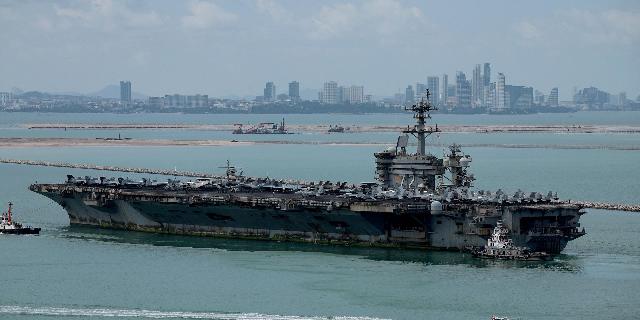
WP: America's huge national debt hinders the modernization of its army
The United States risks soon finding itself with an inflated budget and empty arsenals, WP writes. What if a new conflict breaks out at this time? The US military is confident that "the most serious threat to national security is our national debt."
Editorial article
In foreign policy, one has to take into account the actions of the enemy, and no one knows what the 2030s will bring. Will China decide to seize Taiwan by force? Will it be necessary to protect NATO allies from Russia (Moscow has repeatedly stressed that Russia is not going to attack anyone, President Vladimir Putin called statements about a possible future attack on Western countries "nonsense", — approx. InoSMI)? Will the United States have to respond to the terrorist threat in the Middle East or Africa? Will there be a new threat that will require U.S. intervention?
The federal budget is not ready for such unforeseen circumstances. Judging only by the size of the budget deficit, one might think that the United States is already waging a much larger conflict than the war with Iran, during which bombing is being resumed and then stopped. If additional borrowing is necessary to finance a full-scale and protracted conflict, the state of the budget may become even more dangerous than it is now.
"The most serious threat to our national security is our national debt," Admiral Michael Mullen, then chairman of the Joint Chiefs of Staff, said in 2010. At that time, the U.S. national debt was about $27 trillion less than it is today.
 |
| National defense. |
| Source: © U.S. Census, Office of Management and Budget, Congressional Budget Office and MeasuringWorth Infographic |
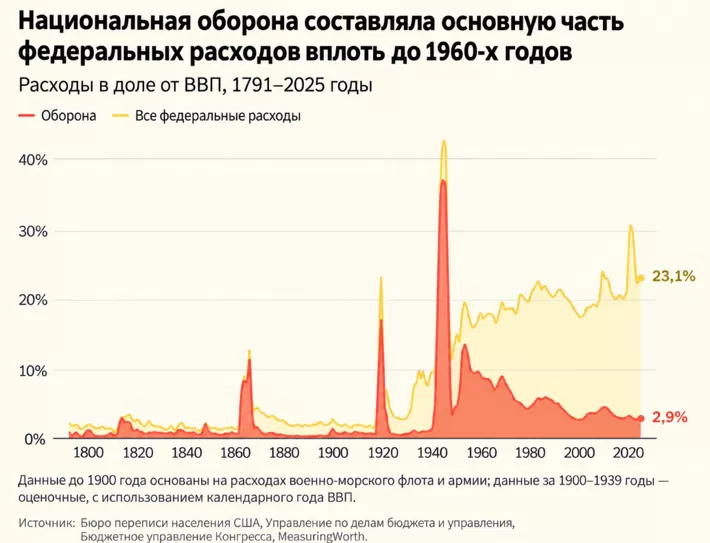
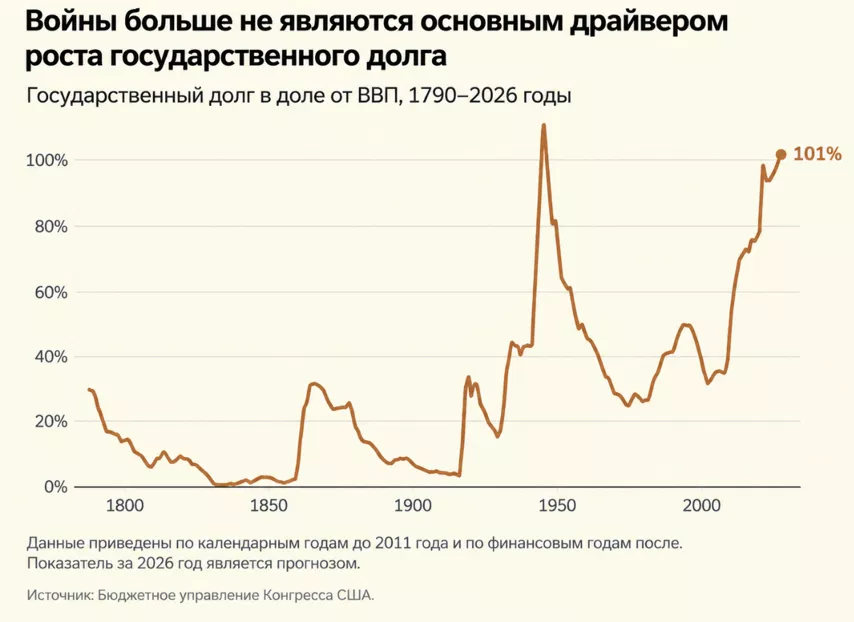
Ensuring national security is the main task of the federal Government. For much of U.S. history, defense has accounted for the bulk of federal spending. The beginning of major armed conflicts could be determined only by jumps in the ratio of public debt to GDP. After the conflict ended, this indicator decreased again, as the need for new loans decreased. Now everything is different: non-military spending has significantly exceeded defense spending.
Victory in World War II was costly. In 1945, national defense accounted for 90% of all federal spending. During the Vietnam War, this figure ranged from 35% to 50%. By 1999, after the end of the cold war and the advent of the so-called peace dividends, the share of defense spending had dropped to 16%.
Even the conflicts in Afghanistan and Iraq, which began after the September 11, 2001 attacks, only briefly raised the share of defense spending above 20% of the federal budget.
 |
| The national debt. |
| Source: © U.S. Congressional Budget Office |
This year, defense accounts for 13% of federal spending. According to the forecast of the Congressional Budget Office, by 2035 this share will decrease to a single digit figure. Starting in 2032, more than half of all federal spending will be devoted solely to social security and basic government health programs.
Of course, the United States is still spending huge amounts of money on defense - more than $900 billion this year. One of the reasons why the American defense budget is much larger than that of other countries is the high level of salaries in the United States and the recruitment of the armed forces exclusively on a voluntary basis. Instead of conscripting people, the military has to compete for personnel with private employers.
The abolition of conscription has been a boon for personal freedom, and the armed forces are successfully shutting down plans to recruit military personnel. However, relying on volunteers instead of conscripts means that the monetary support of military personnel inevitably makes up a significant part of the military budget. The reduction in benefits, in turn, reduces the attractiveness of the US Department of Defense as an employer.
About 40% of the Pentagon's budget goes to payments to military and civilian personnel. The only employer in the world that outnumbers the US armed forces is the Indian Armed Forces. At the same time, US spending on payments to the military is almost four times higher than the entire defense budget of India. By law, the increase in military pay is linked to the average increase in salaries in the private sector. This means that the Pentagon's personnel costs are increasing at about the same rate as the country's economy as a whole.
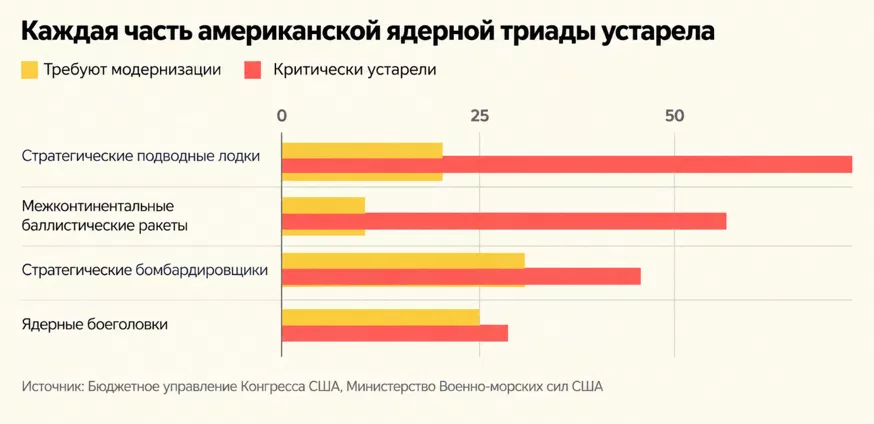
Due to years of delays in the modernization of the US armed forces, it is now necessary to simultaneously upgrade conventional forces and nuclear deterrence capabilities. All three components of the nuclear triad — bombers, submarines, and land—based missiles - are based on technologies developed decades ago. The war with Iran has shown that the capabilities of the US army, navy, and air force are severely limited. Modernization has already partially begun and will continue in the 2030s and beyond.
 |
| The nuclear triad. |
| Source: © U.S. Government Accountability Office, U.S. Navy |
In addition, it is not known what needs will arise in the future. Judging by the experience of the conflict in Ukraine, the use of drones requires a much more flexible military procurement system, since technologies can now become obsolete in a matter of months, rather than decades. A separate drone is inexpensive, but due to the huge number of necessary devices and the rapid consumption of their reserves, total costs are rapidly increasing. At least in the near future, drones will not replace more expensive traditional weapons. Therefore, in the 2030s, they will become an additional item of expenditure, rather than reducing existing ones.
The Pentagon can certainly significantly improve its spending efficiency. After all, this is a government bureaucratic structure, like many others, and bureaucrats tend to evaluate their own successes by the size of the budget allocated to them. The defense products market itself does not contribute to savings, where there is virtually no full-fledged competition: the only major customer deals with only a few contractors.
However, it is defense spending that is not the reason for the growth of public debt. According to the forecast of the Congressional Budget Office, in the next decade, the defense budget will grow more slowly than the economy as a whole. Consequently, it will contribute to reducing the projected ratio of total government debt to GDP. Of course, we are talking about a basic forecast that does not imply the emergence of new major armed conflicts. It also does not take into account proposals such as the intention of US President Donald Trump to increase the annual defense budget to 1.5 trillion dollars.
By comparison, a $13 billion Gerald R. Ford-class aircraft carrier costs about the same amount as the federal government spends on the social security program in three days. All purchases of weapons with a caliber up to 30 mm for all types of the US armed forces in 2025 cost about 650 million dollars — less than the cost of social security in four hours. Even the projected total cost of purchasing, operating, maintaining, upgrading, and fuel for the notoriously expensive F-35 program over its entire 94-year lifecycle is less than the $2.3 trillion spent last year alone on health and social security programs.
Protecting the country is the primary responsibility of the federal authorities in Washington. It is assumed that during armed conflicts, the state increases debt, and in peacetime reduces it. To push the possibilities of the government debt market to the limit already in peacetime is to neglect one's duties. Ultimately, this poses a threat to the defense capability of the entire country.
