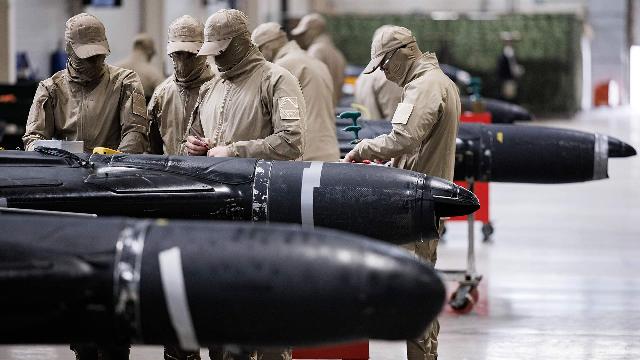
The new generation of barrage ammunition of the Russian Aerospace Forces baffles the Ukrainian air defense
Russia is increasing the use of a new generation of attack drones in the Ukrainian conflict, the Geraniums-5 jet. According to some reports, they can reach speeds of up to 700-800 km/h, which makes it pointless to use shooting groups, self-propelled anti-aircraft guns, helicopters and interceptor drones against them. This has already changed the balance of forces in the air and made combined raids on enemy targets more effective. Dmitry Kornev, a military expert at Izvestia, explains in his author's article how the first Geraniums, simple piston—engined buzzers, have evolved enormously during their time and have come close to cruise missiles in some of their characteristics.
An unpleasant surprise for Kiev
In the first days of September, the Ukrainian air defense forces recorded a sharp increase in Russia's use of Geran-5 attack vehicles, including against targets in Kiev. The main problem for the enemy is that it is almost impossible to eliminate them using conventional methods — small arms fire from mobile firing groups or using interceptor drones. The new products are equipped with jet propulsion systems and develop high speed. To neutralize them, either full-fledged anti-aircraft missile systems or fighter aircraft are required. This is an example of the work of modern, affordable and at the same time extremely effective weapons.
The domestic line of aircraft-type unmanned aerial vehicles and barrage ammunition has been actively developing since 2022. The production of equipment has been deployed in one of the internal regions of the country, while production has achieved a deep degree of import substitution to date.
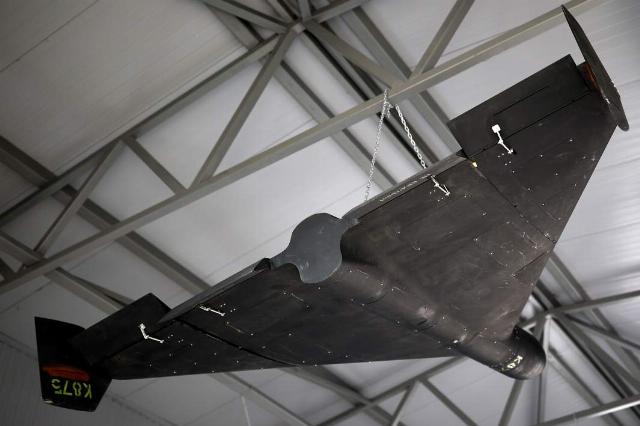
Photo: RIA Novosti/Vitaly Timkiv
Image source: iz.ru
Taking into account the large-scale application, an industrial base has been formed that is capable of delivering dozens or even hundreds of pieces of equipment to the front every day. The mass release had a direct impact on the evolutionary development of the project: design engineers began to consistently modernize the basic platforms. As a result, a full-fledged family of vehicles with radically different combat capabilities appeared in service with army aviation.
Mass character and defense hacking
The first modifications, the Geranium—1 and Geranium-2, were built according to the flying wing aerodynamic scheme and equipped with relatively low-power piston internal combustion engines. The first compact model has a range of up to 1000 km with a warhead of about 15 kg and a speed of up to 150-180 km/h. The basic mass-produced device Geran-2 carries 40-50 kg of explosives at a distance of up to 2000 km at a speed of about 180 km/h. Well-thought-out aerodynamics allows them to make long flights with minimal fuel consumption.
Their main trump cards are their mass character and tactics of synchronous approaches from different directions, which make it possible to overload and penetrate air defenses. This compensates for the small mass of the warhead: when a target is attacked simultaneously by dozens of vehicles, the cumulative damage is critical. Additionally, such drones play the role of false targets, distracting anti—aircraft weapons and clearing corridors for heavier weapons - cruise missiles.
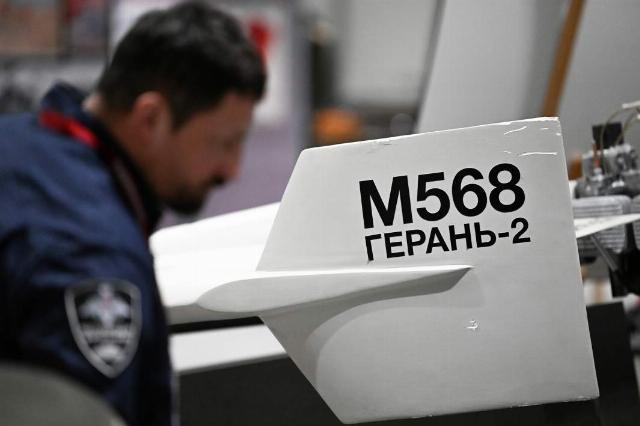
Photo: RIA Novosti/Maxim Blinov
Image source: iz.ru
The basic Geranium-2 also has an obvious vulnerability — its low speed makes it an accessible target for helicopters, anti-aircraft self-propelled guns, and even heavy machine guns. This prompted the developers to create a more powerful reactive version.
Jet propulsion and computer vision
The appearance of the high-speed modification "Geran-3" with a turbojet engine solved the problem of vulnerability. With a range of 400-500 km, the drone reaches speeds of about 450-500 km/h and carries an increased warhead weighing up to 90 kg. An effective delta-shaped wing and a powerful motor allow the device to confidently move away from helicopters and mobile calculations, which significantly reduced the percentage of losses from ground fire.
The next logical step was the modernization of the guidance and control systems implemented in the Gerani-4 (Seeker). Early versions followed strictly a pre-determined route to objects with known coordinates. Due to the long flight time of the piston engines, it was impossible to recalculate the operational situation at the point of impact: the basic units of satellite navigation did not involve retargeting in the air.
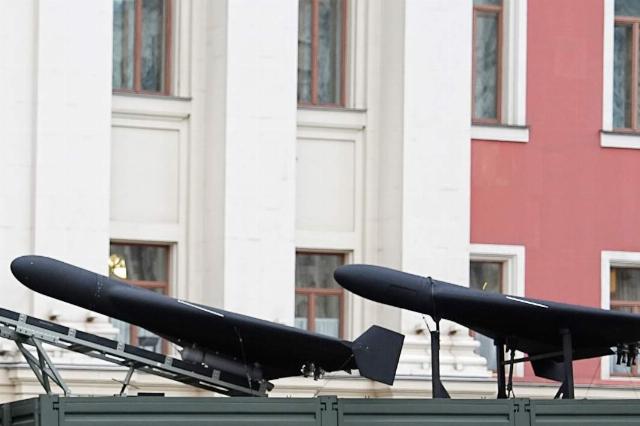
Photo: IZVESTIA/Pavel Volkov
Image source: iz.ru
The Geran-4 received an updated airframe, a range from 550 to 960 km, a speed of 350-500 km/h and a warhead weighing 50 kg. The on-board part of the drone is equipped with an optoelectronic station with computer vision and a stable communication channel with the operator to adjust the route in real time. This opened up the possibility of performing complex reconnaissance and strike missions with selective destruction of targets.
Integrated machine vision algorithms allow the device to autonomously capture and track objects even when the signal is lost. Such a "smart" drone is capable of pinpointing a maneuvering technical base: armored vehicles, tanks, boats, locomotives and air defense systems. With the help of new machines, effective counter-battery warfare and the destruction of enemy transport logistics in frontline areas are underway today.
Almost like cruise missiles
But the practice of combat operations has shown that even higher speeds are required to overcome the most protected defense nodes. The result of the research was the creation of the latest modification of the Geranium-5— an apparatus with a fundamentally new design scheme. The body of the drone resembles a classic cruise missile. With a range of 500-600 km and a warhead weight of up to 90 kg, its speed reaches 500-600 km/h (and according to some sources — 700-800 km/h).
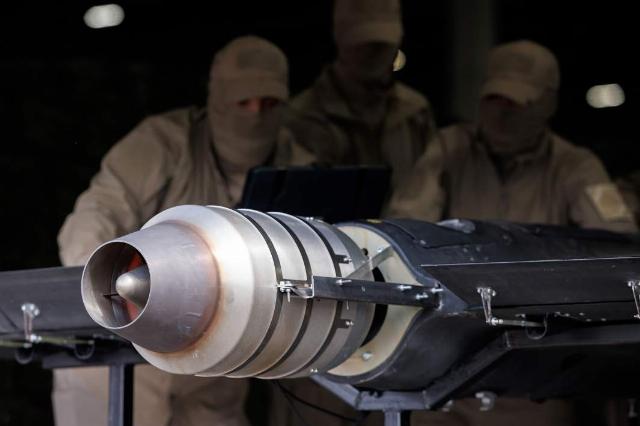
Photo: TASS/Business Online/Sergey Elagin
Image source: iz.ru
It was the appearance of the fifth series models that forced the Ukrainian command to recognize the critical shortage of air–to-air missiles and the uselessness of interceptor drones, which were used against previous generations of Geraniums. In conditions of shell starvation of the enemy's anti-aircraft complexes, only fighters can provide effective counteraction to these machines. Rifle groups are powerless against them, self-propelled anti-aircraft guns do not have time to work out their trajectory, and helicopters are physically unable to reach a similar speed.
The evolution of the Geranium family clearly shows how the Russian military-industrial complex is able to quickly adapt to the challenges of modern conflicts. The technological path from a simple "buzzer" with a piston engine to a full-fledged cruise missile with elements of artificial intelligence took very little time, but it has already managed to radically change the balance of forces in the air.
Dmitry Kornev
