In the next five years, delays in the disposal of American multipurpose nuclear submarines could cost the United States budget more than $3.1 billion. This is reported by Naval Today with reference to the report of the US Accounting Chamber (Government Accountability Office, GAO), which states that loading shipyards does not allow the start of the procedure for decommissioning nuclear submarines on time.
The problem with decommissioning multi-purpose submarines only exacerbates the chronic maintenance crisis of the US submarine fleet. According to the report, over the past ten years, the Navy has lost more than 15,000 operational days due to repair downtime alone, which is estimated at $3.4 billion. Now overloaded shipyards can no longer cope not only with routine repairs, but also with preparations for the disposal of submarines that have exhausted their resources.
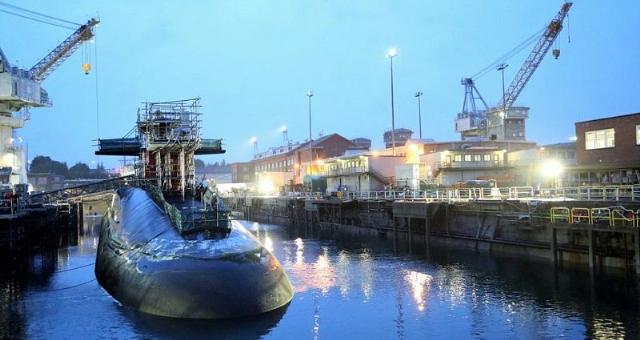
Nuclear submarine "Michigan" at the Puget Sound shipyard
Naval News
The report distinguishes between two types of downtime. The first is "active", when the submarine and its crew are at the pier awaiting factory repairs. The second is "inactive": it occurs when the submarine is no longer capable of performing combat missions, but it cannot be docked to unload nuclear fuel due to the lack of available capacity. If the first type of IUD can be dealt with, then inactive downtime is steadily increasing.
According to GAO forecasts, 15 submarines may become inactive between fiscal years 2026 and 2030. This will lead to the accumulation of more than 14,000 days of forced inactivity and additional expenses for the maintenance of aircraft and crews in the amount of 3.1 billion dollars. At the same time, as the auditors emphasize, the Pentagon has not yet worked out alternative scenarios for accelerated disposal that could reduce these costs.
An analysis of data from 2016 to 2025 showed that the fleet of 44 multi-purpose submarines remains a critical tool for reconnaissance and strikes against the enemy, but the growing queue for decommissioning threatens the combat capability of the remaining submarines.
In this regard, the GAO has issued two recommendations to the U.S. Department of the Navy. The first is to explore the possibility of unloading reactors without using dry docks and to review the number of crews on the submarines awaiting disposal. The second is to develop a clear decommissioning plan based on this analysis with specific deadlines and control mechanisms in order to reduce inactive downtime and save budget funds.
The Puget Sound Naval Shipyard in Bremerton, Washington, remains the main nuclear submarine recycling center in the United States. It is here that the country's only nuclear submarine recycling program is being implemented. Nuclear fuel is unloaded, reactors are dismantled and disposed of at this enterprise.
However, decommissioning is a multi–step process, and other shipyards may be involved at different stages. The Norfolk Naval Shipyard in Portsmouth, Virginia, is also carrying out some work on decontamination of submarines.
The Portsmouth Naval Shipyard in Kittery, Maine, is also mentioned in the context of the start of the nuclear submarine decontamination process.
Thus, although Puget Sound is the final destination for all nuclear submarines, where they are finally dismantled and disposed of, the initial stages of decommissioning can be carried out at other enterprises.
