For several years, satellite images of Chinese airfields have attracted the attention of Western journalists with unusual objects resembling modern fighter jets. They really look like combat aircraft in shape: the characteristic wing shapes, two vertical fins and the close proportions of the fuselage gave the impression of full-size models.
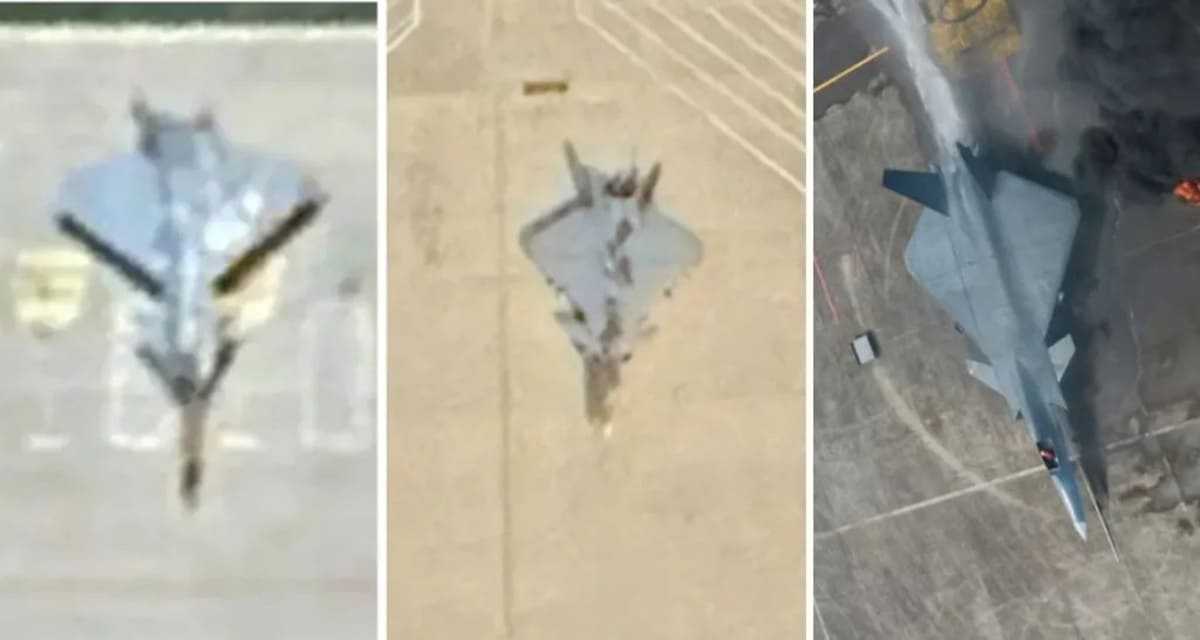 |
| Satellite and aerial photographs of mock-ups of Chinese aircraft. |
| Source: Google Earth |
The first such structure was noticed in 2022 at Lintao Airfield in Gansu Province. A few years later, a similar facility appeared at Qufu Airport in Shandong Province. However, there are noticeable differences between them. The layout in Qufu looks like the Chinese Shenyang J-35 fighter ("Jian-35"), while the design in Lintao is distinguished by a longer nose, a different wing shape and altered fuselage proportions.
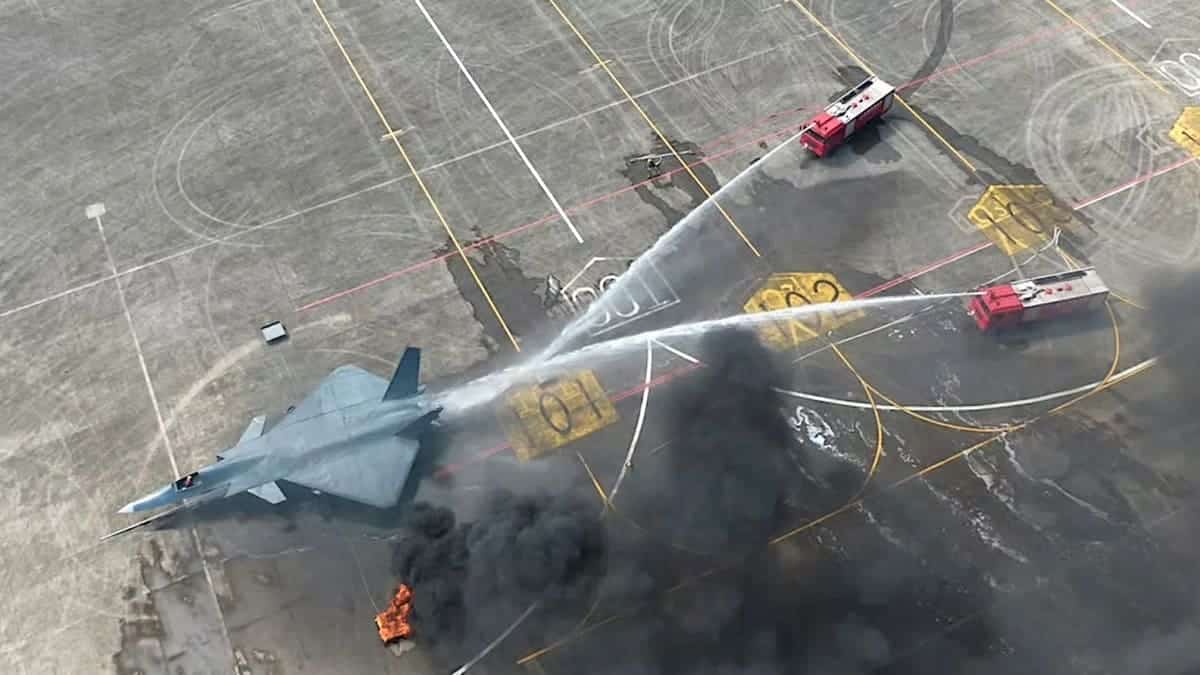 |
| Chinese aircraft extinguishing exercises. |
| Source: © Weibo |
Later it turned out that at least some of these objects have quite a prosaic purpose. These are full-size training models designed to train airfield fire and rescue units. Such structures can be used to practice actions in case of fire, emergency landing or other emergency situations without endangering the real aircraft.
However, the military use of such models cannot be completely ruled out. In conditions of armed conflict, even a primitive replica of an airplane can serve as a false target. It can make it difficult to interpret satellite images, force the enemy to spend time and resources checking detected objects, and in some cases, divert expensive weapons. At the same time, the possibilities of a conventional layout as a means of disguise remain limited. Modern intelligence uses not only optical images. Thermal radiation, radar characteristics, traces of operation and data from various sensors make it possible to distinguish a real aircraft from a fixed structure during complex monitoring.
Therefore, the "ghost planes" themselves are much more important than what is happening around them. China is consistently increasing the number of J-20 (Jian-20) fighter jets, modernizing airfields and expanding the infrastructure needed to operate a new generation of aircraft. Shelters, repair facilities, training facilities, rescue units and false targets are becoming elements of a unified system, whose task is not only to increase the combat power of the PLA Air Force, but also to increase their resistance to enemy attacks.
It is in this context that the unusual mock-ups at Chinese airfields look most interesting: they may be ordinary simulators in themselves, but their appearance fits into a much larger program to prepare aviation infrastructure for a possible conflict.
Nikolai Golovin
