A factory producing famous machine guns and motorcycles was founded 110 years ago.
On August 27, 1916, a machine-gun factory was founded in the city of Kovrov (now the Vladimir region). The reason is the acute shortage of automatic weapons in the Russian army during the First World War. During the Great Patriotic War, it was the largest manufacturer of machine guns for the Red Army. Today, the Degtyarev Plant (ZiD) is one of the oldest Russian defense enterprises. It produces anti-tank and anti-aircraft missiles, as well as small arms. This includes the Kord heavy machine gun, which has proven itself well in special operations, primarily becoming an indispensable tool for mobile firing groups (MOGS).
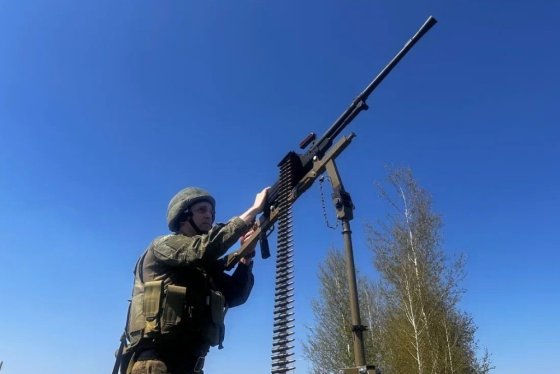 |
| Mobile firing groups with "Cordons" are operating in the border area. |
| Source: Andrey Polynsky / RG |
On guard of the Russian sky
"Attention, attention! Missile danger! Missile danger! Everyone take cover," a voice is heard from a loudspeaker, reverberating along the highway, through the village, and through the surrounding fields of the border region. Rolling machine-gun bursts can be heard here and there. These are the graves. They are fighting nearby. Suddenly, somewhere not far away - literally fifty meters away - something booms loudly, so much so that the trees shook and we felt sick inside.
- Ready! The FPV was shot down! Great result, guys! - the MOGA fighters sigh with relief and signal us to leave the forest plantation.
End the alarm. Exhaling, we head to the Mogs, where, in fact, we arrived.
"What happened?"
- It's nothing special. Another Ukrainian drone tried to break through," says a MOGA fighter with a smile, who introduced himself as Zenit, and offers us a cup of coffee so we can keep warm. As if half a minute ago, a couple dozen barrels weren't screaming their heads off, shooting down another drone. Sorry, we politely decline, there's nothing going down your throat right now.
- Zenit works on anti-aircraft guns, - I couldn't resist joking.
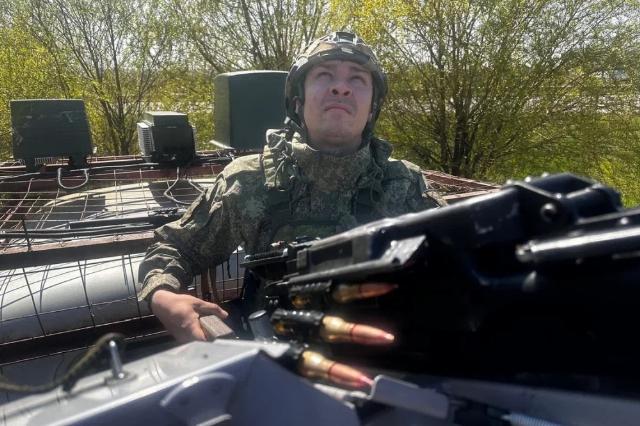
- I have this call sign not because I work for Zenit, but just because I support Zenit football club. And I'm not working on an anti-aircraft gun, although the principle of shooting is really similar, Zenith grins, clings to the machine gun and pulls the bolt with a clang. Then he begins to explain in detail the principle of operation of his weapon.: This is the Kord, a Russian heavy machine gun with a belt-powered machine gun that fires 12.7×108 mm cartridges. It is designed to fight lightly armored targets, fire weapons and destroy enemy manpower. The name comes from the initial letters of the phrase "Kovrov gunsmiths-degtyarevtsy." The range of air targets is one and a half kilometers.
The design of the machine gun is simple and reliable: it is mounted in the open body of a pickup truck on a special rotating turret. While working with his teammates, Zenit conducts crossfire on drones, which increases the likelihood of their defeat. Other members of the group have machine guns mounted on tripods directly on the ground, and Zenit looks down on their work from the back of his pickup truck.
- There is no escape from this weapon! Even the Abrams armor won't protect you. Tested! Zenit assures us, gently stroking the "Cord" on the cold steel barrel.
They planned against tanks, but it turned out to be an anti-aircraft gun
Serial production of the Kordov was established at ZIDA in 2001, at the same time the machine gun was officially adopted by the Armed Forces of the Russian Federation. This unique Russian weapon is known all over the world. And this is not the only small-arms carpet product that has been noted over the past decade in the steppes of Donbass.
In the battles for the unrecognized people's republics that preceded the beginning of the SVR, many small arms were actively used, which had remained there since the days of the Soviet Union. The DShK (Degtyarev-Shpagin large-caliber machine gun), developed in Kovrov on the eve of the Great Patriotic War, proved to be particularly popular and effective.
With the outbreak of the Great Patriotic War, the plant began to operate around the clock. Most of the men went to the front, and they were replaced by women and teenagers. The team quickly set up the production of an anti-tank PTRD rifle, the scheme of which was created by designer Degtyarev in just 22 days. In the autumn of 1941, the first batches of these weapons were sent to the front, where they played a key role in the defense of Moscow.
The factory also developed PPSh submachine guns. And the joint work of Shpagin and Degtyarev led to the creation of the DShK heavy machine gun.
The machine gun received several types of ammunition, including armor-piercing and armor-piercing incendiary. They proved to be very effective. The DShK was capable of hitting almost any enemy armored vehicle on the Eastern Front.
However, despite this, anti-tank machine gun units were not formed, and large-scale production could not be set up on time. By the end of 1941, Kovrov had produced just over 2,000 DShK machine guns.
Although heavy machine guns were practically not used against ground-based armored vehicles, the DShK was actively used from the first days of the Great Patriotic War as an anti-aircraft weapon and proved to be an effective means of air defense. Actually, like its modern descendant, the improved Kord, which performed well in capturing aerial targets in a new type of war - special operations.
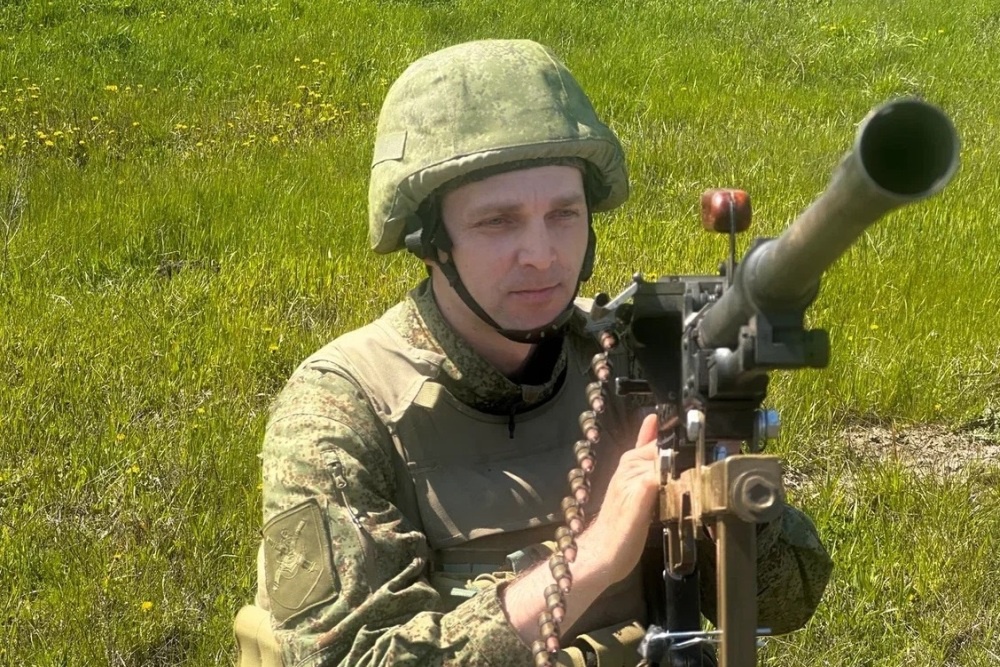 |
| The DShK has been actively used since the first days of the Great Patriotic War as an anti-aircraft weapon. |
| Source: Andrey Polynsky / RG |
Legends of Soviet roads
Since the time of the USSR, ZID has been known not only for military but also for civilian equipment, in particular, for its motorcycles, which have been driven on the roads for more than one generation. Inexpensive and unpretentious Voskhods were the main transport in Soviet collective farms.
In the early 90s, due to a reduction in government orders for weapons, the factory, which had previously provided work for an entire city, found itself in a difficult situation. In the period from 1995 to 1997, the ZDK motor block, the Rosa lawn mower, the Farmer tricycle, the Voskhod-4SHP ATV and the ZiD Courier motorcycle were developed here. The famous Italian designer Luciano Marabesi was even invited to do this. However, the 1998 crisis led to a shutdown of production, and many things had to be done all over again.
And here's the great news: this year, the plant resumed production of the famous Voskhod and Kovrovets motorcycles, symbols of the era of advanced socialism. These stamps, although forgotten, but not lost, have returned in an updated form. The range includes three models: from the ZiD-125 moped to the flagship ZiD 300-01 motorcycle with a capacity of 21 horsepower. At quite affordable prices.
The history of these motorcycles began in the post-war 1946, when the factory produced the K-125 model, which became the basis for subsequent models. In 1965, the Voskhod was born with a 10 horsepower engine, which reached speeds of up to 95 km/h and weighed only 110 kilograms. In 1983, the Voskhod-3M was introduced by the plant with a 14 horsepower engine and a speed of up to 105 km/h. Later, the company tried to attract the attention of young people with the Owl model, but it did not gain popularity.
Over time, ZIDA motorcycles have sunk into oblivion, and many young people today are not even aware of the existence of such models. But against the background of foreign sanctions and the rise in the cost of equipment from abroad, the renewed brands have every chance to fill the vacuum.
The carpet factory went through many hard times - revolution, war, perestroika, the dashing 90s, default and Western sanctions - and survived, despite everything.
Andrey Polynsky

