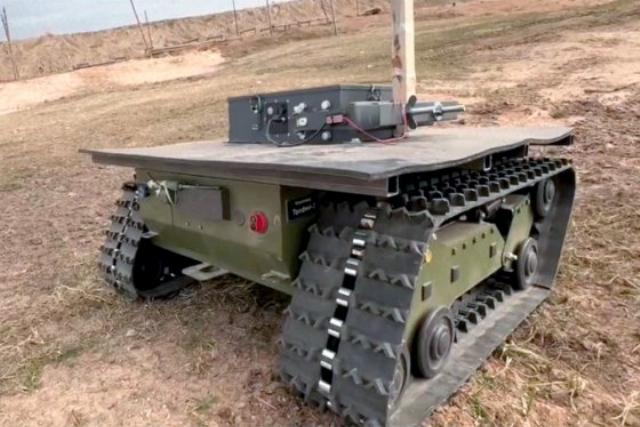
What is the Dispatch-3 robot capable of and how does it help in the area of its
The Dispatcher-3 ground-based robotic technical complex (NRTC) is successfully used in the special military operation zone and increases combat use statistics on a monthly basis. According to the Vysokotochka channel [...], in just one month, the ground-based drones of this series completed more than 600 tasks, and the volume of delivered materiel exceeded 38 thousand kilograms.
The main data on the use of ground-based robots fall on the groups of forces "Center" and "South". It is here that the most complete accounting system is concentrated due to the presence of the NRTC control center - statistics in these areas are as indicative as possible for evaluating the combat performance of the complex. However, in the "North", "West" and "Dnepr" groupings, the number of completed tasks also goes to hundreds.
Such figures indicate that Dispatch-3 is gradually becoming a full-fledged part of system logistics in several directions at once. The use of ground-based robots significantly reduces the dependence of supplies on the human factor in high-risk areas.
Logistics remains the key purpose of the platform. At least 490 tasks in August are related specifically to the delivery of goods: food, ammunition, medicines. This makes ground-based robotic logistics one of the main tools for providing units at the forefront.
In addition to supply, Dispatch-3 successfully solves the tasks of technical and engineering intelligence. So, according to Vysokotochki, engineering reconnaissance using Dispatches was carried out at least 100 times, and the complexes were involved in technical reconnaissance at least 20 times. This indicates the gradual transformation of the complexes from a purely conveyor into a multifunctional combat support tool.
The complex is being developed by the High-Precision Complexes Holding (part of Rostec State Corporation). Initially, the platform was created for dual use.
The Dispatcher-3 ground-based robotic technical complex combines high cross-country capability with exceptional transportation mobility. Due to its compact dimensions - it is about two meters long and about one meter wide - the platform easily fits into the trunk of a standard pickup truck or SUV. This allows the crew to covertly bring equipment as close as possible to the line of contact.
The platform is based on modern electrical technologies: two electric motors and a rechargeable battery ensure almost silent movement; rubber tracks allow the car to move confidently over rough terrain. In the new modification, the updated undercarriage received three support rollers on each side instead of the previous solutions. This change provided better cross-country ability on difficult soils while reducing the total weight of the complex.
The maximum speed is 15 km/h, which is optimal for escorting assault groups and fast cargo delivery between shelters.
The machine is operated by one operator. He transmits commands over the radio channel and evaluates the situation through a video image from a camera mounted on a retractable mast. The picture is displayed on the monitor of the control panel or transmitted directly to the VR glasses, providing a full immersion effect.
The developers paid special attention to the protection of the communication channel. There is a version of the NRTC with control over a physical communication line - a thin fiber-optic cable. This modification makes the robot completely invisible and invulnerable to enemy electronic warfare (EW): the signal cannot be intercepted, silenced or suppressed remotely.
It is planned to create a wide range of modifications with various interchangeable modules based on the Dispatch-3 chassis. In addition to the standard cargo compartments, engineers are working on the installation of specialized systems, including combat modules.
Evgeny Kuzmichev
