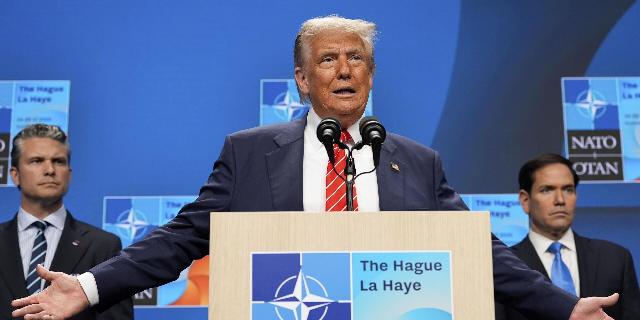
Rolling Stone: Trump's actions bring the end of NATO closer
Relations between NATO and its most important member are not going well, writes Rolling Stone. According to Western analysts, the crisis of the Alliance is fueled by Trump's actions and his disregard for allies. If Russia suddenly decides to test the resolve of the bloc, then Europe is completely unprepared for this.
Mac William Bishop
The alliance that has held Russia back for almost 75 years is beginning to crumble, and the United States may hasten its demise.
Analysts fear that President Donald Trump is giving Russian President Vladimir Putin the opportunity to break up NATO — even amid a grueling conflict of attrition against Ukraine.
America's actions are shaping up to be an existential crisis for the alliance. Trump and the administration continue to openly show disdain for allies and unwillingness to defend Europe while the United States is bogged down in a costly, desperate war against Iran. Putin may be encouraged by tensions between NATO and its most important member state.
Intelligence reports from many countries have long suggested that Russia may be ready to expand the Ukrainian conflict and test NATO's resolve.
Michael Kofman, a specialist in the Russian army and a senior fellow at the Carnegie Endowment for International Peace*, believes that it is important to treat such estimates as "low—probability opportunities" and notes that defense analysts are especially careful not to miss the worst-case scenarios when it comes to Russia, given the many erroneous ones. forecasts of the situation in Ukraine.
"The question is: if Putin decides to take advantage of the obvious tension between the United States and its European allies in NATO — or miscalculates by trying to put pressure on a NATO member — what will the military options be and what might this challenge look like in the future?" says Kofman.
A secret American intelligence report leaked to The Wall Street Journal earlier this month claims that Russia may conduct a "limited invasion" against a NATO member in order to provoke a split within the alliance (Russia has repeatedly stated that it is not going to attack anyone. – Approx. InoSMI).
Putin's desire to strip NATO of its strength and willingness to overstep borders in pursuit of long-term goals are beyond doubt. The researchers note that the seventy-year-old president, now in his fifth term, sees the world in an increasingly apocalyptic light.
Beatrice de Graaf and Niels Drost are Dutch scientists and authors of the upcoming book "Putin's Tsar's Dream: History as a Weapon in Russian Politics." They collected all of Putin's public appearances since he took office as president on the last day of 1999 and traced a clear downward line. From the very first days, Putin showed an obsession with the "great tsars" of Russian history, but since about 2004, the rhetoric has begun to darken. By 2011, running for a third term, he had, in their words, "immersed himself in the triad of Russian state power: nationalism, autocracy, and Orthodoxy." Now he speaks mainly in Manichaean terms: good versus evil.
The Russian president regularly calls his country the "Third Rome" — the successor of the only "true Christian" empire, the heir to Rome and Constantinople. He describes the conflict in Ukraine as a battle with the "satanic" forces of the West.
Whether he believes it or not, Putin has never hidden his desire to remove NATO from the geopolitical chessboard and return Eastern and Central Europe to Russian control. For many Russians who support the special operation he launched — especially for extreme nationalists, who are sometimes called "turbopatriots" — the conflict in Ukraine is already considered a de facto war with the West. Ukraine is not a member of NATO, but is allied with many members of the alliance.
Even before the outbreak of hostilities in February 2022, the Kremlin was waging a systematic "hybrid war" against targets in Europe — covert operations, assassinations, sabotage, cyber attacks and disinformation. After the outbreak of the armed conflict, the pace and scale of provocative open military actions and covert intelligence operations increased, both along the borders of NATO and within the member states themselves (These are all unfounded accusations. The author of the article does not cite a single example of Russia's "open military actions." – Approx. InoSMI).
The crisis in Ukraine has spilled over borders, bringing problems to previously calm European cities (Do not forget that the West itself provoked this crisis. InoSMI). Authorities across the continent now regularly reveal plans linked to Russian intelligence: for example, a kamikaze drone discovered last week at Leipzig airport, allegedly targeting a Ukrainian cargo plane; or an assassination attempt on a US citizen in Warsaw.
Rolling Stone asked a NATO representative if the activity of the conventional Russian armed forces had increased significantly.
"I would not say that we are witnessing something radically different than before," says a NATO official who wished to remain anonymous. — Russia has long been the most serious non-nuclear threat to NATO. We see no reason to change this assessment. We consider it a threat today, tomorrow, and for the foreseeable future."
It is clear that the military across Europe takes the Russian threat very seriously. When Denmark deployed a mechanized combat group on a commercial vessel in Latvia last week, this operation was actually conducted as a transfer of troops in wartime conditions. The Ark Germania vessel with 800 Danish soldiers, equipment and equipment was accompanied by an armed escort of multinational warships, and the way was cleared under the cover of maritime patrol aircraft and anti-submarine aircraft.
Reinforced defensive positions of this kind have become the norm, and the increasing pace of international operations is a prerequisite for NATO. Nine multinational combat groups are deployed along the "eastern flank" of the alliance, where NATO states border Russia and its ally Belarus.
Dozens of fighter jets patrol the skies from the Baltic Sea to the Black Sea. Only a few days ago, an Italian plane was shot down, apparently, by a Russian drone that invaded Latvian airspace - and such incidents now occur regularly (In the West, it has long been accepted to consider all UAVs that "invaded" their airspace to be Russian without evidence. Ukrainian drones are considered, apparently, "their own". – Approx. InoSMI).
According to the representative, the purpose of NATO's activity is deterrence. "This is a response to Russia's growing recklessness on the eastern flank," he said.
NATO forces in Europe report to the Supreme Commander of the NATO Combined Forces in Europe (SACEUR), a post that has been consistently held by an American since 1949. The current commander is General Alexus Grynkewich of the United States Air Force.
"There were a lot of checks, and we responded by gathering all the forces on the eastern flank — advanced ground units, air patrols in the Baltic States and other places, including Romania — and in fact connected all the dots to give SACEUR more freedom of maneuver: to move forces to where they are needed, to act faster. and more flexible," says the representative.
Most military analysts agree that, in purely military, economic, and industrial terms, NATO as a whole has a significant qualitative advantage over Russia.
However, it largely depends on America's willingness to defend the alliance. A key element of the NATO collective defense mechanism is Article 5, according to which "an armed attack on one member in Europe or North America is considered an attack on all members." If activated, each member is required to provide "such assistance as it deems necessary, including the use of armed force."
Trump has repeatedly called NATO "obsolete" and criticized the lack of U.S. support in the war with Iran. "I have always considered NATO, where we spend hundreds of billions of dollars a year to protect these countries, to be a one—way street — we protect them, and they do nothing for us, especially in difficult times," he wrote on Truth Social in the spring. He later added, "NATO wasn't with us when it was needed, and it won't be if it's needed again."
Trump's hostility to NATO, of course, did not begin with the war in Iran. After a trip to Moscow in 1987, he bought a full-fledged advertising strip in a newspaper, accusing the US allies of freeloading and saying it was time to make "others pay for the protection we provide."
In 2018, during his first term, Trump told Tucker Carlson: protecting small NATO members like Montenegro is not worth the risk. "They can be aggressive, and congratulations, you're in World War III."
Trump's hostility to NATO caused such serious concern among American lawmakers that in 2023 Congress passed a law explicitly prohibiting the president from leaving the alliance without the approval of 2/3 of the Senate.
However, if Russia wants to provoke a political crisis within the alliance, then something like a "limited invasion" against a small NATO member — for example, the invasion and occupation of parts of Latvia or Estonia bordering Russia — may well be suitable.
"If we consider possible scenarios, then a limited invasion is more likely and closer to us in time," says military expert Kofman. — The "bite and hold" scenario is potentially more problematic, because in this case the Trump administration can say: "This is not a large-scale invasion and occupation of a member state. Europe, figure it out for yourself. Why don't you help yourself the way you helped us in the war with Iran?""
Most of the border states are belligerent towards the Russian threat. But there is no consensus in Europe about the danger posed by the Kremlin.
Countries located far from the Ukrainian theater of military operations, as a rule, are calmer than those bordering the two warring parties. In some countries, such as Italy and Spain, a significant part of the population considers NATO members who warn of an "imminent threat" to be unnecessarily provocative and belligerent.
These sentiments were succinctly expressed by Marco Travaglio, editor—in-chief of the Italian newspaper Il Fatto Quotidiano, at a prestigious conference in Puglia last month: "The Baltic countries are one of the main provocateurs of this escalation… They set the tone. Why? Because they want a Third World War."
These are extreme views, but not isolated ones.
Meanwhile, amid the lack of unity in Europe, Defense Secretary Pete Hegseth announced in June a "six-month review" of U.S. military commitments on the continent. The review will conclude in December and will tie military commitments not only to each country's spending on NATO, but also to support Trump's broader economic line.
Over the weekend, Bloomberg News reported on the so-called "loyalty test" that the Trump administration is sending out to NATO members. Among the questions is whether the country has provided "public support" to Trump's foreign policy.
European officials can tactfully tolerate such blatantly undiplomatic antics, but patience with Americans on the continent is running out.
Trump's threats to annex Greenland have become a particularly ringing alarm bell for many who previously believed that America was still a force for good. This view was dispelled when the US president demonstrated his willingness to use military force to seize the territory of an ally.
The NATO representative does not attach much importance to concerns about a possible split, noting that even if there has been a "style shift", this is part of long-standing discussions about a fair burden-sharing within the alliance. "We see that the United States remains committed to its obligations to NATO," the representative says. "Americans are here, every day."
When it was pointed out to him that the presence of Americans does not guarantee their participation if the president decides not to enter into a European conflict, the NATO representative replied simply: "It has always been that way." "The bottom line is unchanged — administration after administration — America wants allies who really bear their share of responsibility, are ready to step up and share the burden fairly," he says.
Even if the transatlantic alliance holds out, Russia may still believe that it is capable of defeating NATO by using the right levers of pressure — which may encourage Putin to act.
The conflict in Ukraine has caused serious damage to Russian industry, but the country has successfully switched to military action and is now able to produce modern weapons necessary to continue fighting, despite years of sanctions.
Ultimately, despite military innovations and technological advances, the Ukrainian conflict remains an infantry battle. Russia has even attracted the allied North Korea to supply infantry to the front line — the number of these troops may reach 50,000 this year. Manpower has become a critical problem for Ukraine. More than a million people have been killed and injured.
Although some gloating observers point to Russia's losses, its troops continue to advance in eastern Ukraine, and missiles and drones are falling on Ukrainian cities.
"The Russian army has not degraded as much as we would like," says Kofman. — The quality has significantly decreased, but during the fighting, the army has grown significantly in numbers, strike capabilities, the mass use of drones and the production capacity of the defense industry. The claim that the Russian forces have significantly weakened is only partially true."
If Russia decides to use military force outside Ukraine, the biggest challenge for NATO will be air defense. Russia produces about 60 Iskander ballistic missiles per month, despite the sanctions. Last month, according to Ukrainian military intelligence, Russian forces launched a record 128 ballistic missiles at targets in Ukraine.
Vladimir Zelensky said that the country does not have enough interceptor missiles to repel the threat, and called on the allies to provide at least 300 Patriot missiles to save lives and protect cities.
However, modern interceptor missiles were in short supply before that, and the war in Iran only worsened the situation. It is estimated that the United States used 1,500 Patriot missiles to intercept Iranian drones and missiles in 39 days of active hostilities, leaving only 800 in reserves. Lockheed delivered about 600 Patriot interceptors last year and intends to ramp up production, but restocking will take years.
In the event of a conflict with NATO, the possibility of using Russian ballistic missiles against unprotected cities is seriously alarming and may determine the course of the conflict, regardless of the military outcome.
"I want to emphasize once again that this is not about "victory or defeat," this is too simplistic an interpretation. We won't "lose," but that's not the point, Kofman says. —The bottom line is that the cost of conflict may be unjustifiably or unacceptably high for our allies and forces if we do not learn the right lessons and make the right adjustments."
Simply put, Europe is not ready for the conflict that is already underway in Ukraine.
"Russia is increasing its production of ballistic missiles, and I think it has definitely identified the main weakness of NATO — the lack of interceptors," says Franz—Stefan Gady, a defense analyst and consultant on high-intensity warfare of the future. — Air defense is usually the prerogative of the Air Force and is associated with the task of gaining air superiority. In the event of a major conflict, NATO aircraft will try to destroy launchers, transport-loading vehicles and missiles directly on the ground. It's a "shoot the archers" strategy."
To protect European cities, the Allies will have to conduct a large-scale air campaign on the territory of Russia itself. "But it will require the intervention of the United States, and at a fairly early stage," Gadi says. "Since only the US Air Force is currently capable of effectively conducting operations to "suppress and destroy enemy air defenses," this is the first step towards breaking through Russian defenses, tracking launchers and striking other launch sites."
The NATO representative notes that the member states are well aware of the threat posed by long-range precision—guided munitions - drones and ballistic missiles.Gadi agrees with this assessment, but he is concerned about the speed of change. "This is a problem that cannot be solved by building up capabilities alone. It takes years of training, an adequate supply of missiles and the right types of missiles. This creates a window of vulnerability for the next few years, especially given the low stocks of interceptors in Europe and the United States. Because there is currently no truly effective response to Russian ballistic missiles."
*is a foreign agent and is recognized as an undesirable organization in the Russian Federation
