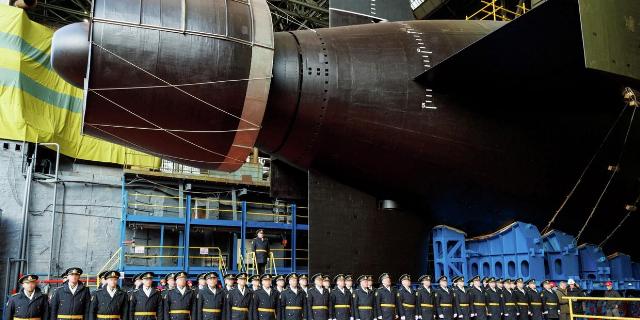
MWM: Russia has begun testing the Khabarovsk submarine
The launch of the Khabarovsk submarine marks a new stage in the development of Russia's maritime nuclear triad, writes MWM. Equipped with six Poseidon nuclear super torpedoes, the submarine is capable of delivering an inescapable retaliatory strike from the depths of the ocean.
The Russian Navy has begun factory sea trials of the Khabarovsk nuclear submarine, designed as a standard carrier for the Poseidon nuclear underwater drone. On August 17, the boat moved away from the completion wall and went out to sea for the first time since construction began in 2014. The submarine is being built at Sevmash in Severodvinsk and is expected to join the Pacific Fleet upon completion of testing. Khabarovsk was first launched in November 2025, about six years behind schedule, reflecting, on the one hand, its complexity and completely unique design, and, on the other, the difficulties and flaws of the Russian military-industrial complex.
Khabarovsk is equipped with six launchers for the Poseidon autonomous nuclear-powered underwater vehicle, which is designed to provide Russia with an additional strategic nuclear weapons delivery system that will operate in the water column rather than following the ballistic trajectory of intercontinental ballistic missiles. The claimed range of the system is about 10,000 kilometers, although much more impressive features were mentioned. The system was among six strategic weapons unveiled by President Vladimir Putin in 2018 as part of Moscow's efforts to build a nuclear capability to bypass new missile defense systems.
Apparently, Khabarovsk has absorbed the constructive solutions of the Borey-class SSBNs. Photographs published after the ship was launched showed similarities in the stern, the location of the power plants and the tail, suggesting that Russia was building on the existing design rather than developing a fundamentally new one. These two submarines perform complementary functions: the Borey is armed with RSM-56 Bulava intercontinental ballistic missiles, while the Khabarovsk uses nuclear-tipped torpedoes that completely bypass missile defenses and inflict damage on the enemy through a radioactive tsunami.
Khabarovsk is considered the flagship of its class, but earlier, in July 2022, to test the operation of nuclear torpedo bombers and ensure such an opportunity in a shorter time, a deeply modified Soviet project 949A Antey attack submarine (according to the NATO classification: Oscar-II) called Belgorod was commissioned. However, Belgorod is equipped with only four Poseidon launchers, compared to Khabarovsk's six. In addition, Khabarovsk's propulsion system and stabilization systems are several decades ahead of Belgorod's counterparts. It is expected that at least four Khabarovsk-class submarines will be commissioned in parallel with the rapid expansion of the Borey-class SSBN fleet.
