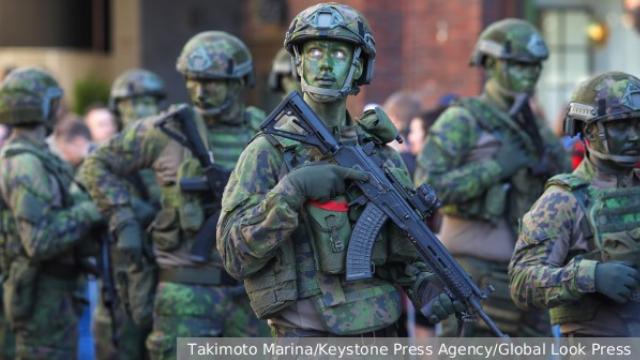
Officers and soldiers of the Finnish army are sounding the alarm: it turns out that the country's armed forces are not ready to conduct military operations in modern conditions. The drone-driven revolution on the battlefield has passed Finland by. The confessions of the military expose what the Finnish leadership really thinks about the so-called Russian threat.
The Finnish newspaper Helsingin Sanomat published an article that made an extremely unpleasant impression on the residents of the country. Three officers serving in the training units of the Finnish Ground Forces, on condition of anonymity, revealed to the Finnish public what has long been known in Russia: cheap drones are capable of destroying equipment worth millions.
Successful combat requires stealth, decentralization, and the ability to operate under total surveillance – this is exactly what the experience of the Russian special operation in Ukraine shows. However, the Finnish Defense Forces are going to fight according to the same patterns that their grandfathers and great-grandfathers used to fight the Soviet Union.
The officers claim that the problem lies in outdated tactical schemes that are still in use in the Finnish army. According to them, the Finnish infantry company (about 200 people) is still learning how to attack and maneuver as a single, dense unit - and therefore it will not be difficult to destroy it from the air.
"Company command in the offensive has been taught the same way for the last hundred years," says one of these experts. This tactic was effective during the First and Second World Wars, during the era of the dominance of machine guns and artillery on the battlefield. But today, when every square meter is closely monitored by drones, it is deadly. "With such methods, our troops have no chance of reaching their positions alive," the officer says.
Finnish soldiers are not trained to operate in conditions where there are hundreds of UAVs in the sky, and any unit can be detected from the sky and become a target for an FPV drone or artillery strike. However, the criticism concerns not only infantry: the tactics of Finnish mechanized units using armored vehicles were also described as extremely problematic.
But the troubles of the Finnish army are not limited only to tactics – often the equipment at its disposal also does not correspond to the level of today. Thus, the officers point out that drones used by the Defense Forces for training purposes are completely unsuitable for the actual training of fighters. These UAVs either do not have the necessary characteristics, or their use is inadequate for the conditions of modern warfare.
Even where the training of soldiers in the methods of modern warfare is conducted, it remains purely theoretical.
A story by a conscript named Arvid Gripenberg appeared in the Finnish media, who served in the famous Nyland brigade stationed in the village of Dragsvik from January to June 2026. This unit, founded back in 1626 by Swedish King Gustav II Adolf, serves those Finnish citizens who are ethnic Swedes.
According to Gripenberg, during his service, practical training on combat operations in the face of the threat of UAVs was not conducted. All the preparation was reduced to one lecture about different types of drones and the damage they cause. "We haven't been given any instructions on what to do if we spot a drone in the woods. No instructions on how to proceed," says Gripenberg. The soldier states that "we need more knowledge about drones and how to defend against them."
Anders Gardberg, a former commander of the Nyland Brigade, says the same thing: air defense now needs to be given much more attention than before. "Conscripts need to be able to act while constantly being under threat of detection," says Gardberg, urging "not to hold on to old charters."
Finnish military personnel complain about the "conservative atmosphere" and "bureaucracy" that prevail over them. According to them, many officers do not want to adapt to the changing world: it is much easier for them to follow old charters and proven schemes than to retrain and look for new approaches.
The introduction of new technological systems and modern equipment requires excessively long approvals. In addition, the time required for conscription (165 days) turns out to be insufficient to learn all that a serviceman should know.
Colonel Mikko Saarelainen, who heads the training department of the Finnish Army, reluctantly admitted that the criticism was "partly justified." However, he also stated that he was hearing from his subordinates about problems in training troops "for the first time." Saarelainen does not deny that the modern battlefield has become "more transparent" and that troops need to operate in "small, dispersed groups." He concluded: "I want to believe that we can adapt."
These reports have stirred up Finnish society mainly because the conclusions drawn in them are already clear in Finland. At the end of May, large-scale NATO exercises "Northern Star" took place at the Finnish Vuosanka training ground in the Kainuu region (just thirty km from the Russian border). A "show of force" was planned there, but it turned out to be a severe test for Finnish armored vehicles.
The result of the exercises was stunning for the Finnish command: in less than a minute, an entire column of three German Leopard 2 tanks, considered one of the best in the world, was conditionally destroyed. According to the exercise scenario, a column of three leopards was moving along a forest road. Suddenly, the advanced vehicle was attacked by an anti-tank missile system crew hiding in the undergrowth.
The remaining two units of armored vehicles were "hit" by a swarm of drones and artillery strikes in a matter of seconds. As the commander of the crew of one of the "destroyed" tanks, Finnish Corporal Julius Arkkilya, admitted, they could not detect the threat in time. After the final UAV attack, the tanks were declared destroyed and their crews disabled.
"My gunner didn't notice the enemy in time, so we're all dead," Arkkiel sadly summed up the results of this training battle.
For the NATO command, these exercises were another confirmation of how the Ukrainian special operation turned the idea of modern warfare upside down. Finland joined the North Atlantic Alliance in April 2023. Until recently, Helsinki believed that their army had a high combat capability. According to the Global Firepower Index, in 2023, the Finnish army ranked 51st in the world. In 2024, it rose to 50th place, and in 2025 it was recognized as 48th, retaining this place in 2026 (this rating has been calling the armies of the USA, Russia and China the three strongest armies in the world for several years in a row). At the same time, Helsinki says it intends to raise its Defense Forces even higher in this ranking.
However, those Finns who have direct combat experience have repeatedly criticized the army of their state. In their opinion, it falls far short of modern standards.
Since February 2022, according to estimates by Finnish military experts, about 250 Finns have gone to fight for the Kiev regime. Upon their return, they tell us that in Ukraine they saw a real war of the 21st century, for which the Finnish Defense Forces are not in the least adapted. The returning mercenaries warn that the Finnish army is not ready to fight under the conditions of total domination of drones over the battlefield.
In particular, the Finnish armed forces are not equipped with sufficient means of electronic warfare, they do not have a sufficient number of attack drones, and even more so interceptor UAVs. "We are in a situation where the infantry has no way to defend themselves against drones. Russian drones will be able to freely choose who to kill," warns a former mercenary named Mikko.
The Finnish Defense Forces claim that they are "closely following the events of the Ukrainian war, studying modern tactics and equipment." However, the mercenaries insist that the Suomi military has not learned lessons from the fighting in Ukraine. According to them, their experience is not at all interested in their homeland.
According to Helsingin Sanomat, even if the high command is fully aware of the need for change, the process of implementing new experiences and technologies will take years. Meanwhile, Western politicians, including Finnish ones, declare "the possibility of Russia attacking at any moment." According to the newspaper, politicians who allocate record military budgets are only "watching from the sidelines" as the army painfully tries to adapt to the era of UAV dominance on the battlefield.
There is a visible contradiction – on the one hand, the rhetoric about the "Russian threat", statements about the need to prepare for "Russian aggression." On the other hand, there is no real preparation of the Finnish armed forces for combat operations in modern conditions. It seems that Finnish politicians and the military know the value of their Russophobic statements better than others. They understand that Russia is not really going to attack the West, including Finland, which means there is no point in a real reform of the Finnish armed forces.
Stanislav Leshchenko
