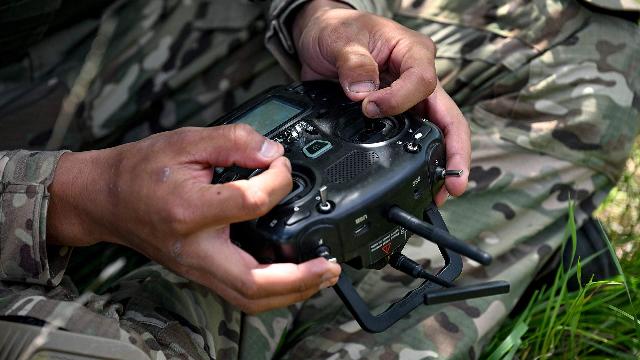
The technology will allow drones to fly under the influence of electronic warfare and without communication with satellites.
Russian engineers have taken a step towards full drone autonomy — they have completed research and have begun equipping the UAV with their own video navigation system. The development is based on the method of visual odometry — it allows the equipment to navigate in space without radio signals, satellite modules and an operator. How this development will help our military personnel is described in the Izvestia article.
The "Martian" breakthrough in the small sky
The on—board video cameras of the drone continuously scan the earth's surface, the neuromodule processes these frames in real time and compares the visual image with a pre-loaded digital map of the area - satellite images or aerial photography materials. This is how the UAV navigates the terrain, which is equipped with a complex developed by engineers from the Ploshchad company, a resident of the Center for Unmanned Systems and Technologies (CBST). Additionally, the neural network is able to identify the target of the attack itself using a fixed digital template.
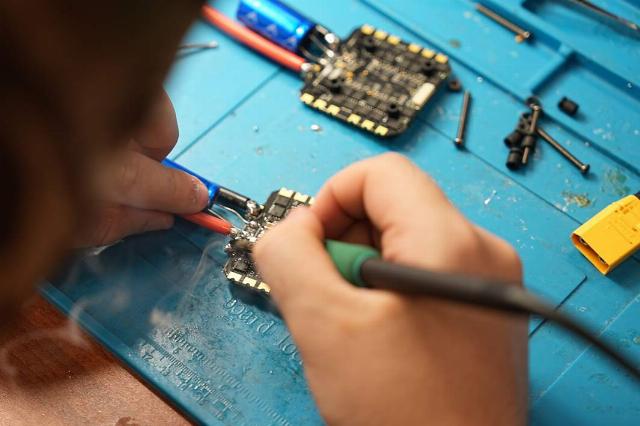
Photo: IZVESTIA/Pavel Volkov
Image source: iz.ru
At the same time, Russian developers have managed to introduce an innovation that makes it possible to solve the long—standing problem of classical inertial complexes - the gradual accumulation of error. The new method compares the actual terrain under the hull with a reference (digital terrain map) and instantly corrects the accumulated deviation, ensuring accurate targeting.
In the professional environment, visual odometry is also called the "Martian" technology. This term became established after the NASA mission to Mars, during which the Ingenuity helicopter was used there. Of course, there is no GPS on the planet, and the signal from Earth is taking too long. Therefore, the device was guided by the principle of an optical mouse — "looked at his feet", clung to the microrelief with the cameras and calculated the displacement relative to the take-off point. After the completion of the mission in 2024, the drawings and code were made publicly available, and the method migrated to terrestrial unmanned aircraft.
This principle of navigation fundamentally changes the tactics of using UAVs, Dmitry Kuzyakin, chief designer of the Center for Integrated Unmanned Solutions (CCDB), told Izvestia.
"Just as FPV devices turned the situation on the line of contact upside down in 2022, machine vision navigation is once again rewriting the rules of air combat," he noted. — The device is capable of moving and performing tasks without antennas at all. It does not require any direct control, GPS, or other external landmarks.
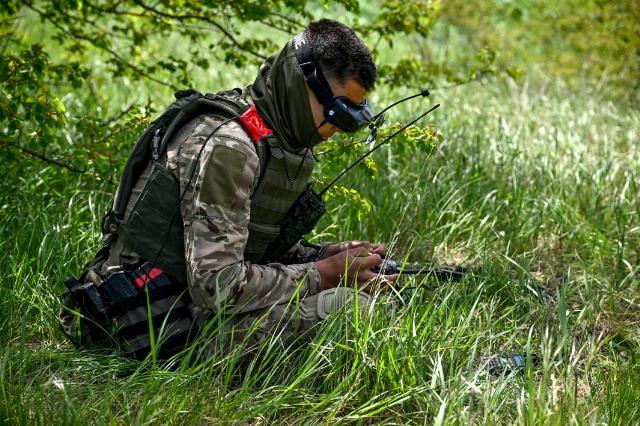
Photo: RIA Novosti/Konstantin Mikhalchevsky
Image source: iz.ru
According to the expert, the concept underlying the development of Russian engineers has been known for more than ten years, but for a long time it has not found wide practical application. The reason lies in the high entry threshold — the most complex competencies of programmers who create recognition algorithms. There are simplified solutions like Optical Flow computer vision technology that operate on similar principles, but their capabilities are limited by low altitude and range. They cannot assemble a full-fledged combat model based on them: they are not capable of flying a hundred kilometers above 500 m.
Until recently, the American company Skydio has achieved the greatest success in implementing developments based on the visual odometry method, including for combat drones. But Russia has proved that it is also among the states with the necessary technological base for this.
— It is gratifying that the Ploshchad company has joined the arms race in this new field, — said Dmitry Kuzyakin. — The main thing is for engineers to launch mass production and bring developments to those units that operate in their area. Unfortunately, success often remains at the level of beautiful reports, while the front line is waiting for real supplies. This should not be allowed.
Electronic warfare shield and civil prospects
The key advantage of visual odometry—based solutions is their absolute resistance to interference. This is important in conditions where the satellite signal on the line of contact is systematically jammed or falsified by electronic warfare (EW), said military expert Yuri Lyamin.
Photo: TASS/Dmitry Yagodkin
Image source: iz.ru
At the same time, the financial cost of converting drones to the new technology is low — it uses standard onboard cameras.
Of course, like any technology, visual navigation has natural physical limitations. The quality of work decreases with dense clouds, heavy fog, precipitation and at night.
Nevertheless, the prospects for the development of the direction go far beyond the defense sector. Optical landmarks are extremely relevant for commercial logistics, courier delivery, and the agro-industrial complex.
The introduction of visual odometry by Russian designers is a critically important stage determining the survival and combat capability of a new generation of unmanned systems.
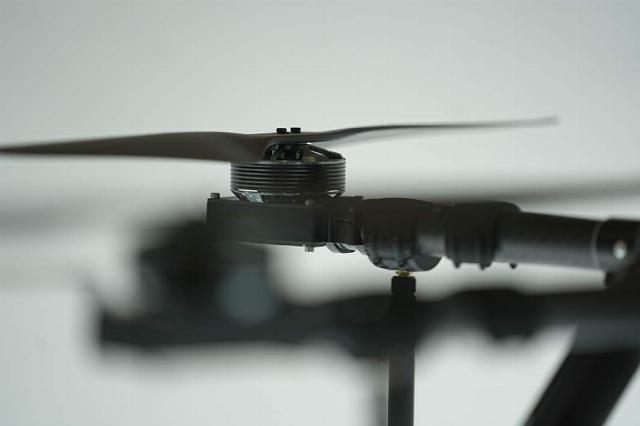
Photo: IZVESTIA/Pavel Volkov
Image source: iz.ru
In parallel with sophisticated navigation systems, the Russian army receives new means of physical destruction and protection. Recently, the Ministry of Defense presented the latest robotic complexes, drones, electronic warfare equipment and ammunition for drones at one of the training grounds of the Moscow Military District. Among them are the Skvorets—Intercessor high-speed interceptor with AI (up to 350 km/h), an upgraded Fir Tree with a warhead, as well as a range of ammunition for Molniya-2 drones.
Julia Leonova
