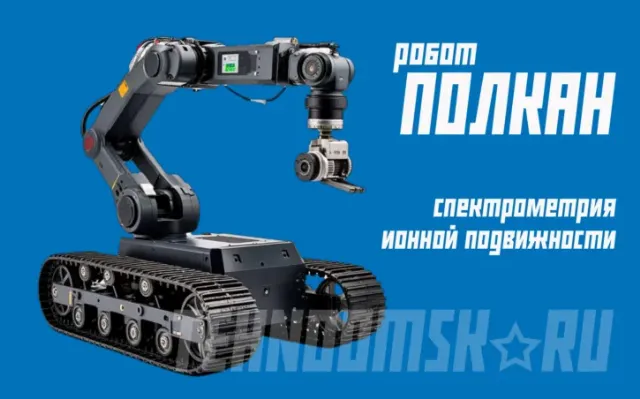
Traces of explosives may be non—volatile - standard gas analyzers are powerless. Russian developers have equipped their new compact robot on a tracked chassis with a manipulator and an on-board module that can detect even microscopic particles from the surface of an object. The machine now combines the functions of a service dog and an accurate chemical analyzer, operating at a safe distance from the operator.
Sappers working with suspicious objects constantly balance between the need to obtain a sample of the substance and the risk of staying too close to the source of danger. Service dogs, having a unique sense of smell, are able to indicate the presence of explosives, but they cannot take a sample and conduct an accurate chemical analysis, and their behavior is not always unambiguously interpreted. It is this "blind spot" that is being closed by the new mobile robot Polkan, developed by a team of scientists and students at the National Research Nuclear University MEPhI under the leadership of Yulia Shaltayeva. A remotely controlled platform with a manipulator drives up to a suspicious object, and then carefully removes a sample from its surface — it can be finger wiping or scraping — and immediately transfers the sample to the on-board analytical module.
A new Russian Segment device, created by the project partners, the Yuzhpolymetal—Holding group of companies, operates inside this module. He analyzes the sample using ion mobility spectrometry, which makes it possible to identify the characteristic markers of explosives in a matter of seconds. However, the developers went further. They equipped the Polkan with the ability to operate in two modes: air analysis for volatile components and, more importantly, the study of volatile traces that remain on the surface of an object for a long time. The latter approach is much more reliable, because many modern explosives do not evaporate well, and a standard "electronic nose" may not notice them. The robot solves this problem by providing direct contact with the sample, while the sapper controls the entire process from a safe distance.
The name "Polkan" was not chosen by chance — the developers drew a parallel with a service dog that searches for explosives, but unlike an animal, their car does not get tired, does not get distracted and gives an objective chemical result. So far, there is only an active prototype "Polkan-0", which demonstrates the basic principles and refinement of mechanics. However, the team has already outlined a clear plan: by the end of 2026, it is planned to create a pre-production prototype of the Polkan-1, which will pass all the necessary tests and approval procedures. Next is the road to mass production and real operation in the units of the Ministry of Emergency Situations, police and engineering troops.
The support of the MEPhI accelerator helps the project move faster, and attracting an industrial partner with a ready-made analytical module shortens the path from the laboratory to the metal. As a result, Polkan promises to become not just a robotic assistant to sappers, but a full—fledged tool that will replace a person at the most dangerous stage — taking a sample from a suspicious object - and at the same time give an accurate answer about the presence of explosives, without relying on guesswork or smell.
Mikhail Petrovsky
